
采用液相色谱-串联质谱法对人血浆和血液中的∆9 - 四氢大麻酚、11 - 羟基 - 四氢大麻酚、四氢大麻酚酸、六氢大麻酚和大麻二酚进行定量分析。
Quantification of ∆9-tetrahydrocannabinol, 11-OH-THC, THC-COOH, hexahydrocannabinol, and cannabidiol in human plasma and blood by liquid chromatography-tandem mass spectrometry.
作者信息
Pavlic Marion, Innerhofer Carolin, Pitterl Florian
机构信息
Institute of Legal Medicine, Medical University of Innsbruck, Muellerstrasse 44, Innsbruck 6020, Austria.
出版信息
J Anal Toxicol. 2025 Feb 15;49(2):85-95. doi: 10.1093/jat/bkae094.
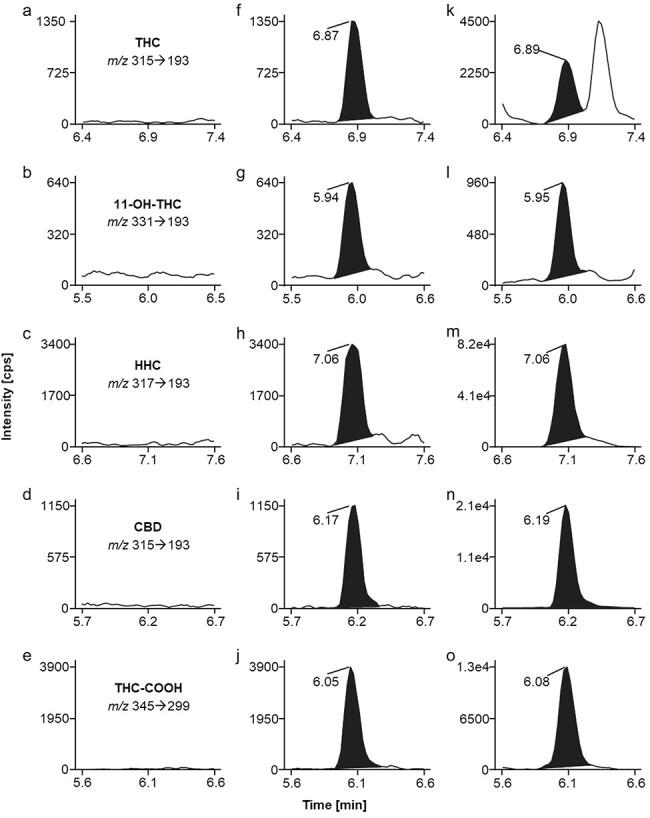
Ongoing legalization of cannabis for recreational use contributes to increasing numbers not only of incidents of driving under the influence, but within all forensic fields. In addition, newly emerging cannabinoids such as hexahydrocannabinol (HHC) and the increasing use of cannabidiol (CBD) products have to be addressed. The aims of this study were first to extend laboratory analysis capacity for the "established" cannabinoid ∆9-tetrahydrocannabinol (THC) and its metabolites 11-OH-THC and THC-COOH in human plasma/blood, and second to develop analytical procedures concerning HHC and CBD. An LC-MS-MS method based on the available (low-end) instrumentation was used. Samples (250 µl) were prepared by protein precipitation and solid-phase extraction. Chromatographic separation was achieved on a reversed-phase C18 column within 15 min. Detection was performed on a 3200 QTRAP instrument (Sciex) in positive multiple reaction monitoring (MRM) mode. Matrix-matched six-point calibrations were generated applying deuterated internal standards for all analytes except HHC. The method was fully validated according to GTFCh guidelines. Linear ranges were 0.5-25 µg/l for THC, 11-OH-THC, HHC and CBD, and 2.0-100 µg/l for THC-COOH, respectively. Limits of detection and limits of quantification were 0.5 and 1.0 µg/l (THC, 11-OH-THC, HHC, CBD), and 2.0 and 4.0 µg/l (THC-COOH). Applicability of plasma calibrations to blood samples was demonstrated. Acceptance criteria for intra- and inter-day accuracy, precision, extraction efficiency, and matrix effects were met. No interfering signals were detected for 80 exogenous compounds. The presented method is sensitive, specific, easy to handle, and does not require high-end equipment. Since its implementation and accreditation according to ISO 17025, the method has proven to be fit for purpose not only in driving under the influence of drug cases but also within postmortem samples. Furthermore, the design of the method allows for an uncomplicated extension to further cannabinoids if required.
大麻用于娱乐用途的持续合法化不仅导致酒后驾车事件数量增加,而且在所有法医领域也是如此。此外,还必须应对新出现的大麻素,如六氢大麻酚(HHC)以及大麻二酚(CBD)产品使用的增加。本研究的目的,一是扩展对人血浆/血液中“已确定的”大麻素Δ9 - 四氢大麻酚(THC)及其代谢物11 - 羟基 - THC和THC - 羧酸(THC - COOH)的实验室分析能力,二是开发有关HHC和CBD的分析程序。使用了基于现有(低端)仪器的液相色谱 - 串联质谱(LC - MS - MS)方法。通过蛋白质沉淀和固相萃取制备样品(250 μl)。在反相C18柱上于15分钟内实现色谱分离。在3200 QTRAP仪器(Sciex)上以正离子多反应监测(MRM)模式进行检测。除HHC外,对所有分析物应用氘代内标生成基质匹配的六点校准曲线。该方法根据GTFCh指南进行了全面验证。THC、11 - 羟基 - THC、HHC和CBD的线性范围分别为0.5 - 25 μg/l,THC - COOH的线性范围为2.0 - 100 μg/l。检测限和定量限分别为0.5和1.0 μg/l(THC、11 - 羟基 - THC、HHC、CBD)以及2.0和4.0 μg/l(THC - COOH)。证明了血浆校准曲线对血液样本的适用性。满足了日内和日间准确性、精密度、提取效率和基质效应的验收标准。对80种外源性化合物未检测到干扰信号。所提出的方法灵敏、特异、易于操作,且不需要高端设备。自根据ISO 17025实施和认可以来,该方法已证明不仅适用于毒品影响下驾驶案件,也适用于死后样本。此外,如果需要,该方法的设计允许简单地扩展到其他大麻素。
 Zotero 插件