
肥胖和2型糖尿病患者在进行低热量饮食并植入/未植入内屏障时的饱腹感激素LEAP2
Satiety Hormone LEAP2 After Low-Calorie Diet With/Without Endobarrier Insertion in Obesity and Type 2 Diabetes Mellitus.
作者信息
Emini Mimoza, Bhargava Raghav, Aldhwayan Madhawi, Chhina Navpreet, Rodriguez Flores Marcela, Aldubaikhi Ghadah, Al Lababidi Moaz, Al-Najim Werd, Miras Alexander D, Ruban Aruchuna, Glaysher Michael A, Prechtl Christina G, Byrne James P, Teare Julian P, Goldstone Anthony P
机构信息
PsychoNeuroEndocrinology Research Group, Division of Psychiatry, Department of Brain Sciences, Imperial College London, Hammersmith Hospital, London W12 0NN, UK.
College of Applied Medical Sciences, King Saud University, Riyadh 11451, Saudi Arabia.
出版信息
J Endocr Soc. 2024 Dec 4;9(1):bvae214. doi: 10.1210/jendso/bvae214. eCollection 2024 Nov 26.
CONTEXT
The liver/foregut satiety hormone liver-expressed antimicrobial peptide 2 (LEAP2) is an inverse agonist at the acyl ghrelin receptor (GHSR), increasing after food intake and decreasing after bariatric surgery and short-term nonsurgical weight loss, but effects of long-term dietary weight loss are unknown.
OBJECTIVE
The objective of this study was to examine and compare the effects of these interventions on fasting and postprandial plasma LEAP2 and investigate potential metabolic mediators of changes in plasma LEAP2.
METHODS
Plasma LEAP2 was measured in a previously published 2-year trial comparing standard medical management (SMM) (including 600-kcal/day deficit) with duodenal-jejunal bypass liner (DJBL, Endobarrier) insertion (explanted after 1 year) in adults with obesity and inadequately controlled type 2 diabetes mellitus.
RESULTS
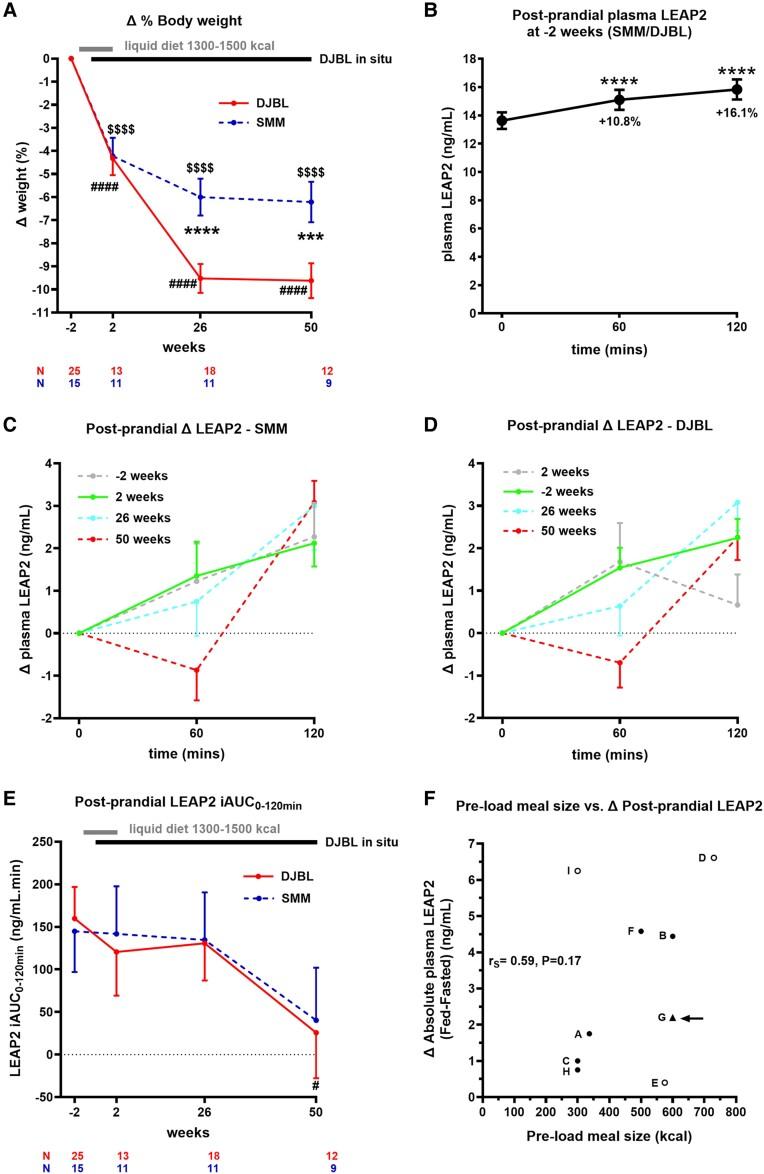
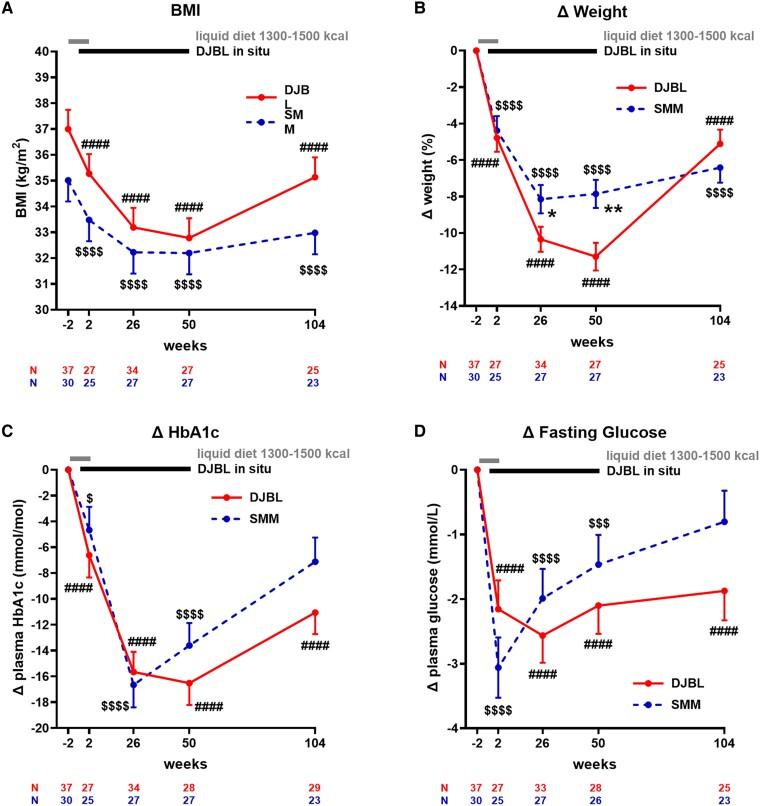
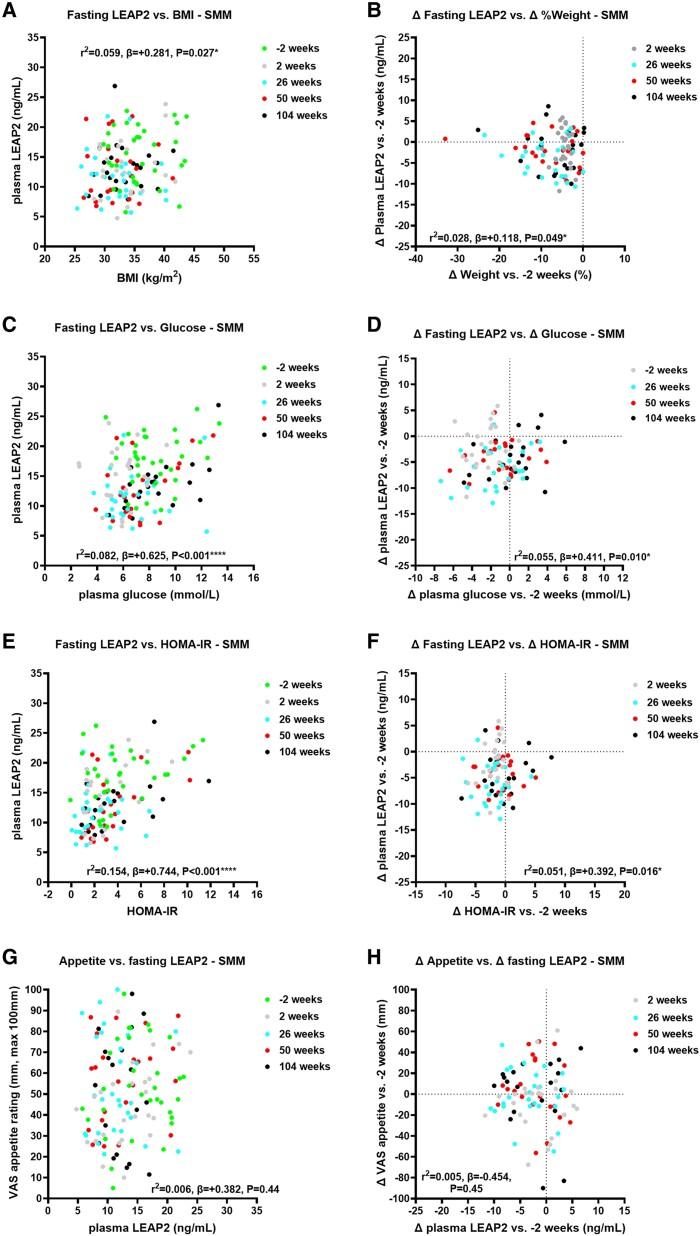
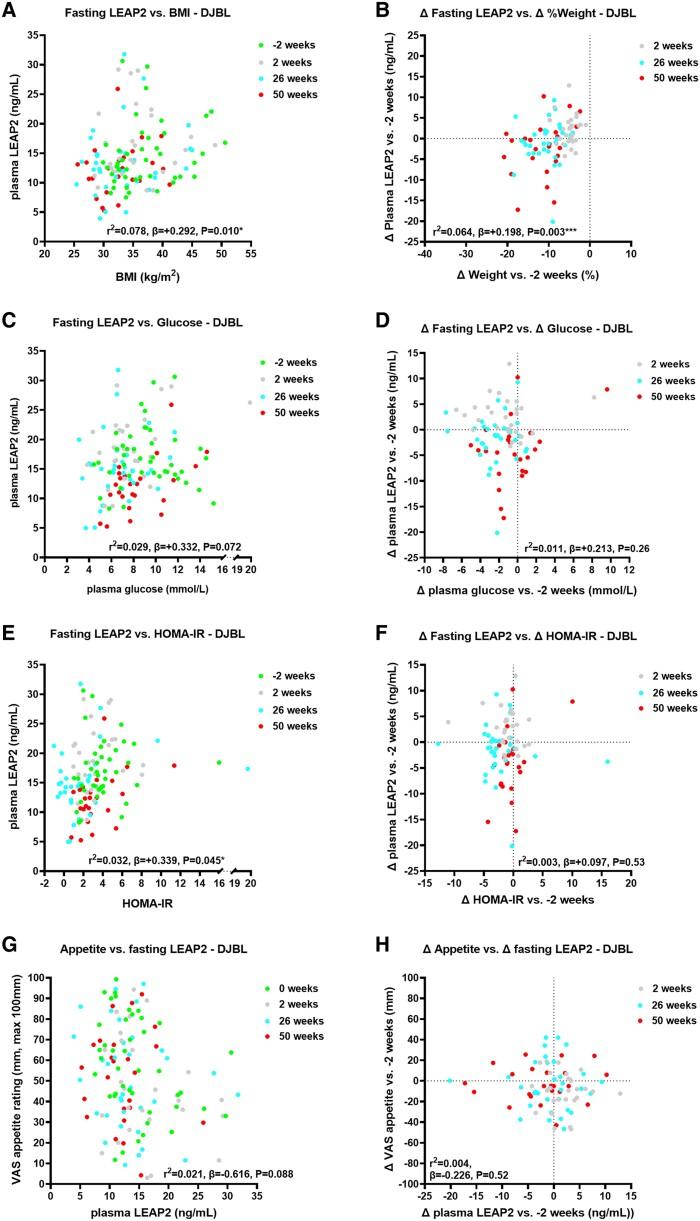
In the SMM group (n = 25-37), weight decreased by 4.3%, 8.1%, 7.8%, and 6.4% at 2, 26, 50, and 104 weeks and fasting plasma LEAP2 decreased from baseline mean ± SD 15.3 ± 0.9 ng/mL by 1.7, 3.8, 2.1, and 2.0 ng/mL, respectively. Absolute/decreases in fasting plasma LEAP2 positively correlated with absolute/decreases in body mass index, glycated hemoglobin A, fasting plasma glucose, serum insulin, homeostatic model assessment for insulin resistance, and serum triglycerides. Despite greater weight loss in the DJBL group (n = 23-30) at 26 to 50 weeks (10.4%-11.4%), the decrease in fasting plasma LEAP2 was delayed and attenuated (vs SMM), which may contribute to greater weight loss by attenuating GHSR signaling. Plasma LEAP2 did not increase with weight regain from 50 to 104 weeks after DJBL explant, suggesting a new set point with weight loss maintenance. Increases in plasma LEAP2 after a 600-kcal meal (10.8%-16.1% at 1-2 hours) were unaffected by weight loss, improved glucose metabolism, or DJBL insertion (n = 9-25), suggesting liver rather than duodenum/jejunum may be the primary source of postprandial LEAP2 secretion.
CONCLUSION
These findings add to our understanding of the regulation and potential physiological role of plasma LEAP2.
背景
肝脏/前肠饱腹感激素肝脏表达抗菌肽2(LEAP2)是酰基胃饥饿素受体(GHSR)的反向激动剂,进食后升高,减肥手术和短期非手术减肥后降低,但长期饮食减肥的影响尚不清楚。
目的
本研究的目的是检查和比较这些干预措施对空腹和餐后血浆LEAP2的影响,并研究血浆LEAP2变化的潜在代谢介质。
方法
在一项先前发表的为期2年的试验中测量血浆LEAP2,该试验比较了标准药物治疗(SMM)(包括每天600千卡热量不足)与十二指肠空肠旁路内衬(DJBL,Endobarrier)植入术(1年后取出)对肥胖且2型糖尿病控制不佳的成年人的影响。
结果
在SMM组(n = 25 - 37)中,体重在2、26、50和104周时分别下降了4.3%、8.1%、7.8%和6.4%,空腹血浆LEAP2从基线平均值±标准差15.3±0.9 ng/mL分别下降了1.7、3.8、2.1和2.0 ng/mL。空腹血浆LEAP2的绝对下降与体重指数、糖化血红蛋白A、空腹血糖、血清胰岛素、胰岛素抵抗稳态模型评估和血清甘油三酯的绝对下降呈正相关。尽管DJBL组(n = 23 - 30)在26至50周时体重减轻更多(10.4% - 11.4%),但空腹血浆LEAP2的下降延迟且减弱(与SMM组相比),这可能通过减弱GHSR信号传导导致更多体重减轻。DJBL取出后50至104周体重恢复时,血浆LEAP2没有增加,这表明体重减轻维持有一个新的设定点。600千卡餐后血浆LEAP2的增加(1 - 2小时时为10.8% - 16.1%)不受体重减轻、葡萄糖代谢改善或DJBL植入的影响(n = 9 - 25),这表明肝脏而非十二指肠/空肠可能是餐后LEAP2分泌的主要来源。
结论
这些发现增加了我们对血浆LEAP2调节及其潜在生理作用的理解。
 Zotero 插件