
肝移植等待名单上受者的肌肉萎缩率:移植后结局及相关血清代谢物模式
The rate of muscle wasting in liver transplant recipients on waiting list: post-transplant outcomes and associated serum metabolite patterns.
作者信息
Rokop Zachary P, O'Connell Thomas M, Munsch Taylor, Nephew Lauren, Orman Eric, Mihaylov Plamen, Mangus Richard S, Kubal Chandrashekhar
机构信息
Division of Transplant Surgery, Department of Surgery, Indiana University School of Medicine, Indianapolis, IN, USA.
Department of Otolaryngology, Head & Neck Surgery, Indiana University School of Medicine, Indianapolis, IN, USA.
出版信息
Hepatobiliary Surg Nutr. 2024 Dec 1;13(6):962-973. doi: 10.21037/hbsn-23-645. Epub 2024 Aug 22.
BACKGROUND
Sarcopenia at the time of liver transplantation (LT) is an established risk factor for mortality following LT. However, most studies in this context have defined sarcopenia by one-time, static measurements. The aims of this study were (I) to determine the impact of the rate of muscle loss in waitlisted LT recipients on post-LT outcomes and (II) to identify patterns of serum metabolites associated with patients with more progressive sarcopenia.
METHODS
Patients undergoing liver transplant from 2008 to 2018 who received more than one computed tomography (CT) scans within 12 months prior to liver transplant were included (n=61). The psoas muscle index (PMI) was calculated using Slice-O-Matic software and corrected for patient height (m). Patients were classified into two groups based the rate of reduction in PMI-high wasting [HW; change in PMI (ΔPMI) ≤-1%/month] and low wasting (LW; ΔPMI >-1%/month). Pre-transplant serum metabolic profiles were collected using nuclear magnetic resonance (NMR) spectroscopy. Living kidney donor sera was used as healthy controls.
RESULTS
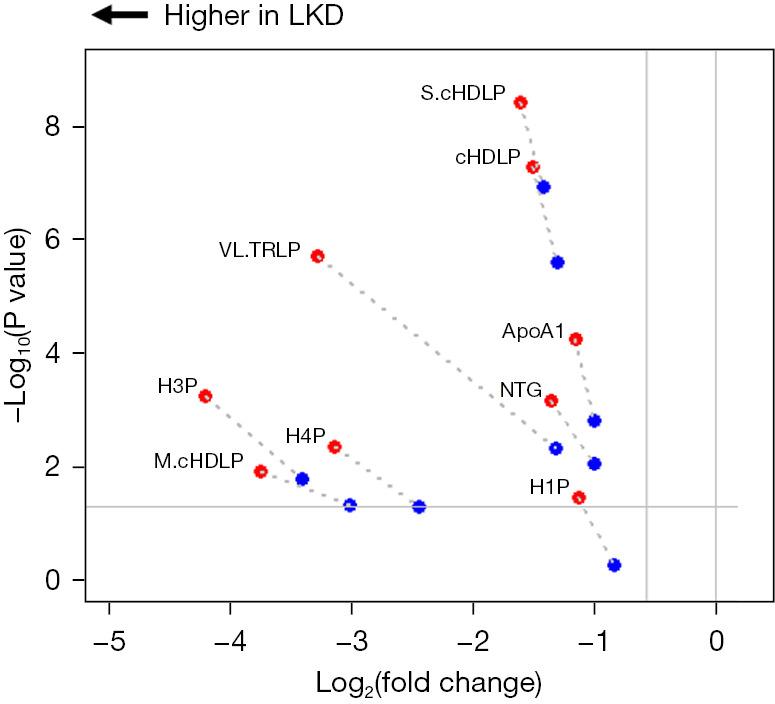
Median ΔPMI was -2.0%/month in HW and -0.15%/month in LW patients (P<0.001). Post-transplant 1-year mortality was significantly higher in HW patients. There were no significant differences in metabolite concentrations between HW and LW patients. However, perturbations in taurine, sarcosine, betaine and the aromatic amino acids (AAAs), were observed in patients with liver disease as compared to healthy controls. Liver disease was also associated with a decrease in lipoprotein profiles, especially high-density lipoprotein (HDL) particles.
CONCLUSIONS
In patients undergoing LT, the rate of progression of sarcopenia is a strong prognostic indicator of post-LT death. Serum metabolite profiles were not characteristically unique to HW patients, and most closely resemble derangements associated with chronic liver disease.
背景
肝移植(LT)时的肌肉减少症是LT后死亡的既定危险因素。然而,在这种情况下的大多数研究都是通过一次性的静态测量来定义肌肉减少症的。本研究的目的是:(I)确定等待肝移植的受者肌肉流失率对LT后结局的影响;(II)识别与肌肉减少症进展更明显的患者相关的血清代谢物模式。
方法
纳入2008年至2018年接受肝移植且在肝移植前12个月内接受过不止一次计算机断层扫描(CT)的患者(n = 61)。使用Slice - O - Matic软件计算腰大肌指数(PMI)并根据患者身高(米)进行校正。根据PMI降低率将患者分为两组——高消耗组[HW;PMI变化(ΔPMI)≤ - 1%/月]和低消耗组(LW;ΔPMI > - 1%/月)。使用核磁共振(NMR)光谱收集移植前血清代谢谱。活体肾供体血清用作健康对照。
结果
HW组患者的ΔPMI中位数为-2.0%/月,LW组患者为-0.15%/月(P < 0.001)。HW组患者移植后1年死亡率显著更高。HW组和LW组患者的代谢物浓度无显著差异。然而,与健康对照相比,肝病患者中观察到牛磺酸、肌氨酸、甜菜碱和芳香族氨基酸(AAA)的扰动。肝病还与脂蛋白谱降低有关,尤其是高密度脂蛋白(HDL)颗粒。
结论
在接受LT的患者中,肌肉减少症的进展速度是LT后死亡的强有力的预后指标。血清代谢物谱并非HW组患者所特有,且与慢性肝病相关的紊乱最为相似。


 Zotero 插件