
富马酸二甲酯在常规医疗实践中治疗多发性硬化症患者的长期安全性和有效性:ESTEEM研究的最终分析
Long-Term Safety and Effectiveness of Dimethyl Fumarate in Patients with Multiple Sclerosis Treated in Routine Medical Practice: Final Analysis of the ESTEEM Study.
作者信息
Pandey Krupa Shah, Giles Kathryn, Balashov Konstantin, Macdonell Richard, Windsheimer Jörg, Martinez Mikel, Božin Ivan, Raynaud Stephanie, Scaramozza Matthew, Mokliatchouk Oksana, Sun Zhaonan, Belviso Nicholas, Sato Yayoi, Lin Xiaochen, Okai Annette
机构信息
Hackensack University Medical Center, Hackensack Meridian School of Medicine, Hackensack, NJ, USA.
Cambridge Memorial Hospital, Cambridge, ON, Canada.
出版信息
Neurol Ther. 2025 Feb;14(1):243-260. doi: 10.1007/s40120-024-00680-z. Epub 2024 Dec 14.
INTRODUCTION
Dimethyl fumarate (DMF) has demonstrated a favorable benefit-risk profile in patients with relapsing-remitting multiple sclerosis (RRMS) in clinical and real-world studies. The ESTEEM study (NCT02047097) was conducted to assess the long-term safety and effectiveness of delayed-release DMF in patients with relapsing forms of MS in routine clinical practice. We report final outcomes from ESTEEM with up to 6.5 years of follow-up.
METHODS
Patients newly prescribed DMF were recruited from 393 sites globally. The primary objective was to assess the incidence and type of serious adverse events (SAEs) and adverse events (AEs) leading to discontinuation of DMF. Secondary objectives included assessment of DMF effectiveness on annualized relapse rate (ARR) and patient-reported outcomes (PROs).
RESULTS
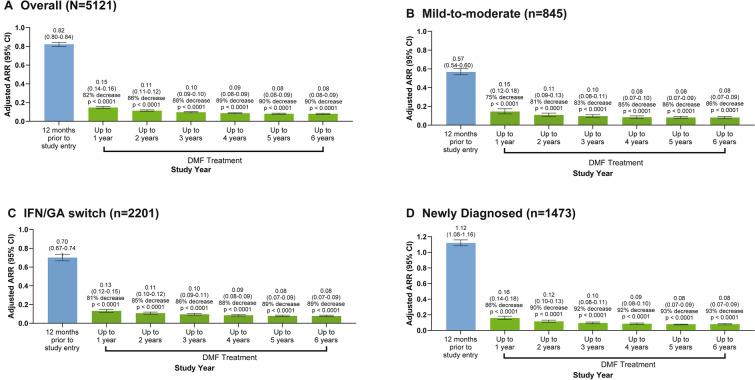
Overall, 5124 patients received ≥ 1 dose of DMF. The mean (standard deviation [SD]) age at enrollment was 40.0 (11.2) years; 74% of patients were female. Patients received DMF for a mean (SD) duration of 31.0 (22.7) months. Primary reasons for discontinuation were AEs (n = 1237; 24%); the most common were gastrointestinal AEs (n = 469; 9%), blood and lymphatic disorders (n = 218; 4%), and vascular disorders (n = 200; 4%). SAEs occurred in 391 (8%) patients, most commonly infections and infestations (n = 102; 2%). Adjusted ARR declined by 90% (95% confidence interval [CI]: 90-91%; p < 0.0001), from 0.81 (95% CI 0.79-0.84) 12 months before enrollment to 0.08 (95% CI 0.08-0.09) 6 years after enrollment. The estimated proportion of patients free from confirmed disability progression sustained over 48 weeks was 87.0% at month 60. Mean scores for physical and psychological impact, fatigue, health, and productivity remained stable over 5 years.
CONCLUSION
DMF demonstrated a safety profile in real-world clinical practice consistent with the known profile of DMF. Relapse rates were low and both ARR and PROs remained stable over time.
TRIAL REGISTRATION
ClinicalTrials.gov Identifier NCT02047097.
引言
在临床和实际研究中,富马酸二甲酯(DMF)已在复发缓解型多发性硬化症(RRMS)患者中展现出良好的效益风险比。开展了ESTEEM研究(NCT02047097),以评估缓释型DMF在常规临床实践中对复发型多发性硬化症患者的长期安全性和有效性。我们报告了ESTEEM研究长达6.5年随访的最终结果。
方法
从全球393个研究点招募新开具DMF处方的患者。主要目的是评估导致停用DMF的严重不良事件(SAE)和不良事件(AE)的发生率及类型。次要目的包括评估DMF对年化复发率(ARR)和患者报告结局(PRO)的有效性。
结果
总体而言,5124例患者接受了≥1剂DMF。入组时的平均(标准差[SD])年龄为40.0(11.2)岁;74%的患者为女性。患者接受DMF的平均(SD)疗程为31.0(22.7)个月。停药的主要原因是AE(n = 1237;24%);最常见的是胃肠道AE(n = 469;9%)、血液和淋巴系统疾病(n = 218;4%)以及血管疾病(n = 200;4%)。391例(8%)患者发生SAE,最常见的是感染和寄生虫感染(n = 102;2%)。调整后的ARR下降了90%(95%置信区间[CI]:90 - 91%;p < 0.0001),从入组前12个月的0.81(95% CI 0.79 - 0.84)降至入组后6年的0.08(95% CI 0.08 - 0.09)。在第60个月时,估计持续48周无确诊残疾进展的患者比例为87.0%。身体和心理影响、疲劳、健康及生产力的平均评分在5年中保持稳定。
结论
在实际临床实践中,DMF展现出的安全性与已知的DMF安全性特征相符。复发率较低,ARR和PRO随时间均保持稳定。
试验注册
ClinicalTrials.gov标识符NCT02047097。



 Zotero 插件