
DNA甲基化的每日节律及完全睡眠剥夺的影响。
Daily rhythm in DNA methylation and the effect of total sleep deprivation.
作者信息
Ämmälä Antti-Jussi, Hancox Thomas P M, Qiuyu Fan, Lahtinen Alexandra, Sulkava Sonja, Revell Victoria L, Ackermann Katrin, Kayser Manfred, Skene Debra J, Paunio Tiina
机构信息
Sleepwell Program and Department of Psychiatry, University of Helsinki and Helsinki University Hospital, Helsinki, Finland.
Department of Public Health and Welfare, Population Health Unit, National Institute of Health and Welfare, Helsinki, Finland.
出版信息
J Sleep Res. 2025 Aug;34(4):e14438. doi: 10.1111/jsr.14438. Epub 2024 Dec 15.
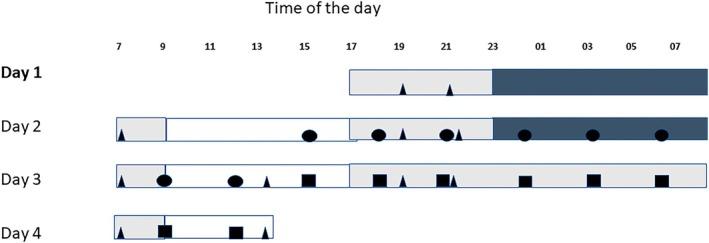
Numerous hormones and genes exhibit diurnal 24-hr rhythms that can also be affected by sleep deprivation. Here we studied diurnal rhythms in DNA methylation under a 24-hr sleep/wake cycle and a subsequent 29 hr of continual wakefulness (1 night of sleep deprivation). Fifteen healthy men (19-35 years) spent 3 days/nights in a sleep laboratory: (1) adaptation; (2) baseline; (3) total sleep deprivation day/night. DNA methylation was analysed from peripheral blood leukocytes, collected every 3 hr for 45 hr (starting at 15:00 hours) during the baseline period and the total sleep deprivation period. Epigenome-wide DNA methylation variation was assessed with the Infinium MethylationEPIC v2.0 Beadchip kit. Rhythm analysis was performed separately for the baseline and the total sleep deprivation time-series data. Pairwise analysis between diurnal samples and sleep deprivation samples at the same timepoint was also carried out to detect differentially methylated positions related to sleep deprivation. Of all DNA methylation sites, 14% exhibited a diurnal rhythm in methylation on the baseline day/night that was altered by sleep deprivation. During sleep deprivation, the number of differentially methylated positions increased towards the end of the sleep deprivation period, with a dominating pattern of hypomethylation. Among differentially methylated positions, an enrichment of genes related to the FAS immune response pathway was detected. In conclusion, DNA methylation exhibits diurnal rhythmicity, and this time-of-day variation needs to be considered when studying DNA methylation as a biomarker in biomedical studies. In addition, the observed DNA methylation changes under wakefulness might serve as a mediator of sleep deprivation-related immune response alterations.
许多激素和基因呈现出昼夜24小时节律,睡眠剥夺也会对其产生影响。在此,我们研究了在24小时睡眠/觉醒周期以及随后连续29小时清醒(1晚睡眠剥夺)情况下DNA甲基化的昼夜节律。15名健康男性(19 - 35岁)在睡眠实验室度过3天/夜:(1)适应期;(2)基线期;(3)完全睡眠剥夺日/夜。在基线期和完全睡眠剥夺期,每3小时采集一次外周血白细胞用于分析DNA甲基化,共采集45小时(从15:00开始)。使用Infinium MethylationEPIC v2.0 Beadchip试剂盒评估全基因组DNA甲基化变异。分别对基线期和完全睡眠剥夺期的时间序列数据进行节律分析。还在同一时间点对昼夜样本和睡眠剥夺样本进行成对分析,以检测与睡眠剥夺相关的差异甲基化位点。在所有DNA甲基化位点中,14%在基线日/夜表现出甲基化的昼夜节律,且这种节律因睡眠剥夺而改变。在睡眠剥夺期间,差异甲基化位点的数量在睡眠剥夺期结束时增加,主要模式为低甲基化。在差异甲基化位点中,检测到与FAS免疫反应途径相关的基因富集。总之,DNA甲基化呈现昼夜节律性,在生物医学研究中将DNA甲基化作为生物标志物进行研究时,需要考虑这种每日时间变化。此外,在清醒状态下观察到的DNA甲基化变化可能是睡眠剥夺相关免疫反应改变的介导因素。

 Zotero 插件