
1,2,3-三唑-甲基-甲萘醌衍生物的合成:针对两种血液寄生寄生虫的电化学及抗寄生虫特性评估
Synthesis of 1,2,3-Triazole-Methyl-Menadione Derivatives: Evaluation of Electrochemical and Antiparasitic Properties against two Blood-Dwelling Parasites.
作者信息
Dupouy Baptiste, Karpstein Tanja, Häberli Cécile, Cal Monica, Rottmann Matthias, Mäser Pascal, Keiser Jennifer, Elhabiri Mourad, Davioud-Charvet Elisabeth
机构信息
Laboratoire d'Innovation Moléculaire et Applications (LIMA), Team Bio(IN)organic & Medicinal Chemistry, UMR7042 CNRS-Université de Strasbourg-Université Haute-Alsace, European School of Chemistry, Polymers and Materials (ECPM), 25, rue Becquerel, F-67087, Strasbourg, France.
Swiss Tropical and Public Health Institute, Kreuzstrasse 2, CH-4123, Allschwil, Switzerland.
出版信息
ChemMedChem. 2025 Mar 15;20(6):e202400731. doi: 10.1002/cmdc.202400731. Epub 2025 Jan 8.
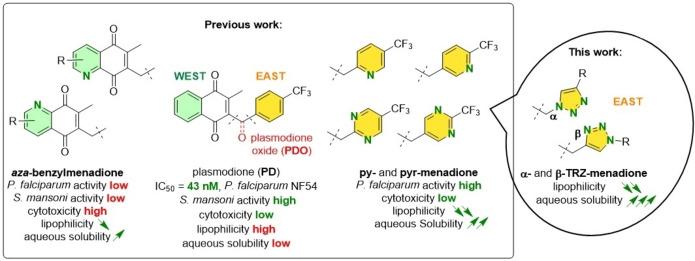
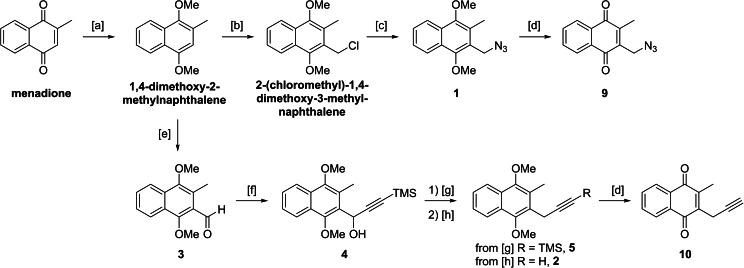
This study explores the synthesis and evaluation of novel 1,2,3-triazole-methyl-1,4-naphthoquinone hybrids, focusing on their electrochemical properties and antiparasitic efficacies against two human blood-dwelling parasites Plasmodium falciparum and Schistosoma mansoni. Using copper-catalyzed azide-alkyne cycloaddition (CuAAC), a well-established tool in click chemistry, two synthetic routes were assessed to develop α- and β-[triazole-methyl]-menadione derivatives. By optimizing the CuAAC reaction conditions, yields were significantly improved, reaching up to 94 % for key intermediates and resulting in the formation of a library of approximately 30 compounds. Biological evaluation of the compounds in antiparasitic drug assays demonstrated notable antischistosomal potencies, while no significant activity was observed for the same series against P. falciparum parasites. Electrochemical and 'benzylic' oxidation studies confirmed that the active 'benzoyl' metabolite responsible for the antiplasmodial activity of plasmodione cannot be generated. These findings highlight the potential of triazole-linked menadione hybrids as promising early candidates for antischistosomal drug development, and provides insights into structure-activity relationships crucial for future therapeutic strategies.
本研究探索新型1,2,3-三唑-甲基-1,4-萘醌杂合物的合成与评价,重点关注其电化学性质以及对两种寄生于人体血液中的寄生虫——恶性疟原虫和曼氏血吸虫的抗寄生虫效力。利用铜催化的叠氮化物-炔烃环加成反应(CuAAC)这一点击化学中成熟的工具,评估了两条合成路线以开发α-和β-[三唑-甲基]-甲萘醌衍生物。通过优化CuAAC反应条件,产率显著提高,关键中间体的产率高达94%,并由此形成了一个约30种化合物的库。在抗寄生虫药物试验中对这些化合物进行的生物学评价显示出显著的抗血吸虫效力,而该系列化合物对恶性疟原虫未观察到明显活性。电化学和“苄基”氧化研究证实,负责甲萘醌抗疟活性的活性“苯甲酰”代谢物无法生成。这些发现突出了三唑连接的甲萘醌杂合物作为抗血吸虫药物开发有前景的早期候选物的潜力,并为未来治疗策略至关重要的构效关系提供了见解。





 Zotero 插件