
体表电位标测:高密度皮肤电生理学的视角
Body Surface Potential Mapping: A Perspective on High-Density Cutaneous Electrophysiology.
作者信息
Ruiz-Mateos Serrano Ruben, Farina Dario, Malliaras George G
机构信息
Electrical Engineering Division, Department of Engineering, University of Cambridge, Cambridge, CB3 0FA, UK.
Department of Bioengineering, Faculty of Engineering, Imperial College London, London, W12 7TA, UK.
出版信息
Adv Sci (Weinh). 2025 Jan;12(4):e2411087. doi: 10.1002/advs.202411087. Epub 2024 Dec 16.
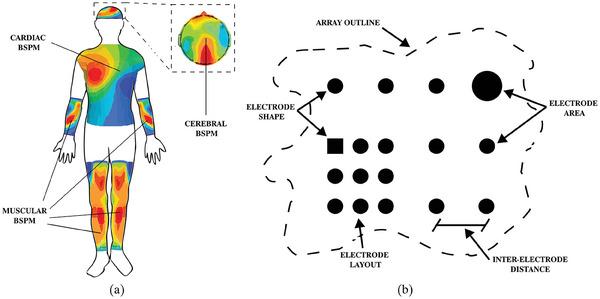
The electrophysiological signals recorded by cutaneous electrodes, known as body surface potentials (BSPs), are widely employed biomarkers in medical diagnosis. Despite their widespread application and success in detecting various conditions, the poor spatial resolution of traditional BSP measurements poses a limit to their diagnostic potential. Advancements in the field of bioelectronics have facilitated the creation of compact, high-quality, high-density recording arrays for cutaneous electrophysiology, allowing detailed spatial information acquisition as BSP maps (BSPMs). Currently, the design of electrode arrays for BSP mapping lacks a standardized framework, leading to customizations for each clinical study, limiting comparability, reproducibility, and transferability. This perspective proposes preliminary design guidelines, drawn from existing literature, rooted solely in the physical properties of electrophysiological signals and mathematical principles of signal processing. These guidelines aim to simplify and generalize the optimization process for electrode array design, fostering more effective and applicable clinical research. Moreover, the increased spatial information obtained from BSPMs introduces interpretation challenges. To mitigate this, two strategies are outlined: observational transformations that reconstruct signal sources for intuitive comprehension, and machine learning-driven diagnostics. BSP mapping offers significant advantages in cutaneous electrophysiology with respect to classic electrophysiological recordings and is expected to expand into broader clinical domains in the future.
由皮肤电极记录的电生理信号,即体表电位(BSPs),是医学诊断中广泛使用的生物标志物。尽管它们在检测各种病症方面得到了广泛应用并取得了成功,但传统BSP测量的空间分辨率较差限制了其诊断潜力。生物电子学领域的进步推动了用于皮肤电生理学的紧凑、高质量、高密度记录阵列的创建,从而能够获取作为BSP图(BSPMs)的详细空间信息。目前,用于BSP映射的电极阵列设计缺乏标准化框架,导致每项临床研究都需要定制,限制了可比性、可重复性和可转移性。本文提出了初步的设计指南,这些指南借鉴了现有文献,仅基于电生理信号的物理特性和信号处理的数学原理。这些指南旨在简化和概括电极阵列设计的优化过程,促进更有效和适用的临床研究。此外,从BSPMs获得的更多空间信息带来了解释挑战。为了缓解这一问题,概述了两种策略:用于直观理解的重建信号源的观测变换,以及机器学习驱动的诊断。与经典电生理记录相比,BSP映射在皮肤电生理学中具有显著优势,预计未来将扩展到更广泛的临床领域。



 Zotero 插件