
致病性变异相关乳腺癌中的肿瘤微环境与表观遗传调控
The Tumour Microenvironment and Epigenetic Regulation in Pathogenic Variant-Associated Breast Cancers.
作者信息
Tay Jun Yu, Ho Josh Xingchong, Cheo Fan Foon, Iqbal Jabed
机构信息
Lee Kong Chian School of Medicine, Imperial College London-Nanyang Technological University, Singapore 308232, Singapore.
Department of Anatomical Pathology, Division of Pathology, Singapore General Hospital, Singapore 169856, Singapore.
出版信息
Cancers (Basel). 2024 Nov 21;16(23):3910. doi: 10.3390/cancers16233910.
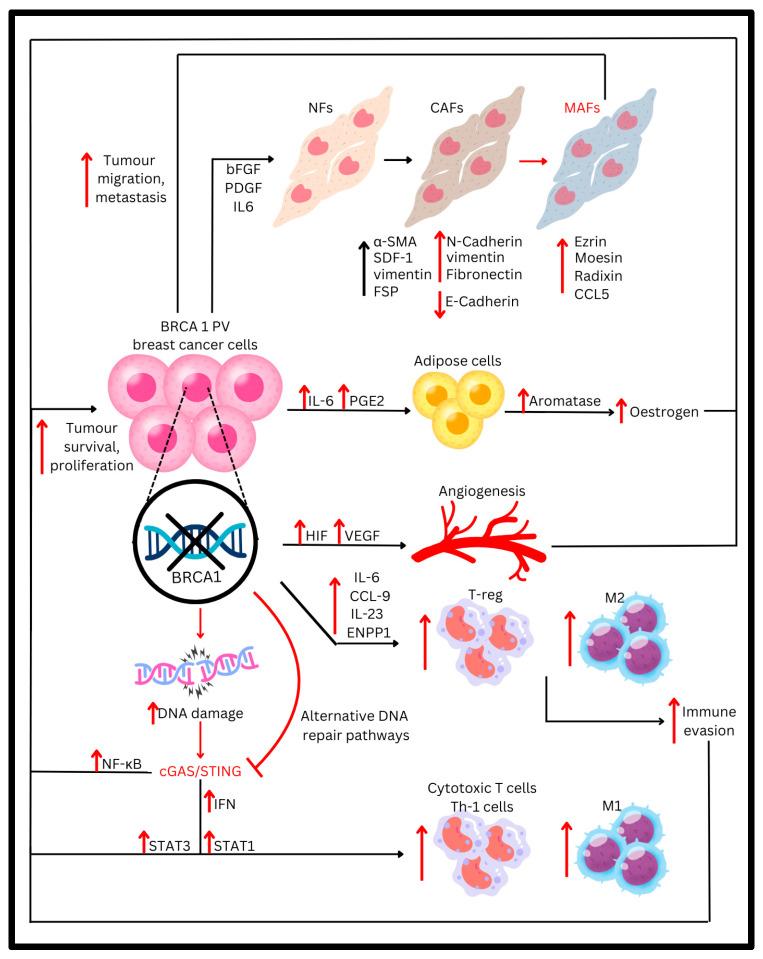
: pathogenic variant (PV)-associated breast cancers are most commonly seen in hereditary genetic conditions such as the autosomal-dominant Hereditary Breast and Ovarian Cancer (HBOC) syndrome, and rarely in sporadic breast cancer. Such breast cancers tend to exhibit greater aggressiveness and poorer prognoses due to the influence of pathogenic variants (PVs) on the tumour microenvironment. Additionally, while the genetic basis of PV breast cancer is well-studied, the role of epigenetic mediators in the tumourigenesis of these hereditary breast cancers is also worth exploring. : PVs in the gene interact with stromal cells and immune cells, promoting epithelial-mesenchymal transition, angiogenesis, and affecting oestrogen levels. Additionally, PVs contribute to breast cancer development through epigenetic effects on cells, including DNA methylation and histone acetylation, leading to the suppression of proto-oncogenes and dysregulation of cytokines. In terms of epigenetics, lysine-specific demethylase 1 (LSD-1) is considered a master epigenetic regulator, governing both transcriptional repression and activation. It exerts epigenetic control over and, to a lesser extent, genes. The upregulation of LSD-1 is generally associated with a poorer prognosis in cancer patients. In the context of breast cancer in PV carriers, LSD-1 contributes to tumour development through various mechanisms. These include the maintenance of a hypoxic environment and direct suppression of gene expression. : While LSD-1 itself does not directly cause mutations in or genes, its epigenetic influence sheds light on the potential role of LSD-1 inhibitors as a therapeutic approach in managing breast cancer, particularly in individuals with PVs. Targeting LSD-1 may help counteract its detrimental effects and provide a promising avenue for therapy in this specific subgroup of breast cancer.
与致病变异(PV)相关的乳腺癌最常见于遗传性遗传疾病,如常染色体显性遗传性乳腺癌和卵巢癌(HBOC)综合征,而在散发性乳腺癌中很少见。由于致病变异(PV)对肿瘤微环境的影响,此类乳腺癌往往表现出更强的侵袭性和更差的预后。此外,虽然PV乳腺癌的遗传基础已得到充分研究,但表观遗传调节因子在这些遗传性乳腺癌发生中的作用也值得探索。基因中的PV与基质细胞和免疫细胞相互作用,促进上皮-间质转化、血管生成,并影响雌激素水平。此外,PV通过对细胞的表观遗传效应,包括DNA甲基化和组蛋白乙酰化,促进乳腺癌的发展,导致原癌基因的抑制和细胞因子的失调。在表观遗传学方面,赖氨酸特异性去甲基化酶1(LSD-1)被认为是一种主要的表观遗传调节因子,可控制转录抑制和激活。它对基因以及在较小程度上对基因发挥表观遗传控制作用。LSD-1的上调通常与癌症患者较差的预后相关。在PV携带者的乳腺癌背景下,LSD-1通过多种机制促进肿瘤发展。这些机制包括维持缺氧环境和直接抑制基因表达。虽然LSD-1本身不会直接导致基因或基因的突变,但其表观遗传影响揭示了LSD-1抑制剂作为治疗乳腺癌,特别是对PV个体的治疗方法的潜在作用。靶向LSD-1可能有助于抵消其有害影响,并为这一特定亚组的乳腺癌治疗提供一条有前景的途径。

 Zotero 插件