
瑞戈非尼联合BRAF/MEK抑制剂治疗难治性黑色素瘤脑转移
Regorafenib Combined with BRAF/MEK Inhibitors for the Treatment of Refractory Melanoma Brain Metastases.
作者信息
Dirven Iris, Pierre Eden, Vander Mijnsbrugge An-Sofie, Vounckx Manon, Kessels Jolien I, Neyns Bart
机构信息
Team Laboratory for Medical and Molecular Oncology (LMMO), Translational Oncology Research Center (TORC), Vrije Universiteit Brussel (VUB), Universitair Ziekenhuis Brussel (UZ Brussel), Laarbeeklaan 101, 1090 Brussels, Belgium.
出版信息
Cancers (Basel). 2024 Dec 5;16(23):4083. doi: 10.3390/cancers16234083.
BACKGROUND
There are no active treatment options for patients with progressive melanoma brain metastases (MBM) failing immune checkpoint blockade (ICB) and BRAF/MEK inhibitors (BRAF/MEKi). Regorafenib (REGO), an oral multi-kinase inhibitor (incl. RAF-dimer inhibition), can overcome adaptive resistance to BRAF/MEKi in preclinical models.
METHODS
This is a single-center retrospective case series of patients with refractory MBM treated with REGO plus BRAF/MEKi (compassionate use).
RESULTS
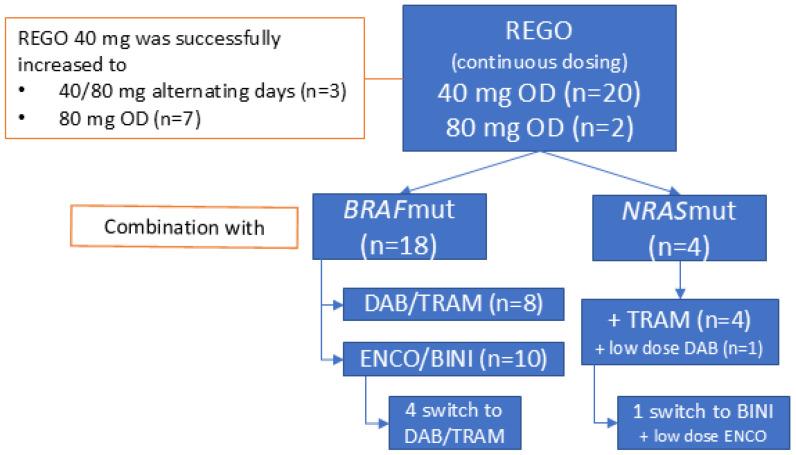
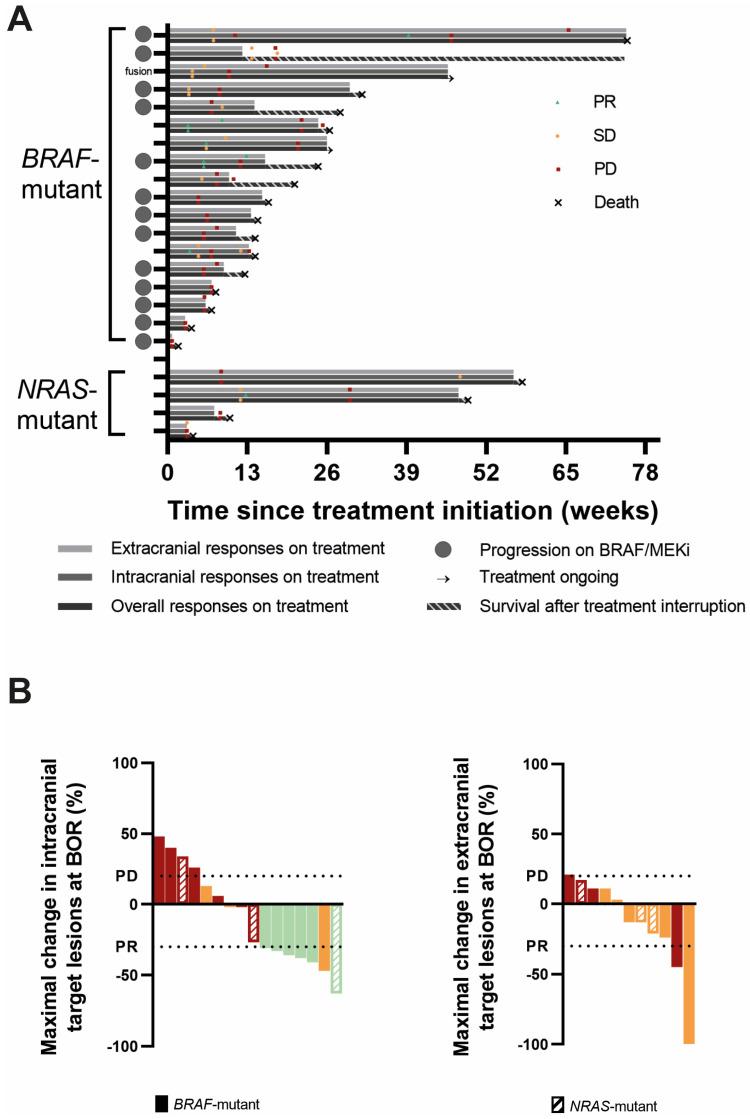
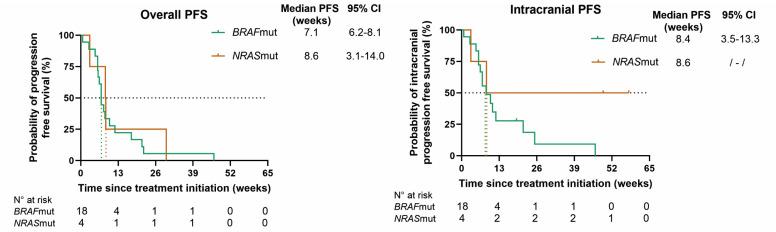
A total of 22 patients were identified (18 -mutant, 4 -mutant; 19 with progressive MBM; 11 on corticosteroids). Thirteen -mutant patients were progressing on BRAF/MEKi at the time of REGO association. -mutant patients received REGO (40-80 mg once daily) combined with BRAF/MEKi, -mutant patients were treated with REGO + MEKi (+low-dose BRAFi to mitigate skin-toxicity). Grade 3 TRAE included arterial hypertension ( = 4) and maculopapular rash ( 3). There were no G4/5 TRAE. In -mutant patients, overall and intracranial objective response rates (overall ORR and IC-ORR) were 11 and 29%, and overall and intracranial disease control rates (overall DCR and IC-DCR) were 44 and 59%, respectively. In -mutant patients overall ORR and IC-ORR were 0 and 25% and overall DCR and IC-DCR were 25 and 50%, respectively. The median PFS and OS were, respectively, 7.1 and 16.4 weeks in -mutant and 8.6 and 10.1 weeks in -mutant patients.
CONCLUSIONS
In heavily pretreated patients with refractory MBM, REGO combined with BRAF/MEKi demonstrated promising anti-tumor activity with an acceptable safety profile. In -mutant melanoma patients, responses cannot solely be attributed to BRAF/MEKi rechallenge. Further investigation in a prospective trial is ongoing to increase understanding of the efficacy.
背景
对于免疫检查点阻断(ICB)和BRAF/MEK抑制剂(BRAF/MEKi)治疗失败的进行性黑色素瘤脑转移(MBM)患者,目前尚无有效的治疗方案。瑞戈非尼(REGO)是一种口服多激酶抑制剂(包括RAF二聚体抑制),在临床前模型中可克服对BRAF/MEKi的适应性耐药。
方法
这是一项单中心回顾性病例系列研究,纳入了接受REGO联合BRAF/MEKi(同情用药)治疗的难治性MBM患者。
结果
共确定了22例患者(18例BRAF突变,4例NRAS突变;19例为进行性MBM;11例使用皮质类固醇)。13例BRAF突变患者在联合使用REGO时,BRAF/MEKi治疗出现进展。NRAS突变患者接受REGO(每日一次40 - 80mg)联合BRAF/MEKi治疗,NRAS突变患者接受REGO + MEKi治疗(联合低剂量BRAFi以减轻皮肤毒性)。3级治疗相关不良事件(TRAE)包括动脉高血压(n = 4)和斑丘疹(n = 3)。无4/5级TRAE。在BRAF突变患者中,总体和颅内客观缓解率(总体ORR和IC - ORR)分别为11%和29%,总体和颅内疾病控制率(总体DCR和IC - DCR)分别为44%和59%。在NRAS突变患者中,总体ORR和IC - ORR分别为0和25%,总体DCR和IC - DCR分别为25%和50%。BRAF突变患者的中位无进展生存期(PFS)和总生存期(OS)分别为7.1周和16.4周,NRAS突变患者分别为8.6周和10.1周。
结论
在经过大量预处理的难治性MBM患者中,REGO联合BRAF/MEKi显示出有前景的抗肿瘤活性,且安全性可接受。在NRAS突变的黑色素瘤患者中,反应不能仅归因于BRAF/MEKi再挑战。正在进行一项前瞻性试验以进一步了解其疗效。

 Zotero 插件