
子宫内膜异位症管理的饮食和营养干预措施
Dietary and Nutritional Interventions for the Management of Endometriosis.
作者信息
Abulughod Nour, Valakas Stefanie, El-Assaad Fatima
机构信息
University of New South Wales Microbiome Research Centre, School of Clinical Medicine, UNSW Medicine & Health, St George & Sutherland Clinical Campuses, Sydney, NSW 2217, Australia.
The Dietologist, Sydney, NSW 2008, Australia.
出版信息
Nutrients. 2024 Nov 21;16(23):3988. doi: 10.3390/nu16233988.
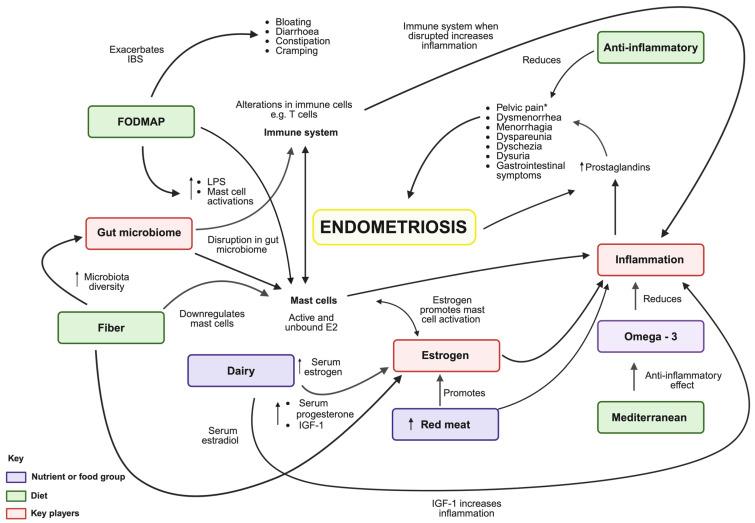
Endometriosis is a chronic, complex, systemic inflammatory condition that impacts approximately 190 million girls and women worldwide, significantly impacting their quality of life. The effective management of endometriosis requires a multi-disciplinary and holistic approach, one that includes surgical and medical management, such as a laparoscopy and a chronic medical management plan, as well as dietary, nutritional, and lifestyle adjunct interventions, such as pelvic pain physiotherapy and acupuncture. There is growing evidence to support the role of dietary and nutritional interventions in the adjunct management of endometriosis-related pain and gastrointestinal symptoms. However, the implementation of these interventions is often not regulated, as patients with endometriosis often adopt self-management strategies. Diet and nutrition can modulate key players integral to the pathophysiology of endometriosis, such as, but not limited to, inflammation, estrogen, and the microbiome. However, it is unclear as to whether diet plays a role in the prevention or the onset of endometriosis. In this review, we discuss three key players in the pathogenesis of endometriosis-inflammation, estrogen, and the microbiome-and we summarize how diet and nutrition can influence their mechanisms, and consequently, the progression and manifestation of endometriosis. There is a major need for evidence-based, non-invasive adjunct management of this debilitating disease, and diet and nutritional interventions may be suitable.
子宫内膜异位症是一种慢性、复杂的全身性炎症性疾病,全球约有1.9亿女性受其影响,严重影响她们的生活质量。子宫内膜异位症的有效管理需要多学科和整体的方法,包括手术和药物管理,如腹腔镜检查和慢性药物管理计划,以及饮食、营养和生活方式辅助干预措施,如盆腔疼痛物理治疗和针灸。越来越多的证据支持饮食和营养干预在辅助管理子宫内膜异位症相关疼痛和胃肠道症状方面的作用。然而,这些干预措施的实施往往缺乏规范,因为子宫内膜异位症患者通常采用自我管理策略。饮食和营养可以调节子宫内膜异位症病理生理学中不可或缺的关键因素,如但不限于炎症、雌激素和微生物群。然而,饮食是否在子宫内膜异位症的预防或发病中起作用尚不清楚。在这篇综述中,我们讨论了子宫内膜异位症发病机制中的三个关键因素——炎症、雌激素和微生物群——并总结了饮食和营养如何影响它们的机制,进而影响子宫内膜异位症的进展和表现。对于这种使人衰弱的疾病,迫切需要基于证据的非侵入性辅助管理方法,饮食和营养干预可能是合适的。
 Zotero 插件