
饮食中烟酸对地中海地区人群代谢功能障碍相关脂肪性肝病的影响:一项基于人群的研究。
Impact of Dietary Niacin on Metabolic Dysfunction-Associated Steatotic Liver Disease in Mediterranean Subjects: A Population-Based Study.
作者信息
Antentas Maria, Rojo-López Marina Idalia, Vendrell Pau, Granado-Casas Minerva, Genua Idoia, Fernandez-Camins Berta, Rossell Joana, Niño-Narvión Julia, Moreira Estefanía, Castelblanco Esmeralda, Ortega Emilio, Vlacho Bogdan, Alonso Nuria, Mauricio Didac, Julve Josep
机构信息
Institut de Recerca Sant Pau (IR SANT PAU), Sant Quintí 77-79, 08041 Barcelona, Spain.
Grup de Diabetis d'Atenció Primària (DAP-Cat), Unitat de Suport a la Recerca Barcelona, Fundació Institut Universitari per a la Recerca a l'Atenció Primària de Salut Jordi Gol i Gurina, 08007 Barcelona, Spain.
出版信息
Nutrients. 2024 Nov 30;16(23):4178. doi: 10.3390/nu16234178.
BACKGROUND
The impact of dietary niacin on metabolic dysfunction-associated steatotic liver disease (MASLD) is elusive. This sub-study aimed to investigate the relationship between dietary niacin intake and the presence of MASLD in participants from two Catalonian cohorts.
METHODS
A total of 222 subjects with MASLD were age- and sex-matched to 222 non-MASLD subjects. Dietary nutrients were analyzed using a validated food frequency questionnaire (FFQ). Dietary niacin and other nutrients were adjusted for total energy intake. MASLD was defined by a Fatty Liver Index (FLI) of >60 and by having at least one component of metabolic syndrome. The association between niacin intake (distributed into tertiles) and the presence of MASLD was assessed using multivariate logistic regression. Potential non-linear relationships were also analyzed through restricted cubic spline regression (RCS).
RESULTS
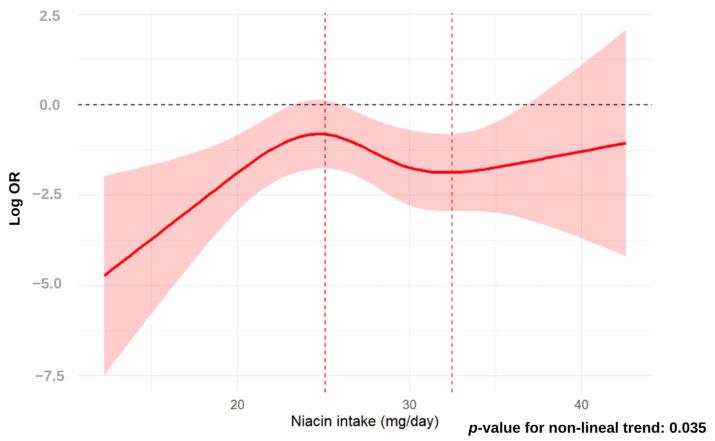
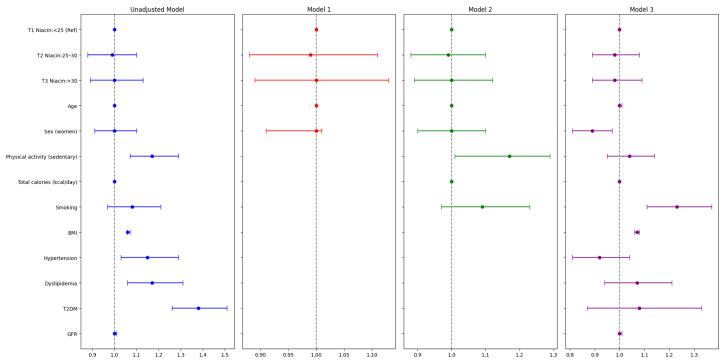
Our data revealed that subjects with MASLD had worse metabolic profiles. The dietary intake of niacin did not differ between subjects with and without MASLD. Even after adjusting for different confounding variables, i.e., sociodemographic variables, smoking status, physical activity, and cardiometabolic comorbidities, no significant associations were observed between higher intakes of niacin (tertiles 2 and 3) and the presence of MASLD: odds ratio (95% confidence) second tertile: 0.99 (0.89-1.09); third tertile: 0.98 (0.89-1.10). However, RCS analysis uncovered a significant non-linear dose-response association between dietary niacin intake and odds of MASLD. Specifically, such analysis revealed that MASLD risk was decreased in subjects with niacin intake values of <35 mg/day.
CONCLUSIONS
Our data showed that dietary niacin intake was associated with lower odds of MASLD in a Mediterranean population; however, our logistic regression analysis failed to reveal significant associations between the intake of niacin and the risk of MASLD. Further research is warranted to establish a causal relationship between dietary niacin interventions and MASLD.
背景
膳食烟酸对代谢功能障碍相关脂肪性肝病(MASLD)的影响尚不明确。本亚研究旨在调查来自两个加泰罗尼亚队列的参与者中膳食烟酸摄入量与MASLD存在情况之间的关系。
方法
总共222名患有MASLD的受试者与222名非MASLD受试者进行年龄和性别匹配。使用经过验证的食物频率问卷(FFQ)分析膳食营养素。膳食烟酸和其他营养素根据总能量摄入进行调整。MASLD的定义为脂肪肝指数(FLI)>60且患有代谢综合征的至少一种组分。使用多因素逻辑回归评估烟酸摄入量(分为三分位数)与MASLD存在情况之间的关联。还通过受限立方样条回归(RCS)分析潜在的非线性关系。
结果
我们的数据显示,患有MASLD的受试者代谢状况更差。有和没有MASLD的受试者之间膳食烟酸摄入量没有差异。即使在调整了不同的混杂变量,即社会人口统计学变量、吸烟状况、身体活动和心脏代谢合并症之后,在较高的烟酸摄入量(第二和第三三分位数)与MASLD存在情况之间也未观察到显著关联:比值比(95%置信区间)第二三分位数:0.99(0.89 - 1.09);第三三分位数:0.98(0.89 - 1.10)。然而,RCS分析发现膳食烟酸摄入量与MASLD的比值之间存在显著的非线性剂量反应关联。具体而言,该分析显示,烟酸摄入量<35毫克/天的受试者中MASLD风险降低。
结论
我们的数据表明,在地中海人群中,膳食烟酸摄入量与较低的MASLD几率相关;然而,我们的逻辑回归分析未能揭示烟酸摄入量与MASLD风险之间的显著关联。有必要进行进一步研究以确定膳食烟酸干预与MASLD之间的因果关系。

 Zotero 插件