
马立司他米布促进黑色素瘤癌细胞衰老或长期凋亡。
Marizomib Promotes Senescence or Long-Term Apoptosis in Melanoma Cancer Cells.
作者信息
Piskorz Wiktoria Monika, Krętowski Rafał, Cechowska-Pasko Marzanna
机构信息
Department of Pharmaceutical Biochemistry, Medical University of Bialystok, Mickiewicza 2A, 15-222 Białystok, Poland.
出版信息
Molecules. 2024 Nov 29;29(23):5652. doi: 10.3390/molecules29235652.
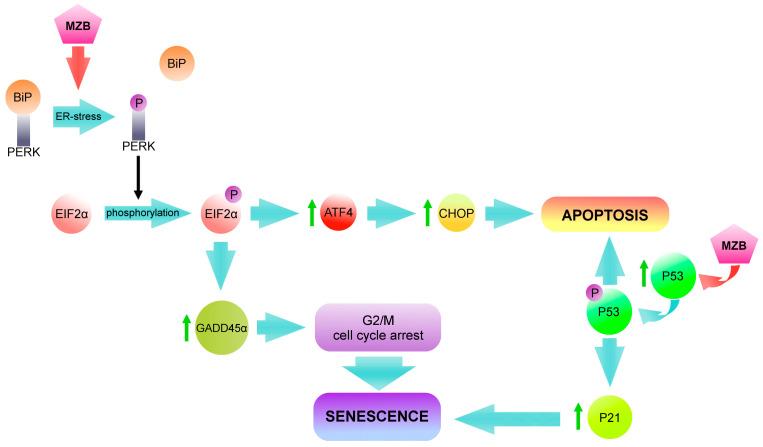
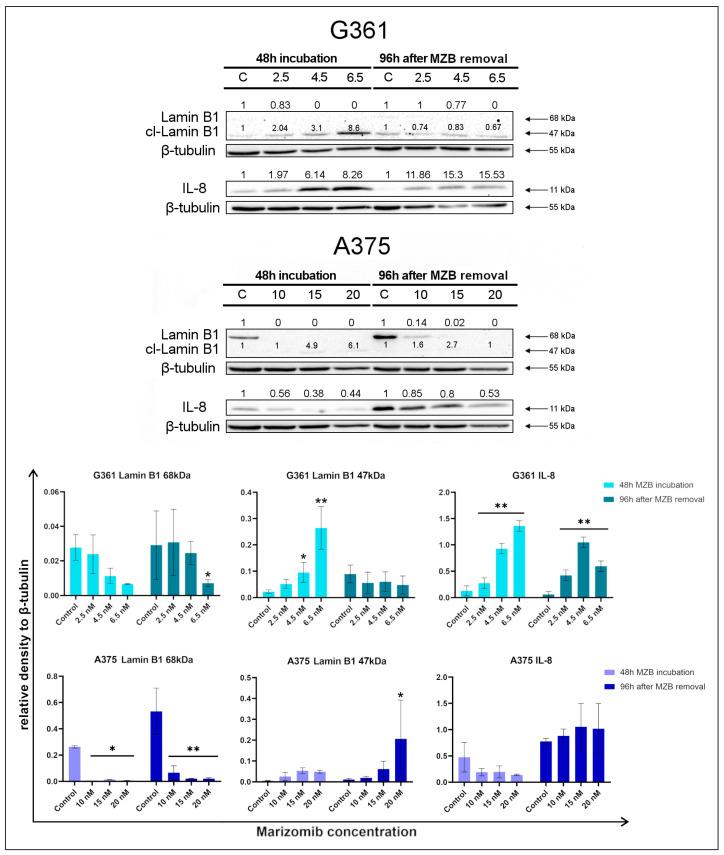
Cellular senescence is cell cycle arrest and the inhibition of cell proliferation. New anticancer approaches include the elimination of cancer cells through the induction of senescence followed by senolysis. New prosenescence compounds are still being searched for. Little is known about the ability of proteasome inhibitors to induce senescence in tumor cells, especially in malignant melanoma. The aim of our study was to verify the activity of a natural proteasome inhibitor-marizomib (MZB)-directly after incubation and after its removal to assess its potential to induce senescence or long-term apoptosis in malignant melanoma cell lines (A375 and G361). After 48 h of incubation with MZB, we observed an increased number of SA-β-galactosidase-positive cells, upregulated expression of P21 and P-P53 proteins and an increased number of cells at the subG1 phase (line G361) or at both the subG1 and G2/M phases (line A375). After 96 h from inhibitor removal, the G361 line presented signs of senescence (increased level of SA-β-galactosidase, IL-8, P-P53, G2/M and S phases of cell cycle, decreased lamin B1 and cleaved lamin B1), while the A375 line demonstrated more signs of apoptosis (increased subG1 phase, P-P53, cleaved lamin B1). The gathered findings suggest that MZB resulted in the induction of cellular senescence (line G361) or enhanced apoptosis (line A375) in the melanoma cell lines tested here and could be a promising therapeutic factor in malignant melanoma treatment.
细胞衰老即细胞周期停滞和细胞增殖抑制。新的抗癌方法包括通过诱导衰老随后进行衰老细胞清除来消除癌细胞。目前仍在寻找新的促衰老化合物。关于蛋白酶体抑制剂诱导肿瘤细胞尤其是恶性黑色素瘤细胞衰老的能力,人们了解甚少。我们研究的目的是验证天然蛋白酶体抑制剂——马立司他明(MZB)在孵育后及去除后直接的活性,以评估其诱导恶性黑色素瘤细胞系(A375和G361)衰老或长期凋亡的潜力。用MZB孵育48小时后,我们观察到衰老相关β-半乳糖苷酶阳性细胞数量增加、P21和磷酸化P53蛋白表达上调,以及处于亚G1期(G361细胞系)或亚G1期和G2/M期(A375细胞系)的细胞数量增加。在去除抑制剂96小时后,G361细胞系呈现出衰老迹象(衰老相关β-半乳糖苷酶、白细胞介素-8、磷酸化P53水平升高,细胞周期的G2/M期和S期增加,核纤层蛋白B1和切割的核纤层蛋白B1减少),而A375细胞系表现出更多凋亡迹象(亚G1期、磷酸化P53、切割的核纤层蛋白B1增加)。收集到的研究结果表明,MZB在此处测试的黑色素瘤细胞系中导致了细胞衰老(G361细胞系)的诱导或凋亡增强(A375细胞系),并且可能是恶性黑色素瘤治疗中有前景的治疗因素。



 Zotero 插件