
长期新冠的光影:潜伏感染是真正的隐藏敌人吗?
Lights and Shadows of Long COVID: Are Latent Infections the Real Hidden Enemy?
作者信息
Serapide Francesca, Talarico Marisa, Rotundo Salvatore, Pascale Vittorio, Serraino Riccardo, Trecarichi Enrico Maria, Russo Alessandro
机构信息
Dipartimento di Scienze Mediche e Chirurgiche, Università "Magna Graecia", 88100 Catanzaro, Italy.
Unità Operativa di Cardiologia, Azienda Ospedaliero Universitaria Renato Dulbecco, 88100 Catanzaro, Italy.
出版信息
J Clin Med. 2024 Nov 25;13(23):7124. doi: 10.3390/jcm13237124.
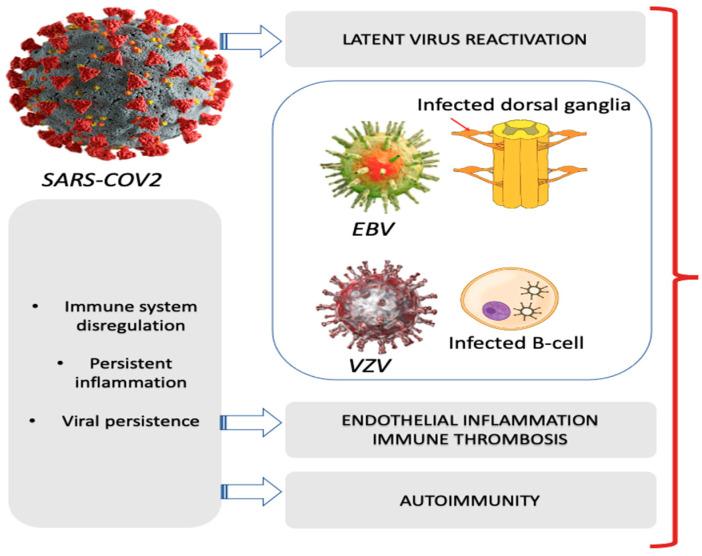
Long COVID-19 (LC) is a poorly understood, multifactorial condition that persists for at least three months following SARS-CoV-2 infection. The underlying pathophysiological mechanisms responsible for the wide range of associated symptoms-including fatigue, brain fog, and respiratory issues-remain unclear. However, emerging evidence suggests that the reactivation of latent viral infections, such as Epstein-Barr virus, cytomegalovirus, and varicella-zoster virus, may significantly contribute to the complexity of LC. These latent viruses can be reactivated by SARS-CoV-2, contributing to a chronic inflammatory state that prolongs symptomatology. This review confirms the potential involvement of latent viral infections in LC and examines whether these infections play an independent role or act synergistically with other factors. In addition, recent studies have highlighted viral persistence and immune dysregulation as key elements in LC. Our findings suggest that preventative strategies, including vaccination and antiviral treatments during the acute phase of COVID-19, show potential in reducing LC risk by preventing viral reactivation. However, tailored diagnostic and therapeutic strategies targeting these latent infections are urgently needed. Identifying biomarkers of viral reactivation, particularly for high-risk populations, could be considered another effective strategy to mitigate LC severity. Further research is crucial to better understand the interactions between SARS-CoV-2 and latent infections, and to improve the prevention and treatment of LC.
新冠后综合征(LC)是一种了解甚少的多因素病症,在感染严重急性呼吸综合征冠状病毒2(SARS-CoV-2)后持续至少三个月。导致包括疲劳、脑雾和呼吸问题等一系列相关症状的潜在病理生理机制仍不清楚。然而,新出现的证据表明,爱泼斯坦-巴尔病毒、巨细胞病毒和水痘-带状疱疹病毒等潜伏病毒的重新激活可能显著加剧了新冠后综合征的复杂性。这些潜伏病毒可被SARS-CoV-2重新激活,导致慢性炎症状态,从而延长症状持续时间。本综述证实了潜伏病毒感染在新冠后综合征中的潜在作用,并探讨了这些感染是发挥独立作用还是与其他因素协同作用。此外,最近的研究强调病毒持续存在和免疫失调是新冠后综合征的关键因素。我们的研究结果表明,包括在新冠急性期进行疫苗接种和抗病毒治疗在内的预防策略,在通过预防病毒重新激活降低新冠后综合征风险方面显示出潜力。然而,迫切需要针对这些潜伏感染的定制化诊断和治疗策略。识别病毒重新激活的生物标志物,尤其是针对高危人群,可被视为减轻新冠后综合征严重程度的另一项有效策略。进一步的研究对于更好地理解SARS-CoV-2与潜伏感染之间的相互作用以及改善新冠后综合征的预防和治疗至关重要。

 Zotero 插件