
5%利多卡因贴剂预处理预防开颅术后疼痛的疗效:一项随机临床试验
Efficacy of Preemptive Topical Lidocaine 5% Plaster in the Prevention of Post-Craniotomy Pain, a Randomized Clinical Trial.
作者信息
Han Xueye, Yang Yixuan, Ren Tong, Ji Nan, Luo Fang
机构信息
Department of Anesthesiology and Pain Medicine, Beijing Chao-Yang Hospital, Capital Medical University, Beijing, 100027, People's Republic of China.
Department of Pain Management, Beijing Tiantan Hospital, Capital Medical University, Beijing, 100070, People's Republic of China.
出版信息
J Pain Res. 2024 Dec 13;17:4251-4261. doi: 10.2147/JPR.S499264. eCollection 2024.
OBJECTIVE
The current landscape is characterized by a dearth of effective, safe, simple, and noninvasive methods for preventing pain following craniotomy. This clinical trial seeks to evaluate the efficacy profile of preemptive application of a topical 5% lidocaine patch in alleviating post-craniotomy pain.
METHODS
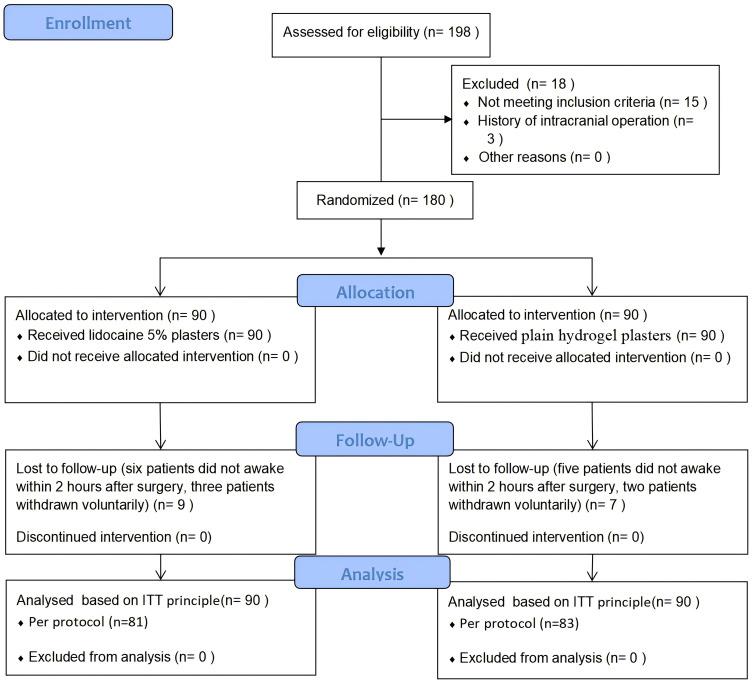
This was a multi-centric, prospective randomized placebo-controlled triple-blind clinical trial. Eligible patients were randomly assigned to either the masked intervention group, who received lidocaine 5% white hydrogel plasters (N = 90), or the placebo control group who received plain hydrogel plasters of the same pattern, size, appearance and material as L5Ps, but free of lidocaine (N = 90). Primary outcome was the pain intensity (Visual Analogue Scale at 24 h) after craniotomy. Secondary outcomes included: intra-operative analgesics consumption, pain intensity, cumulative rescue analgesics consumption, sleeping scores, adverse effects such as skin reactions, etc. The intention-to-treat analyses and the per-protocol analyses were used.
RESULTS
There were no statistically significant differences in the VAS scores at 24 h after craniotomy (P = 0.539). However, subgroup analysis for female and male patients showed that statistically significant differences were found in VAS scores in male patients (0 [0, 3] in the masked intervention group at 24 h after craniotomy and 3 [1, 4.5] in the placebo control group, P = 0.017). There were no obvious side effects directly associated with preemptive L5P.
CONCLUSION
Preemptive lidocaine 5% plaster as a safe technique was not found to be effective in reducing post-craniotomy pain, but potential gender disparities in the outcomes of this method warrant further investigation.
TRIAL REGISTRATION
ClinicalTrials.Gov (NCT04169854).
目的
目前的情况是缺乏有效、安全、简单且无创的开颅术后疼痛预防方法。本临床试验旨在评估预先应用5%利多卡因局部贴剂缓解开颅术后疼痛的疗效。
方法
这是一项多中心、前瞻性随机安慰剂对照三盲临床试验。符合条件的患者被随机分配到隐蔽干预组(90例,接受5%利多卡因白色水凝胶贴剂)或安慰剂对照组(90例,接受与利多卡因5%水凝胶贴剂相同图案、尺寸、外观和材料但不含利多卡因的普通水凝胶贴剂)。主要结局是开颅术后24小时的疼痛强度(视觉模拟评分)。次要结局包括:术中镇痛药用量、疼痛强度、累积补救镇痛药用量、睡眠评分、皮肤反应等不良反应。采用意向性分析和符合方案分析。
结果
开颅术后24小时视觉模拟评分无统计学显著差异(P = 0.539)。然而,对男性和女性患者的亚组分析显示,男性患者的视觉模拟评分存在统计学显著差异(开颅术后24小时,隐蔽干预组为0[0, 3],安慰剂对照组为3[1, 4.5],P = 0.017)。预先使用利多卡因5%水凝胶贴剂没有明显的直接副作用。
结论
未发现预先使用5%利多卡因贴剂作为一种安全技术在减轻开颅术后疼痛方面有效,但该方法结果中潜在的性别差异值得进一步研究。
试验注册
ClinicalTrials.Gov(NCT04169854)

 Zotero 插件