
雏鸡早期发育过程中肠道上皮细胞和固有免疫细胞的个体发生及功能:探索胚胎期免疫调节营养
Ontogeny and function of the intestinal epithelial and innate immune cells during early development of chicks: to explore in ovo immunomodulatory nutrition.
作者信息
Ayalew Habtamu, Xu Changchun, Adane Assefa, Sanchez Astrid Lissette Barreto, Li Siman, Wang Jing, Wu Shugeng, Qiu Kai, Qi Guanghai, Zhang Haijun
机构信息
Laboratory of Quality and Safety Risk Assessment for Animal Products on Feed Hazards (Beijing) of the Ministry of Agriculture and Rural Affairs, Institute of Feed Research, Chinese Academy of Agricultural Sciences, Beijing 100081, China; University of Gondar, College of Veterinary Medicine and Animal Sciences, Po. Box 196, Gondar, Ethiopia.
Laboratory of Quality and Safety Risk Assessment for Animal Products on Feed Hazards (Beijing) of the Ministry of Agriculture and Rural Affairs, Institute of Feed Research, Chinese Academy of Agricultural Sciences, Beijing 100081, China.
出版信息
Poult Sci. 2025 Jan;104(1):104607. doi: 10.1016/j.psj.2024.104607. Epub 2024 Nov 27.
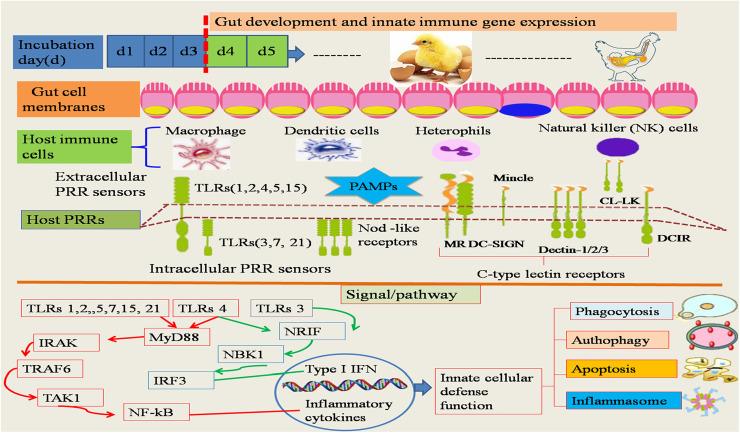
Intestinal epithelial cells (IECs) and innate immune cells in the gastrointestinal tract (GIT) of chickens play crucial roles in pathogens defense and maintaining gut health. However, their effectiveness influenced with their developmental and functional stages during pre and post hatch periods of chick. During embryonic development, differentiation and migration of these innate immune systems are tightly regulated by diverse cellular and molecular factors. The maturation and functionality of IECs are histologically evident starting embryonic day (ED) 14. Moreover, the innate immun cells, such as dendritic cells (DCs), macrophages, natural killer (NK) cells, and gamma-delta (γδ) T cells have showed developmental expression varation, while most identified by the 3rd days of incubation and capable of responsing to their cognate ligands of pathogens by ED 17, it may not efficient during posthatch period. In modern poultry production, in ovo feeding of bioactive substances is a topic of interest to maximize the protection capability of hatched chicks by enhancing improvement on the development of innate immune systems. However, their actions and effects on each distinct innate immune involved response are inconsistent and not clearly understood. Thus, summarizing the ontogeny and function of IECs, innate immunity systems, and interaction mechanisms of in ovo feeding of bioactive substances could provide baseline information for designing targeted in ovo feeding interventions to modulate cell waise specific innate immune systems.
鸡胃肠道中的肠上皮细胞(IECs)和先天免疫细胞在抵御病原体和维持肠道健康方面发挥着关键作用。然而,在雏鸡孵化前和孵化后的时期,它们的有效性会受到其发育和功能阶段的影响。在胚胎发育过程中,这些先天免疫系统的分化和迁移受到多种细胞和分子因素的严格调控。IECs的成熟和功能从胚胎第14天开始在组织学上就很明显。此外,先天免疫细胞,如树突状细胞(DCs)、巨噬细胞、自然杀伤(NK)细胞和γδT细胞,呈现出发育性表达变化,虽然大多数在孵化第3天时可识别,并且在胚胎第17天时能够对病原体的同源配体作出反应,但在孵化后时期可能效率不高。在现代家禽生产中,在卵内饲喂生物活性物质是一个备受关注的话题,旨在通过加强先天免疫系统的发育来最大化雏鸡的保护能力。然而,它们对每种不同的先天免疫相关反应的作用和影响并不一致,也尚未得到清楚的了解。因此,总结IECs、先天免疫系统的个体发生和功能以及在卵内饲喂生物活性物质的相互作用机制,可以为设计有针对性的卵内饲喂干预措施以调节细胞特异性先天免疫系统提供基础信息。

 Zotero 插件