
静脉麻醉和吸入麻醉对食管癌患者术后炎症标志物的影响:一项回顾性研究。
Effects of intravenous anesthesia and inhalation anesthesia on postoperative inflammatory markers in patients with esophageal cancer: a retrospective study.
作者信息
Ren Jie, Ma Yue, Wei Ming, Li Zhiguo
机构信息
Department of Anesthesiology, Guizhou Provincial People's Hospital, No.83 Zhongshan East Road, Nanming District, Guiyang, Guizhou, 550002, China.
Department of Orthopedics, The Second Affiliated Hospital of Air Force Medical University, Xi'an, Shanxi Province, 710000, China.
出版信息
BMC Anesthesiol. 2024 Dec 19;24(1):462. doi: 10.1186/s12871-024-02856-4.
BACKGROUND
Inflammatory markers have been confirmed to be associated with the prognosis of cancer patients. In this study, we compared the impacts of intravenous anesthesia and inhalation anesthesia on the neutrophil-to-lymphocyte ratio (NLR), the platelet-to-lymphocyte ratio (PLR), and the systemic immune-inflammation index (SII) after esophageal cancer surgery.
METHODS
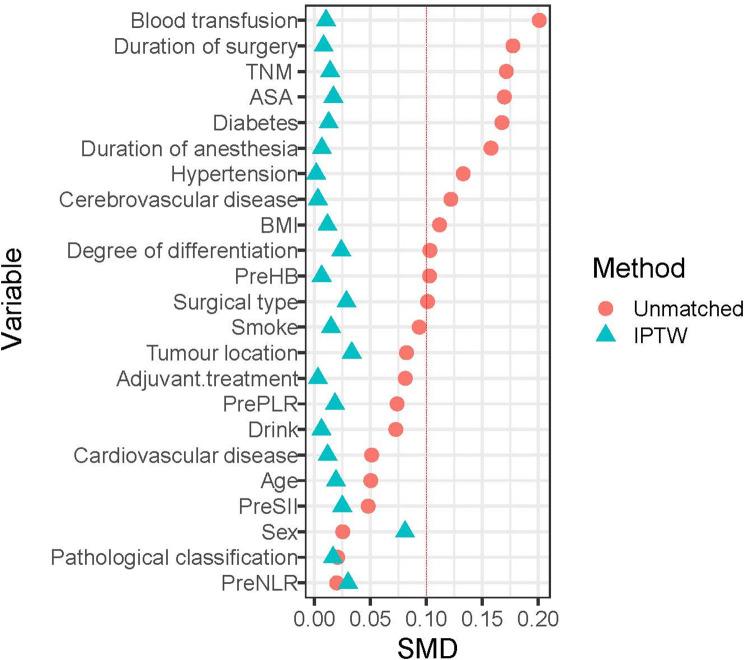
We retrospectively reviewed the electronic medical records of patients who underwent esophagectomy from January 1, 2014 to December 31, 2016. Patients respectively received total intravenous anesthesia (TIVA) or inhalational anesthesia (INHA). Inverse probability of treatment weighting (IPTW) was employed to minimize differences. The Mann-Whitney U test or Kruskal Wallis test was utilized to compare the effect of the two groups on postoperative NLR, PLR and SII.
RESULTS
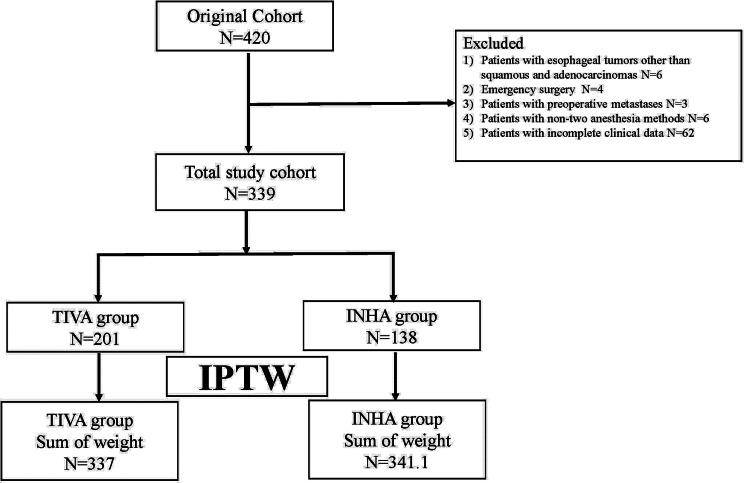
A total of 519 patients who had undergone esophageal cancer resection were recruited in this study, among whom 339 patients were eligible (TIVA group, n = 201, INHA group, n = 138). After IPTW, there was no statistically significant difference in NLR, PLR, and SII on the first postoperative day(P = 0.1951), (P = 0.5611), (P = 0.9684) and on the third postoperative day(P = 0.5961), (P = 0.1804), (P = 0.9653) between the two groups.
CONCLUSIONS
In conclusion, there was no significant difference in NLR, PLR and SII between intravenous anesthesia or inhalational anesthesia. TIVA is not superior to INHA in reducing the perioperative inflammatory response of esophageal cancer.
SYNOPSIS
Inflammatory markers play an important role in the recurrence, metastasis and survival of tumor patients after surgery. In this study, we will compare the effects of different anesthesia methods on inflammatory markers.
背景
炎症标志物已被证实与癌症患者的预后相关。在本研究中,我们比较了静脉麻醉和吸入麻醉对食管癌手术后中性粒细胞与淋巴细胞比值(NLR)、血小板与淋巴细胞比值(PLR)以及全身免疫炎症指数(SII)的影响。
方法
我们回顾性分析了2014年1月1日至2016年12月31日接受食管切除术患者的电子病历。患者分别接受全静脉麻醉(TIVA)或吸入麻醉(INHA)。采用治疗权重逆概率法(IPTW)以尽量减少差异。使用曼-惠特尼U检验或克鲁斯卡尔-沃利斯检验比较两组对术后NLR、PLR和SII的影响。
结果
本研究共纳入519例接受食管癌切除术的患者,其中339例符合条件(TIVA组,n = 201;INHA组,n = 138)。IPTW后,两组术后第1天的NLR、PLR和SII(P = 0.1951)、(P = 0.5611)、(P = 0.9684)以及术后第3天的(P = 0.5961)、(P = 0.1804)、(P = 0.9653)均无统计学显著差异。
结论
总之,静脉麻醉和吸入麻醉在NLR、PLR和SII方面无显著差异。在减轻食管癌围手术期炎症反应方面,TIVA并不优于INHA。
概要
炎症标志物在肿瘤患者术后的复发、转移和生存中起重要作用。在本研究中,我们将比较不同麻醉方法对炎症标志物的影响。

 Zotero 插件