
四名克莱夫斯特拉综合征儿科患者的临床特征与基因分析
Clinical characteristics and genetic analysis of four pediatric patients with Kleefstra syndrome.
作者信息
Ren Rong, Liu Yedan, Liu Peipei, Zhao Jing, Hou Mei, Li Shuo, Chen Zongbo, Yuan Aiyun
机构信息
Department of Neurorehabilitation, Affiliated Women's and Children's Hospital of Qingdao University, No. 6 Tongfu Road, Qingdao, 266000, Shandong, China.
Department of Pediatrics, Affiliated Hospital of Qingdao University, No. 16 Jiangsu Road, Qingdao, 266000, Shandong, China.
出版信息
BMC Med Genomics. 2024 Dec 18;17(1):290. doi: 10.1186/s12920-024-02065-5.
BACKGROUND
Kleefstra syndrome spectrum (KLEFS) is an autosomal dominant disorder that can lead to intellectual disability and autism spectrum disorders. KLEFS encompasses Kleefstra syndrome-1 (KLEFS1) and Kleefstra syndrome-2 (KLEFS2), with KLEFS1 accounting for more than 75%. However, limited information is available regarding KLEFS2. KLEFS1 is caused by a subtelomeric chromosomal abnormality resulting in either deletion at the end of the long arm of chromosome 9, which contains the EHMT1 gene, or by variants in the EHMT1 gene and the KMT2C gene that cause KLEFS2.
METHODS
This study was a retrospective analysis of clinical data from four patients with KLEFS. Exome sequencing (ES) and Sanger sequencing techniques were used to identify and validate the candidate variants, facilitating the analysis of genotype‒phenotype correlations of the EHMT1 and KMT2C genes. Protein structure modeling was performed to evaluate the effects of the variants on the protein's three-dimensional structure. In addition, real-time quantitative reverse transcription‒polymerase chain reaction (RT‒qPCR) and western blotting were used to examine the protein and mRNA levels of the KMT2C gene.
RESULTS
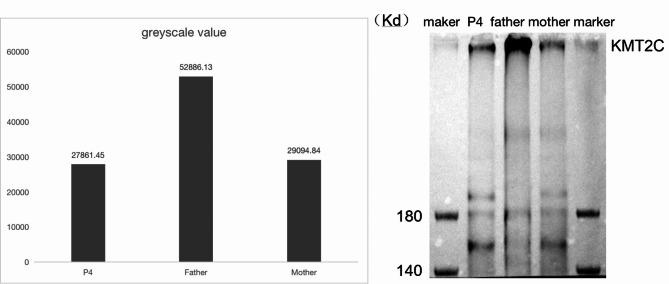
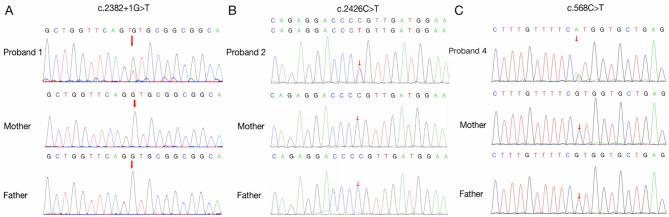
Two patients with KLEFS1 were identified: one with a novel variant (c.2382 + 1G > T) and the other with a previously reported variant (c.2426 C > T, p.Pro809Leu) in the EHMT1 gene. A De novo deletion at the end of the long arm of chromosome 9 was also reported. Furthermore, a patient with KLEFS2 was identified with a novel variant in the KMT2C gene (c.568 C > T, p.Arg190Ter). The RT‒qPCR and western blot results revealed that the expression of the KMT2C gene was downregulated in the KLEFS2 sample.
CONCLUSION
This study contributes to the understanding of both KLEFS1 and KLEFS2 by identifying novel variants in EHMT1 and KMT2C genes, thereby expanding the variant spectrum. Additionally, we provide the first evidence of how a KMT2C variant leads to decreased gene and protein expression, enhancing our understanding of the molecular mechanisms underlying KLEFS2. Based on these findings, children exhibiting developmental delay, hypotonia, distinctive facial features, and other neurodevelopmental abnormalities should be considered for ES to ensure early intervention and treatment.
背景
克莱夫斯特拉综合征谱系(KLEFS)是一种常染色体显性疾病,可导致智力残疾和自闭症谱系障碍。KLEFS包括克莱夫斯特拉综合征1型(KLEFS1)和克莱夫斯特拉综合征2型(KLEFS2),其中KLEFS1占比超过75%。然而,关于KLEFS2的信息有限。KLEFS1由亚端粒染色体异常引起,导致9号染色体长臂末端缺失,该区域包含EHMT1基因,或者由EHMT1基因和KMT2C基因的变异导致KLEFS2。
方法
本研究对4例KLEFS患者的临床资料进行回顾性分析。采用外显子组测序(ES)和桑格测序技术鉴定并验证候选变异,以分析EHMT1和KMT2C基因的基因型-表型相关性。进行蛋白质结构建模以评估变异对蛋白质三维结构的影响。此外,采用实时定量逆转录-聚合酶链反应(RT-qPCR)和蛋白质免疫印迹法检测KMT2C基因的蛋白质和mRNA水平。
结果
鉴定出2例KLEFS1患者:1例在EHMT1基因中有一个新变异(c.2382+1G>T),另1例有一个先前报道的变异(c.2426 C>T,p.Pro809Leu)。还报告了1例9号染色体长臂末端的新生缺失。此外,鉴定出1例KLEFS2患者,其KMT2C基因中有一个新变异(c.568 C>T,p.Arg190Ter)。RT-qPCR和蛋白质免疫印迹结果显示,KLEFS2样本中KMT2C基因的表达下调。
结论
本研究通过鉴定EHMT1和KMT2C基因中的新变异,有助于对KLEFS1和KLEFS2的理解,从而扩大变异谱。此外,我们首次提供了KMT2C变异导致基因和蛋白质表达降低的证据,加深了我们对KLEFS2潜在分子机制的理解。基于这些发现,对于表现出发育迟缓、肌张力减退、特殊面部特征和其他神经发育异常的儿童,应考虑进行外显子组测序,以确保早期干预和治疗。



 Zotero 插件