
SWI/SNF复合物高频突变亚基在肿瘤中作用的研究进展
Advances in the study of the role of high-frequency mutant subunits of the SWI/SNF complex in tumors.
作者信息
Zhao Jiumei, Zhu Jing, Tang Yu, Zheng Kepu, Li Ziwei
机构信息
Chongqing Nanchuan District People's Hospital, Chongqing, China.
Kunming Medical University, Kunming, China.
出版信息
Front Oncol. 2024 Dec 4;14:1463892. doi: 10.3389/fonc.2024.1463892. eCollection 2024.
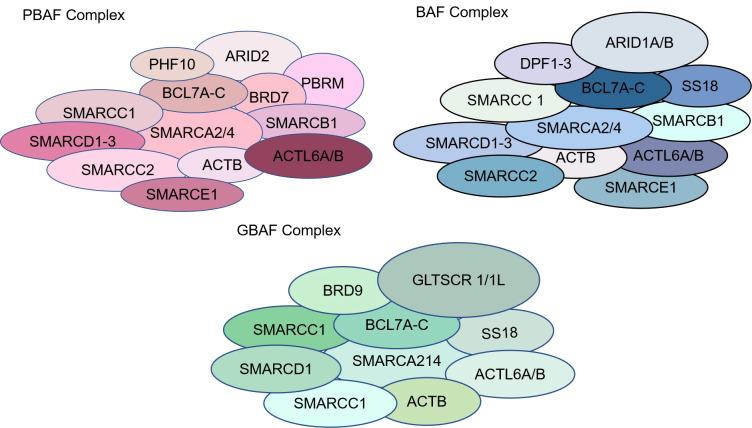
SWI/SNF (Switch/Sucrose non-fermentable, switch/sucrose non-fermentable) chromatin remodeling complex is a macromolecular complex composed of multiple subunits. It can use the energy generated by the hydrolysis of ATP (Adenosine triphosphate) to destroy the connection between DNA and histones, achieve the breakdown of nucleosomes, and regulate gene expression. SWI/SNF complex is essential for cell proliferation and differentiation, and the abnormal function of its subunits is closely related to tumorigenesis. Among them, ARID1A, an essential non-catalytic subunit of the SWI/SNF complex, can regulate the targeting of the complex through DNA or protein interactions. Moreover, the abnormal function of ARID1A significantly reduces the targeting of SWI/SNF complex to genes and participates in critical intracellular activities such as gene transcription and DNA synthesis. As a catalytic subunit of the SWI/SNF complex, SMARCA4 has ATPase activity that catalyzes the hydrolysis of ATP to produce energy and power the chromatin remodeling complex, which is critical to the function of the SWI/SNF complex. The study data indicate that approximately 25% of cancers have one or more SWI/SNF subunit genetic abnormalities, and at least nine different SWI/SNF subunits have been identified as having repeated mutations multiple times in various cancers, suggesting that mutations affecting SWI/SNF subunits may introduce vulnerabilities to these cancers. Here, we review the mechanism of action of ARID1A and SMARCA4, the two subunits with the highest mutation frequency in the SWI/SNF complex, and the research progress of their targeted therapy in tumors to provide a new direction for precise targeted therapy of clinical tumors.
SWI/SNF(开关/蔗糖不发酵)染色质重塑复合体是一种由多个亚基组成的大分子复合体。它能够利用三磷酸腺苷(ATP)水解产生的能量破坏DNA与组蛋白之间的连接,实现核小体的解体,并调节基因表达。SWI/SNF复合体对细胞增殖和分化至关重要,其亚基的功能异常与肿瘤发生密切相关。其中,ARID1A是SWI/SNF复合体的一个必需非催化亚基,可通过DNA或蛋白质相互作用调节该复合体的靶向作用。此外,ARID1A的功能异常会显著降低SWI/SNF复合体对基因的靶向作用,并参与基因转录和DNA合成等关键的细胞内活动。作为SWI/SNF复合体的催化亚基,SMARCA4具有ATP酶活性,可催化ATP水解产生能量,为染色质重塑复合体提供动力,这对SWI/SNF复合体的功能至关重要。研究数据表明,约25%的癌症存在一个或多个SWI/SNF亚基的基因异常,并且至少有9种不同的SWI/SNF亚基已被鉴定在各种癌症中多次发生重复突变,这表明影响SWI/SNF亚基的突变可能会使这些癌症产生弱点。在此,我们综述了SWI/SNF复合体中突变频率最高的两个亚基ARID1A和SMARCA4的作用机制及其在肿瘤靶向治疗方面的研究进展,为临床肿瘤的精准靶向治疗提供新方向。

 Zotero 插件