
以CGF联合Bio-Oss胶原作为植骨材料在骨凿上颌窦底提升术后同期植入种植体:一项前瞻性研究。
CGF with Bio-Oss collagen as grafting materials for simultaneous implant placement after osteotome sinus floor elevation: a prospective study.
作者信息
Shahood Bashar, Harphoush Seba, Muhaisen Belal O M, Qiu Jing
机构信息
Department of Oral Implantology, Affiliated Hospital of Stomatology, Nanjing Medical University, Nanjing, 210029, PR China.
The Key Laboratory of Modern Toxicology of Ministry of Education, School of Public Health, Nanjing Medical University, Nanjing, 211166, PR China.
出版信息
BMC Oral Health. 2024 Dec 19;24(1):1515. doi: 10.1186/s12903-024-05320-4.
BACKGROUND
Osteotome sinus floor elevation (OSFE) procedure with simultaneous implant placement is known to be an efficient procedure in the atrophic maxilla, where bone regeneration is required the most. The purpose of this study was to radiologically evaluate the efficacy of using Bio-Oss Collagen with Concentrated Growth Factor (CGF) as grafting materials for OSFE with simultaneous implant placement in the atrophic maxilla after one year of functional loading.
METHODS
A total of 126 implants were placed for 123 patients. Our inclusion criteria were patients with Residual Bone Height (RBH) ≤ 5 whom underwent OSFE procedure and simultaneous implant placement with different grafting materials: Group A with no grafting materials, Group B with Bio-Oss bone graft, and Group C with Bio-Oss Collagen with CGF. The Implants Survival Rate (ISR) was the primary outcome variable. Secondary outcome variables included radiographic measurements assessed at four follow-up time points, the Implant Stability Quotient (ISQ), and bone density (B). Indicators of bone formation were compared at different time points. Appropriate statistical analyses were conducted, with statistical significance set at a P value of 0.05 for all tests.
RESULTS
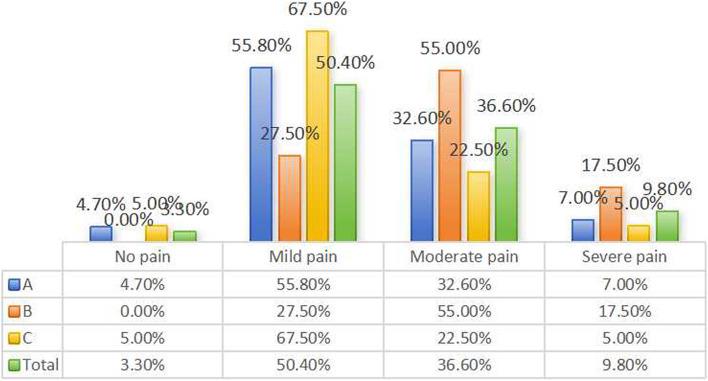
ISR was 96%. A significant positive relationship was found between RBH and ISR, [r (126) = .359, p = .000]. Endo sinus bone gain indictors increased in both grafted groups as compared to the non-grafted group. Total Bone Resorption (TBR1) and (TBR2) significantly decreased in both grafted groups compared to the non-grafted group (P = .004, P = .000). Graft size (D) was a positive predictor for ISR at three time points: D0 (odds ratio [OR] 8.06; 95% CI 1.59 to 38.24; P = .010); D1 (OR 96.58; 95% CI 1.69 to 5.52; P = .027); D2 (OR 4.97; 95% CI 1.29 to 19.19; P = .020). Visual Analog Scale (VAS) pain score significantly increased in Group B compared to Groups A and C (P = .000).
CONCLUSION
The combination of Bio-Oss Collagen with CGF as grafting material is a reliable protocol after OSFE with simultaneous implant placement in the atrophic maxilla. This approach is accompanied by high patient satisfaction.
背景
骨凿上颌窦底提升术(OSFE)同期植入种植体是一种在萎缩性上颌骨中非常有效的手术,因为该部位最需要骨再生。本研究的目的是通过影像学评估在萎缩性上颌骨中进行OSFE同期植入种植体后,使用Bio-Oss骨胶原与浓缩生长因子(CGF)作为移植材料在功能负载一年后的疗效。
方法
共为123例患者植入了126枚种植体。我们的纳入标准是剩余骨高度(RBH)≤5的患者,这些患者接受了OSFE手术并同期使用不同的移植材料植入种植体:A组不使用移植材料,B组使用Bio-Oss骨移植材料,C组使用Bio-Oss骨胶原与CGF。种植体存活率(ISR)是主要的观察变量。次要观察变量包括在四个随访时间点评估的影像学测量、种植体稳定性商数(ISQ)和骨密度(B)。比较不同时间点的骨形成指标。进行了适当的统计分析,所有检验的统计学显著性设定为P值0.05。
结果
ISR为96%。发现RBH与ISR之间存在显著的正相关关系,[r(126)=0.359,p = 0.000]。与未移植组相比,两个移植组的窦内骨增量指标均增加。与未移植组相比,两个移植组的总骨吸收(TBR1)和(TBR2)均显著降低(P = 0.004,P = 0.000)。移植尺寸(D)在三个时间点是ISR的正向预测因子:D0(优势比[OR]8.06;95%置信区间1.59至38.24;P = 0.010);D1(OR 96.58;95%置信区间1.69至5.52;P = 0.027);D2(OR 4.97;95%置信区间1.29至19.19;P = 0.020)。与A组和C组相比,B组的视觉模拟量表(VAS)疼痛评分显著增加(P = 0.000)。
结论
Bio-Oss骨胶原与CGF联合作为移植材料是萎缩性上颌骨OSFE同期植入种植体后的可靠方案。这种方法患者满意度高。


 Zotero 插件