
使用胰高血糖素样肽-1类似物治疗下丘脑性肥胖。
Treatment of Hypothalamic Obesity With GLP-1 Analogs.
作者信息
Dimitri Paul, Roth Christian L
机构信息
The Department of Paediatric Endocrinology, Sheffield Children's NHS Foundation Trust, Sheffield, S10 2TH, UK.
University of Sheffield, Sheffield, S10 2TN, UK.
出版信息
J Endocr Soc. 2024 Nov 14;9(1):bvae200. doi: 10.1210/jendso/bvae200. eCollection 2024 Nov 26.
INTRODUCTION
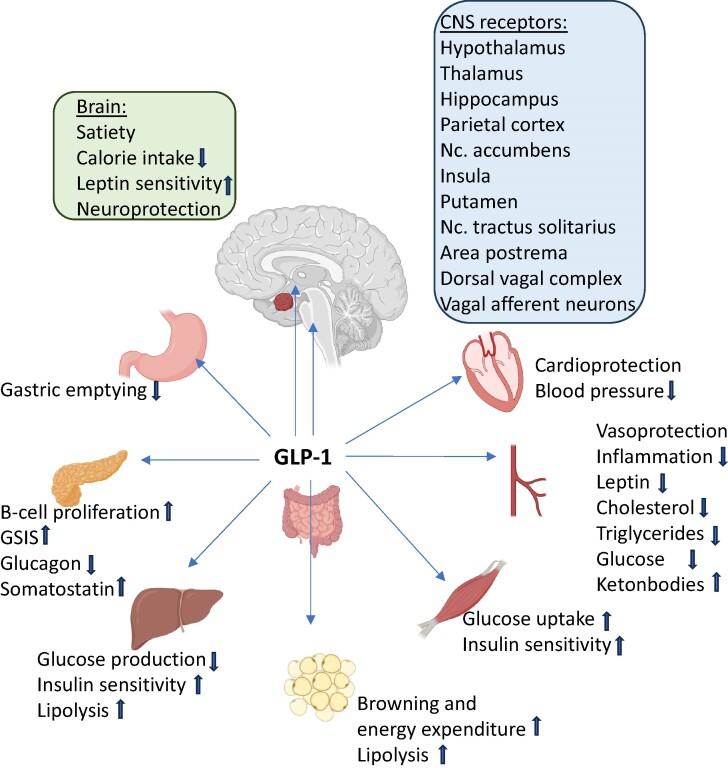
Congenital and acquired damage to hypothalamic nuclei or neuronal circuits controlling satiety and energy expenditure results in hypothalamic obesity (HO). To date, successful weight loss and satiety has only been achieved in a limited number of affected patients across multiple drug trials. Glucagon-like peptide-1 (GLP-1) acts via central pathways that are independent from the hypothalamus to induce satiety. GLP-1 receptor agonists (GLP-1RAs) may provide an alternative approach to treating HO.
METHODS
We performed a comprehensive search in Medline, Google Scholar, and clinical trials registries (ClinicalTrials.gov; clinicaltrialsregister.eur). This nonsystematic literature review was conducted to identify scientific papers published from January 2005 to February 2024 using the Pubmed and Embase databases. Key words used were GLP-1, GLP-1RA, hypothalamic obesity, suprasellar tumor, and craniopharyngioma.
RESULTS
Our search identified 7 case studies, 5 case series, and 2 published clinical trials relating to the use of GLP-1RAs in HO. All case studies demonstrated weight loss and improved metabolic function. In contrast, results from case series were variable, with some showing no weight loss and others demonstrating moderate to significant weight loss and improved metabolic parameters. In the ECHO clinical trial, nearly half the subjects randomized to weekly exenatide showed reduced body mass index (BMI). Paradoxically, BMI reduction was greater in patients with more extensive hypothalamic injuries.
CONCLUSION
GLP-1RAs potentially offer a new approach to treating HO. There is a need to stratify patients who are more likely to respond. Further randomized controlled trials are required to determine their efficacy either in isolation or combined with other therapies.
引言
下丘脑核或控制饱腹感及能量消耗的神经回路的先天性和后天性损伤会导致下丘脑性肥胖(HO)。到目前为止,在多项药物试验中,仅有少数受影响患者实现了成功减重和饱腹感改善。胰高血糖素样肽-1(GLP-1)通过独立于下丘脑的中枢途径发挥作用以诱导饱腹感。GLP-1受体激动剂(GLP-1RAs)可能为治疗HO提供一种替代方法。
方法
我们在Medline、谷歌学术和临床试验注册库(ClinicalTrials.gov;clinicaltrialsregister.eur)中进行了全面检索。本非系统性文献综述旨在利用Pubmed和Embase数据库识别2005年1月至2024年2月发表的科学论文。使用的关键词为GLP-1、GLP-1RA、下丘脑性肥胖、鞍上肿瘤和颅咽管瘤。
结果
我们的检索确定了7项病例研究、5个病例系列以及2项已发表的关于GLP-1RAs用于HO的临床试验。所有病例研究均显示体重减轻和代谢功能改善。相比之下,病例系列的结果各不相同,一些显示没有体重减轻,而另一些则显示中度至显著体重减轻以及代谢参数改善。在ECHO临床试验中,近一半随机接受每周一次艾塞那肽治疗的受试者体重指数(BMI)降低。矛盾的是,下丘脑损伤更广泛的患者BMI降低幅度更大。
结论
GLP-1RAs可能为治疗HO提供一种新方法。有必要对更可能有反应的患者进行分层。需要进一步的随机对照试验来确定其单独使用或与其他疗法联合使用时的疗效。
 Zotero 插件