
代谢功能障碍相关脂肪性肝病患者血清叶酸和维生素B水平与全因死亡率的关联:一项前瞻性队列研究
Associations of serum folate and vitamin B levels with all-cause mortality among patients with metabolic dysfunction associated steatotic liver disease: a prospective cohort study.
作者信息
Zhu Jiaxin, Liao Xinyi, Du Lei, Lv Pengju, Deng Jian
机构信息
Department of Clinical Laboratory, Zhengzhou Central Hospital Affiliated to Zhengzhou University, Zhengzhou, China.
Department of Anesthesiology, West China Hospital, Sichuan University, Chengdu, China.
出版信息
Front Endocrinol (Lausanne). 2024 Dec 5;15:1426103. doi: 10.3389/fendo.2024.1426103. eCollection 2024.
INTRODUCTION
Serum folate and vitamin B levels correlate with the prevalence of fatty liver disease, but it is not clear how they affect mortality. Therefore, this study aimed to investigate the association of serum folate and vitamin B concentrations with all-cause mortality in individuals with metabolic dysfunction-associated steatotic liver disease (MASLD).
METHODS
MASLD subjects were from the Third National Health and Nutrition Examination Survey (NHANES III) in the United States, and mortality follow-up data were obtained by linkage to death records from the National Death Index. Multivariable Cox proportional regression models and restricted cubic spline (RCS) models were used to evaluate the association of serum folate/vitamin B with all-cause mortality in the MASLD population.
RESULTS
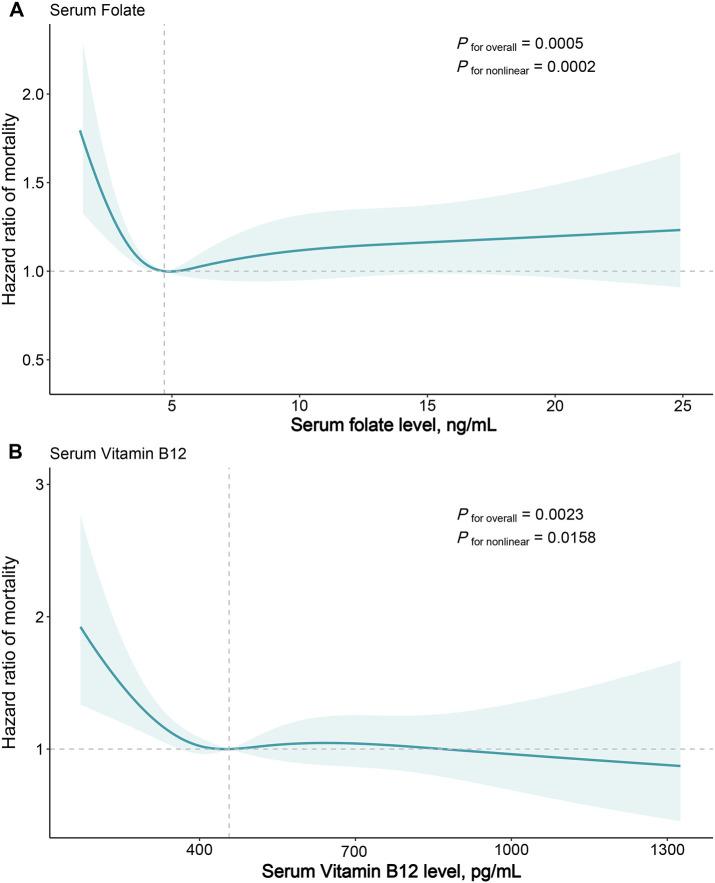
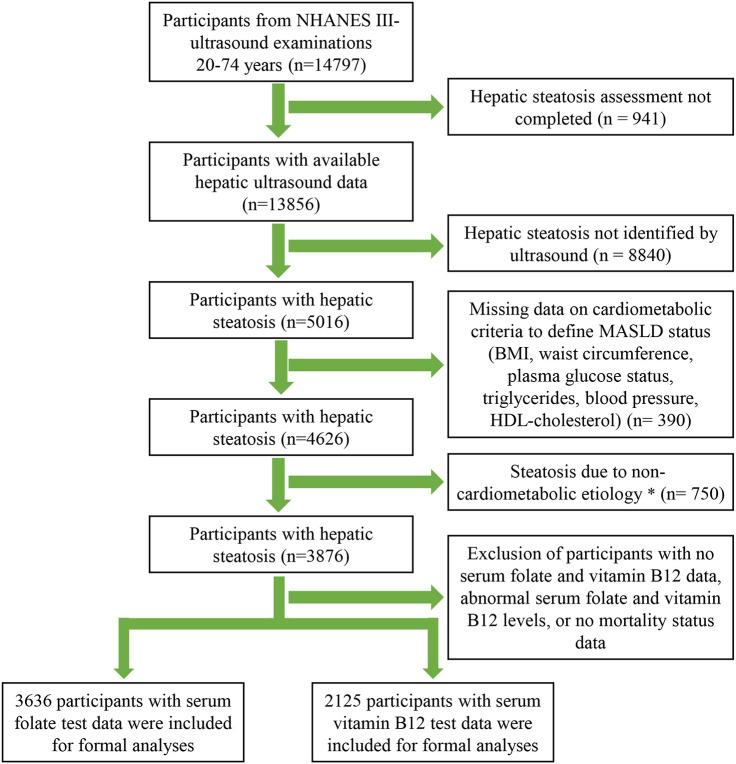
3,636 and 2,125 MASLD individuals were included in the analyses related to serum folate and vitamin B, respectively. During a follow-up period of more than 20 years, the RCS models demonstrated significant nonlinear associations of both serum folate (0.001) and vitamin B ( =0.016) with all-cause mortality in MASLD. When their serum concentrations were below the median level, the risk of all-cause mortality decreased with increasing concentration, reaching a lowest risk around the median level, and then leveled off. In the multivariable cox regression model, for vitamin B, the risk of all-cause mortality was reduced by 42% and 28% in the third and fourth quartile groups, respectively, compared with the lowest quartile group (hazard ratio [HR]=0.58, 95% CI: 0.39-0.86, =0.008; HR =0.72, 95% CI: 0.54-0.96, =0.026, respectively). For folate, the risk of all-cause mortality was reduced by 28% in the third quartile compared with the lowest quartile (HR =0.72, 95% CI: 0.57-0.91, =0.005).
CONCLUSION
This longitudinal cohort study suggests that low serum folate and vitamin B levels in patients with MASLD are significantly associated with an elevated risk of all-cause mortality.
引言
血清叶酸和维生素B水平与脂肪性肝病的患病率相关,但它们如何影响死亡率尚不清楚。因此,本研究旨在调查代谢功能障碍相关脂肪性肝病(MASLD)患者血清叶酸和维生素B浓度与全因死亡率之间的关联。
方法
MASLD受试者来自美国第三次全国健康和营养检查调查(NHANES III),通过与国家死亡指数的死亡记录进行关联获得死亡率随访数据。使用多变量Cox比例回归模型和受限立方样条(RCS)模型来评估MASLD人群中血清叶酸/维生素B与全因死亡率的关联。
结果
分别有3636名和2125名MASLD个体纳入了与血清叶酸和维生素B相关的分析。在超过20年的随访期内,RCS模型显示血清叶酸(P=0.001)和维生素B(P=0.016)与MASLD的全因死亡率均存在显著的非线性关联。当它们的血清浓度低于中位数水平时,全因死亡率风险随着浓度升高而降低,在中位数水平左右达到最低风险,然后趋于平稳。在多变量Cox回归模型中,对于维生素B,与最低四分位数组相比,第三和第四四分位数组的全因死亡率风险分别降低了42%和28%(风险比[HR]=0.58,95%置信区间:0.39-0.86,P=0.008;HR=0.72,95%置信区间:0.54-0.96,P=0.026)。对于叶酸,与最低四分位数组相比,第三四分位数组的全因死亡率风险降低了28%(HR=0.72,95%置信区间:0.57-0.91,P=0.005)。
结论
这项纵向队列研究表明,MASLD患者血清叶酸和维生素B水平低与全因死亡率风险升高显著相关。
 Zotero 插件