
消费者对脊髓损伤康复中功能性电刺激和机器人外骨骼的看法:一项小型综述。
Consumer views of functional electrical stimulation and robotic exoskeleton in SCI rehabilitation: A mini review.
作者信息
Pei Yalian, Tobita Mari, Dirlikov Benjamin, Arnold Dannae, Tefertiller Candace, Gorgey Ashraf
机构信息
Department of Communication Disorders and Sciences, Syracuse University, Syracuse, New York, USA.
Departmentof Physical Medicine and Rehabilitation, Rancho Los Amigos National Rehabilitation Center, Downey, California, USA.
出版信息
Artif Organs. 2025 May;49(5):729-748. doi: 10.1111/aor.14925. Epub 2024 Dec 23.
BACKGROUND
Functional electrical stimulation (FES) and robotic exoskeletons represent emerging technologies with significant potential for restoring critical physical functions such as standing and walking-functions that are most susceptible after spinal cord injury (SCI). However, the further development and successful integration of these technologies into clinical practice and daily life require a deep understanding of consumer perspectives.
OBJECTIVE
This review synthesizes consumer perspectives from a diverse range of technology stakeholders, including medical service providers, researchers, and persons affected by SCI-those living with SCI and their caregivers. By capturing this diverse range of perspectives, the review aims to describe the real-world implications, challenges, and expectations associated with FES and robotic exoskeleton technologies.
METHODS
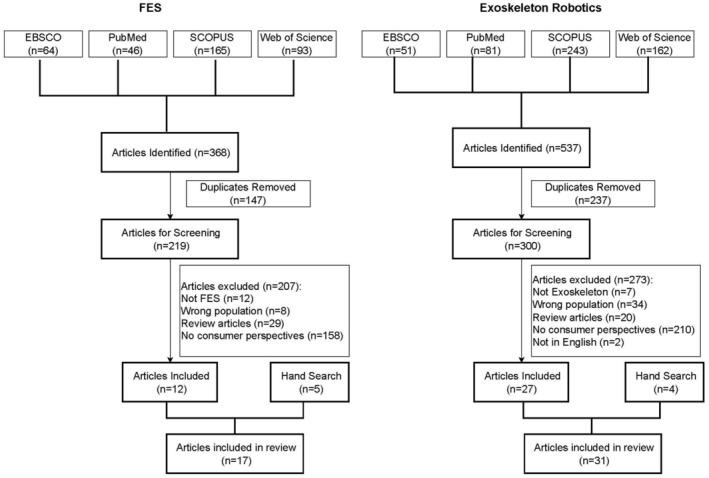
Relevant literature was primarily identified through a search in EBSCO, SCOPUS, and Web of Science. The authors supplemented the search by reviewing reference lists including appropriate articles identified by the authors. The PICO question guiding this process was defined as P (persons with SCI and caregivers, researchers, clinicians, and developers), I (use of FES or robotic exoskeletons), C (technology users compared to non-users), and O (stakeholder perspectives and experiences). Each identified article underwent a thorough appraisal, after which findings were summarized to present consumers' viewpoints on FES and robotic exoskeleton technologies.
RESULTS
The review focuses on key areas such as perceived benefits, limitations, implementation barriers, and consumer expectations. The benefits identified are multifaceted, extending from physical improvements, such as enhanced mobility and muscle strength, to psychological gains including increased confidence and sense of independence. However, these technologies also face perceived limitations, often related to accessibility, cost, and usability challenges. Beyond technical issues, implementation barriers are related to factors like insurance coverage and the need for specialized training for both users and providers. Consumer expectations include hope for technological advancements, increased accessibility and affordability, and a desire for more personalized and adaptable solutions tailored to the unique needs of individuals with SCI.
CONCLUSION
This comprehensive overview of consumer perspectives offers insights into the needs and preferences of the end-users, which are essential for creating user-centric technology and effectively translating research findings into clinical practice.
背景
功能性电刺激(FES)和机器人外骨骼代表了新兴技术,在恢复诸如站立和行走等关键身体功能方面具有巨大潜力,而这些功能在脊髓损伤(SCI)后最易受损。然而,这些技术的进一步发展以及成功融入临床实践和日常生活需要深入了解消费者的观点。
目的
本综述综合了来自不同技术利益相关者的消费者观点,包括医疗服务提供者、研究人员以及受SCI影响的人群——脊髓损伤患者及其护理人员。通过收集这些不同的观点,本综述旨在描述与FES和机器人外骨骼技术相关的实际影响、挑战和期望。
方法
相关文献主要通过在EBSCO、SCOPUS和科学网中进行检索来确定。作者通过查阅参考文献列表(包括作者确定的相关文章)对检索进行补充。指导这一过程的PICO问题定义为P(脊髓损伤患者及其护理人员、研究人员、临床医生和开发者)、I(使用FES或机器人外骨骼)、C(技术使用者与非使用者对比)和O(利益相关者的观点和经历)。对每一篇确定的文章进行全面评估,之后总结研究结果以呈现消费者对FES和机器人外骨骼技术的观点。
结果
本综述聚焦于感知到的益处、局限性、实施障碍和消费者期望等关键领域。所确定的益处是多方面的,从身体改善(如增强的移动性和肌肉力量)到心理收获(包括增强的自信心和独立感)。然而,这些技术也面临着感知到的局限性,通常与可及性、成本和可用性挑战有关。除了技术问题,实施障碍还与保险覆盖范围以及用户和提供者都需要专门培训等因素有关。消费者期望包括对技术进步的希望、更高的可及性和可承受性,以及渴望获得更符合脊髓损伤个体独特需求的个性化和适应性更强的解决方案。
结论
对消费者观点的这一全面概述提供了对终端用户需求和偏好的洞察,这对于创建以用户为中心的技术以及有效地将研究结果转化为临床实践至关重要。
 Zotero 插件