
具有增强表面积的分层NiCoO@CuS复合电极用于高性能混合超级电容器。
Hierarchical NiCoO@CuS composite electrode with enhanced surface area for high-performance hybrid supercapacitors.
作者信息
Muralee Gopi Chandu V V, Kulurumotlakatla Dasha Kumar, Raghavendra K V G, Suneetha Maduru, Ramesh R
机构信息
Department of Electrical Engineering, University of Sharjah Sharjah P. O. Box 27272 United Arab Emirates.
Graduate School of Convergence Science, Pusan National University San 30 Jangjeon-dong, Geumjeong-gu Busan 609-735 Republic of Korea.
出版信息
RSC Adv. 2024 Dec 23;14(54):40087-40097. doi: 10.1039/d4ra07808j. eCollection 2024 Dec 17.
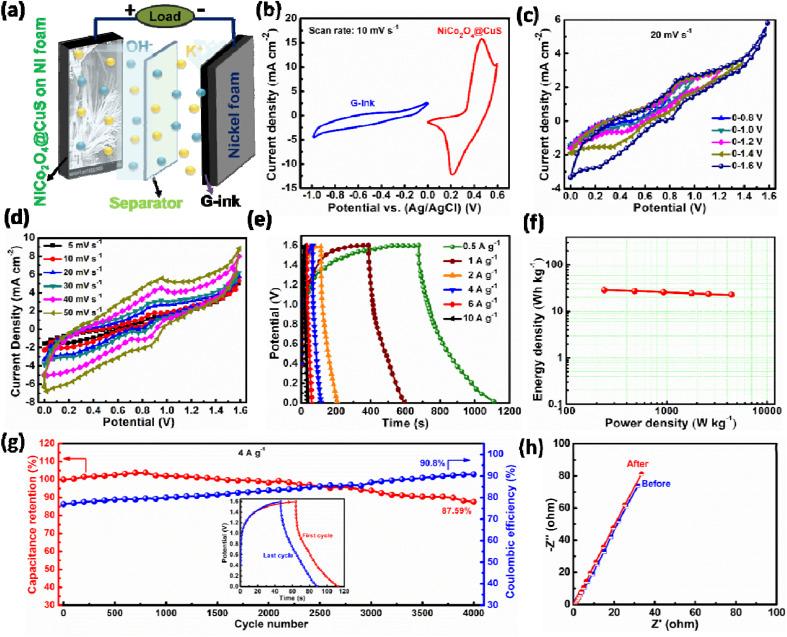
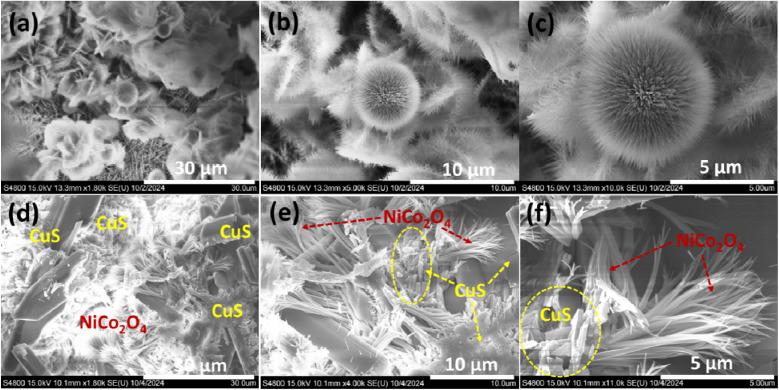
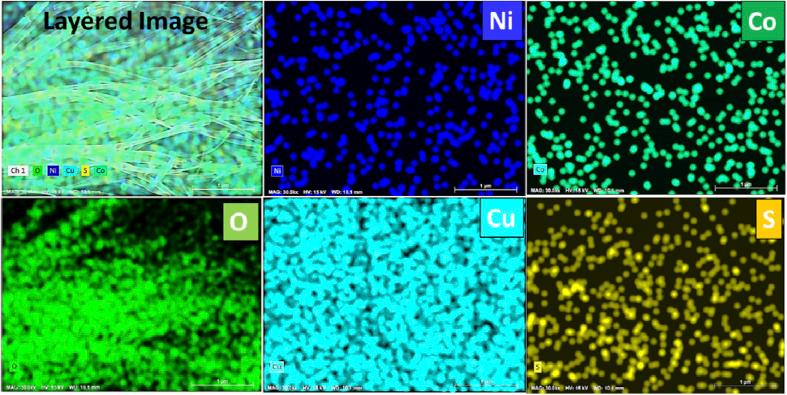
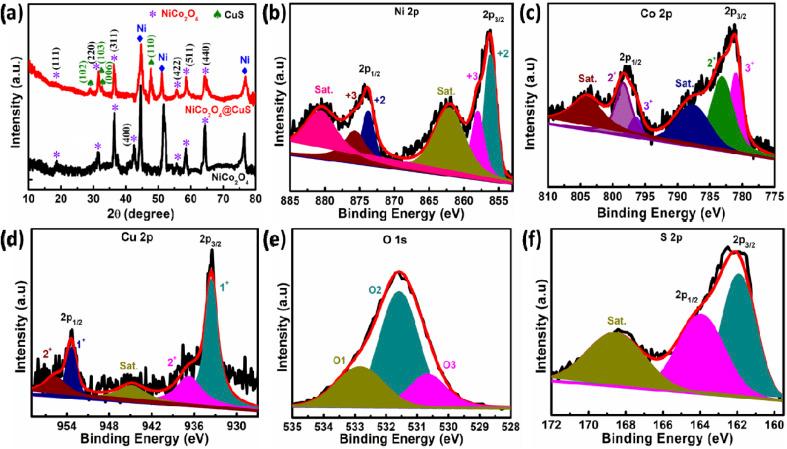
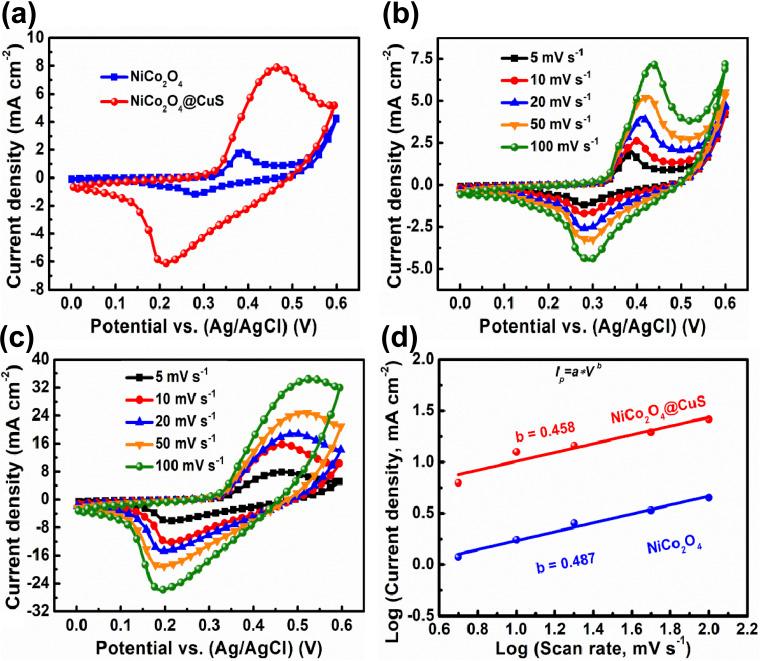
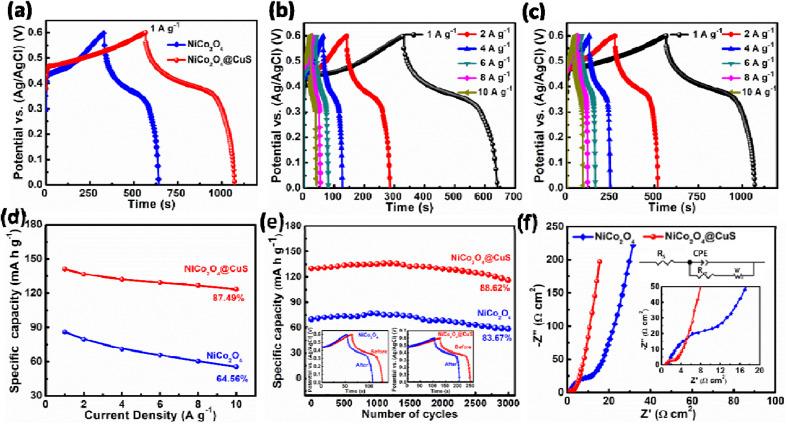
Hierarchical binder-free NiCoO@CuS composite electrodes have been successfully fabricated on a nickel foam surface using a facile hydrothermal method and directly used as a battery-type electrode material for supercapacitor applications. The surface morphological studies reveal that the composite electrode exhibited porous NiCoO nanograss-like structures with CuS nanostructures. The surface area of the composite is significantly enhanced (91.38 m g) compared to NiCoO (52.16 m g), with a predominant pore size of 3-6 nm. This synergistic combination enhanced the electrode's electrochemical properties. The NiCoO@CuS electrode delivered an impressive specific capacitance of 141.13 mA h g at 1 A g, surpassing the performance of the bare NiCoO electrode. The composite electrode also exhibited excellent rate capability and cycling stability, retaining 87.49% of its initial capacity at high current densities and 88.62% after 3000 cycles. A hybrid supercapacitor (HSC) device assembled using NiCoO@CuS and G-ink electrodes attained a peak energy density of 28.85 W h kg at a power density of 238.2 W kg, outperforming many reported HSCs. Additionally, the HSC device demonstrated exceptional cycling stability, retaining 87.59% of its initial capacitance after 4000 cycles. The superior performance of the NiCoO@CuS composite electrode is attributed to the synergistic combination of NiCoO and CuS, which promotes interfacial electron separation and facilitates rapid electron transfer.
采用简便的水热法在泡沫镍表面成功制备了分级无粘结剂的NiCoO@CuS复合电极,并将其直接用作超级电容器应用的电池型电极材料。表面形态研究表明,复合电极呈现出具有CuS纳米结构的多孔NiCoO纳米草状结构。与NiCoO(52.16 m²/g)相比,复合材料的表面积显著增加(91.38 m²/g),主要孔径为3 - 6 nm。这种协同组合增强了电极的电化学性能。NiCoO@CuS电极在1 A/g电流密度下表现出令人印象深刻的141.13 mA h/g的比电容,超过了裸NiCoO电极的性能。复合电极还表现出优异的倍率性能和循环稳定性,在高电流密度下保持其初始容量的87.49%,在3000次循环后保持88.62%。使用NiCoO@CuS和G-ink电极组装的混合超级电容器(HSC)器件在功率密度为238.2 W/kg时达到了28.85 W h/kg的峰值能量密度,优于许多已报道的HSC。此外,HSC器件表现出出色的循环稳定性,在4000次循环后保持其初始电容的87.59%。NiCoO@CuS复合电极的优异性能归因于NiCoO和CuS的协同组合,这促进了界面电子分离并有利于快速电子转移。

 Zotero 插件