
佩戴口罩规定对中风发病率和死亡率的影响:一项基于中国人群的回顾性队列研究
The impacts of mask-wearing regulations on stroke morbidity and mortality: a population-based retrospective cohort study in China.
作者信息
Shi Yulin, Wang Xiaonan, Li Ning, Li WanWei, Meng Xianfeng, Wang Baohua, Wan Xia
机构信息
Department of Epidemiology and Biostatistics, Institute of Basic Medical Sciences Chinese Academy of Medical Sciences, School of Basic Medicine Peking, Union Medical College, Beijing, 100005, China.
State Key Laboratory of Respiratory Health and Multimorbidity, Beijing, China.
出版信息
BMC Public Health. 2024 Dec 24;24(1):3577. doi: 10.1186/s12889-024-20837-7.
BACKGROUND
It is common to protect people from air pollution by wearing masks, but how much of its health effect on cardiovascular diseases (CVDs) is unknown. This study aimed to determine whether the mask intervention associated with decrease in stroke morbidity and mortality.
METHODS
We conducted a retrospective cohort study comprising 7.8 million residents in Weifang, China from 2016 to 2022. The primary outcome was the daily stroke morbidity and mortality. An interrupted time series analysis, adjusting for underlying secular trends, seasonal patterns, air pollution, meteorological factors, health services utilization and road lockdowns, was performed to assess the immediate and gradual changes of stroke morbidity and mortality after the implementation of mask-wearing regulations.
RESULTS
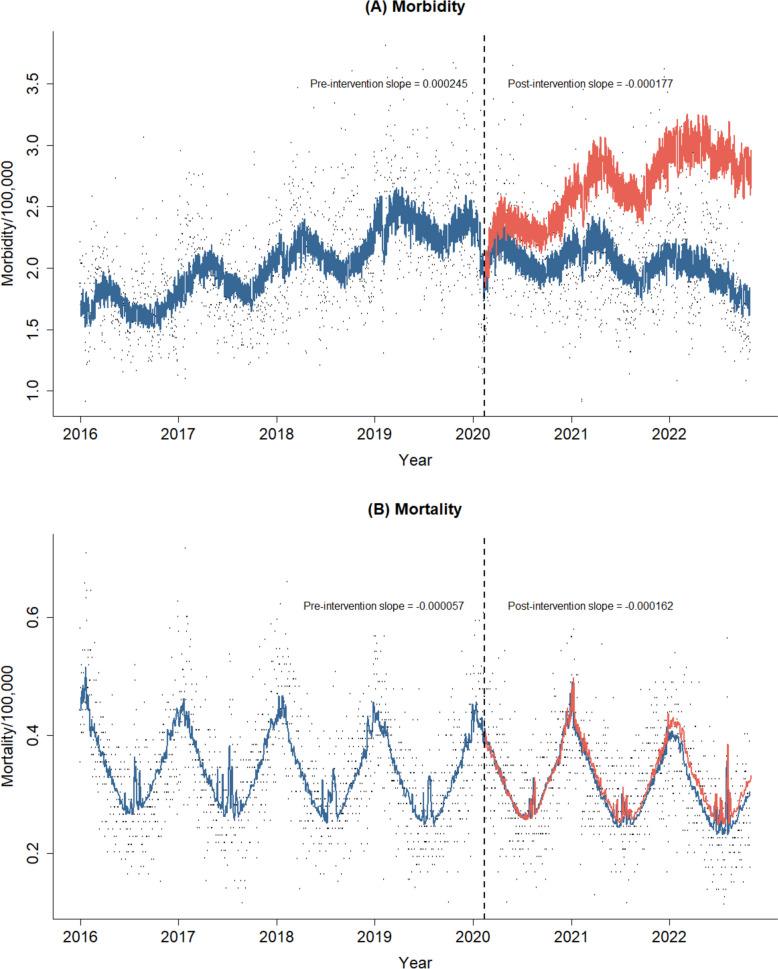
During the study period, 400,245 incident cases and 64,719 deaths of stroke were identified. Findings indicated a 5.5% (95% confidence interval (CI): 0.8%-10.0%) immediate and a 14.3% annual gradual (95% CI: 12.7%-15.8%) reduction were observed in stroke morbidity after the implementation of the regulations, which resulted in an overall reduction of 38.6% (95% CI: 34.1%-43.2%) within 33 months of follow-up. Similarly, there was the gradual decrease in stroke mortality. It resulted in an overall post-intervention decrease of 8.4% (95% CI, 1.6%-15.1%). The subgroup analyses indicated that overall post-regulation reductions in stroke morbidity were observed across all age groups, genders, and subtypes. However, the overall reduction in stroke mortality among male and those with hemorrhagic stroke was not statistically significant.
CONCLUSION
These findings have implications for policy makers and public health experts seeking to reduce burden of stroke morbidity and mortality at the population level through personal protection measure in regions with severe air pollution.
背景
通过佩戴口罩来保护人们免受空气污染很常见,但口罩对心血管疾病(CVD)的健康影响程度尚不清楚。本研究旨在确定口罩干预是否与中风发病率和死亡率的降低相关。
方法
我们进行了一项回顾性队列研究,纳入了2016年至2022年中国潍坊的780万居民。主要结局是每日中风发病率和死亡率。进行了中断时间序列分析,调整了潜在的长期趋势、季节模式、空气污染、气象因素、医疗服务利用情况和道路封锁情况,以评估实施口罩佩戴规定后中风发病率和死亡率的即时和逐渐变化。
结果
在研究期间,共确定了400245例中风发病病例和64719例中风死亡病例。研究结果表明,实施规定后,中风发病率立即降低了5.5%(95%置信区间(CI):0.8%-10.0%),每年逐渐降低14.3%(95%CI:12.7%-15.8%),在随访的33个月内总体降低了38.6%(95%CI:34.1%-43.2%)。同样,中风死亡率也逐渐下降。干预后总体下降了8.4%(95%CI,1.6%-15.1%)。亚组分析表明,在所有年龄组、性别和亚型中,规定实施后中风发病率总体均有所降低。然而,男性和出血性中风患者的中风死亡率总体降低在统计学上并不显著。
结论
这些发现对于寻求通过个人防护措施在空气污染严重地区降低人群中风发病率和死亡率负担的政策制定者和公共卫生专家具有启示意义。

 Zotero 插件