
电针与假电针对左侧结直肠癌腹腔镜手术后术后肠梗阻的影响:一项多中心、随机、假对照试验的研究方案
Effect of electroacupuncture versus sham electroacupuncture on postoperative ileus after laparoscopic surgery for left-sided colorectal cancer: study protocol for a multicentre, randomised, sham-controlled trial.
作者信息
Zhou Yan, Zhang Mingming, Yang Chen, Li Shu-Hao, Guixing Xu, Zihan Yin, Sun Ming-Sheng, Yang Jiao, Wang Yang-Yang, Dai Wei, He Yueyi, Han Lin, Lin Jie, Liang Fan-Rong, Liu Fang
机构信息
Chengdu University of Traditional Chinese Medicine, Chengdu, Sichuan Province, China.
Department of General Surgery, Sichuan University West China Hospital, Chengdu, Sichuan, China.
出版信息
BMJ Open. 2024 Dec 26;14(12):e086438. doi: 10.1136/bmjopen-2024-086438.
INTRODUCTION
Postoperative ileus (POI) is an inevitable complication after abdominal surgery, often hindering recovery and prolonging hospital stay. Despite the increasing use of electroacupuncture (EA) as an alternative treatment for gastrointestinal dysfunction, its effectiveness for POI is still controversial. This study aims to verify the efficacy and safety of EA in alleviating POI.
METHODS AND DESIGN
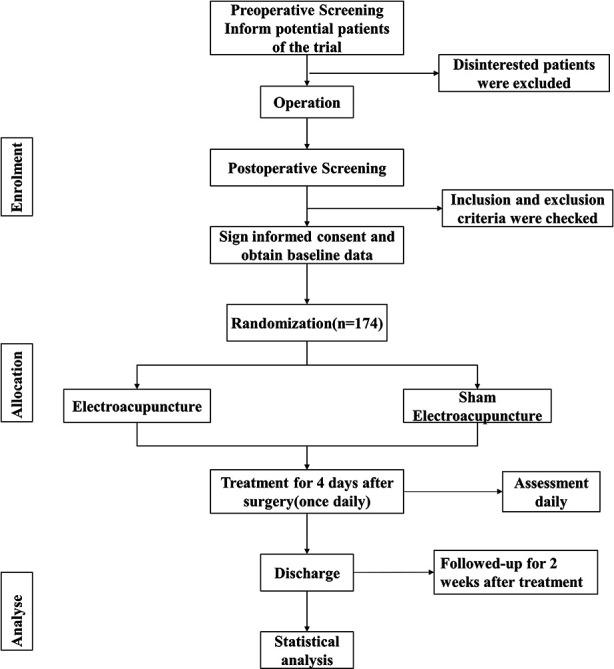
The study is a multicentre, randomised, sham-controlled trial. A total of 174 patients undergoing laparoscopic surgery for left-sided colorectal cancer will be randomly assigned to an EA group and a sham acupuncture group at a ratio of 1:1. Treatment for both groups will commence on the first day after the operation and continue once a day for four consecutive days. The primary outcome is time to first defecation. Secondary outcomes include time to first flatus, time to first tolerance to liquid and semiliquid diet, Functional Assessment of Cancer Therapy-Colorectal (FACT-C, V.4.0), postoperative nausea and vomiting, postoperative pain and abdominal distension, the Gastrointestinal Quality of Life Index, Self-Rating Depression Scale, Self-Rating Anxiety Scale, Gastrointestinal Symptom Rating Scale, length of the postoperative hospital stay, time to first postoperative ambulation, evaluation of the expected value of acupuncture, and satisfaction evaluation.
ETHICS AND DISSEMINATION
The results will be disseminated through peer-reviewed publications. This study protocol (V.2.0, 1 October 2023) involves human participants and has been approved by the Ethics Committee of Sichuan Cancer Hospital (number KY-2023-041-01), Meishan Hospital of Traditional Chinese Medicine (number 2024LC001) and The Seventh People's Hospital of Chengdu (number KY2024-001-01). Each individual who agrees to participate in the research will provide written informed consent after the objectives and procedures of this study are explained to them.
TRIAL REGISTRATION NUMBER
ChiCTR2400079645. Registered on 8 January 2024.
引言
术后肠梗阻(POI)是腹部手术后不可避免的并发症,常常阻碍康复并延长住院时间。尽管电针(EA)作为胃肠功能障碍的替代治疗方法的应用越来越广泛,但其对POI的有效性仍存在争议。本研究旨在验证EA缓解POI的疗效和安全性。
方法与设计
本研究为多中心、随机、假针刺对照试验。总共174例接受腹腔镜手术治疗左侧结直肠癌的患者将按1:1的比例随机分配至EA组和假针刺组。两组治疗均在术后第一天开始,连续四天每天进行一次。主要结局是首次排便时间。次要结局包括首次排气时间、首次耐受流食和半流食时间、癌症治疗功能评估-结直肠癌(FACT-C,V.4.0)、术后恶心呕吐、术后疼痛和腹胀、胃肠道生活质量指数、自评抑郁量表、自评焦虑量表、胃肠道症状评定量表、术后住院时间、首次术后下床活动时间、针刺期望值评估和满意度评估。
伦理与传播
研究结果将通过同行评审出版物进行传播。本研究方案(V.2.0,2023年10月1日)涉及人类受试者,已获得四川省肿瘤医院伦理委员会(编号KY-2023-041-01)、眉山市中医医院伦理委员会(编号2024LC001)和成都市第七人民医院伦理委员会(编号KY2024-001-01)的批准。每位同意参与研究的个体在向其解释本研究的目的和程序后将提供书面知情同意书。
试验注册号
ChiCTR2400079645。于2024年1月8日注册。

 Zotero 插件