
基于疾病网络的心力衰竭共病研究方法:现状与未来展望
Disease Network-Based Approaches to Study Comorbidity in Heart Failure: Current State and Future Perspectives.
作者信息
Gomez-Ochoa Sergio Alejandro, Lanzer Jan D, Levinson Rebecca T
机构信息
Department of General Internal Medicine and Psychosomatics, Heidelberg University Hospital, Im Neuenheimer Feld 410, 69120, Heidelberg, Germany.
Institute for Computational Biomedicine, Faculty of Medicine, Heidelberg University, Heidelberg University Hospital, Heidelberg, Germany.
出版信息
Curr Heart Fail Rep. 2024 Dec 27;22(1):6. doi: 10.1007/s11897-024-00693-7.
PURPOSE OF REVIEW
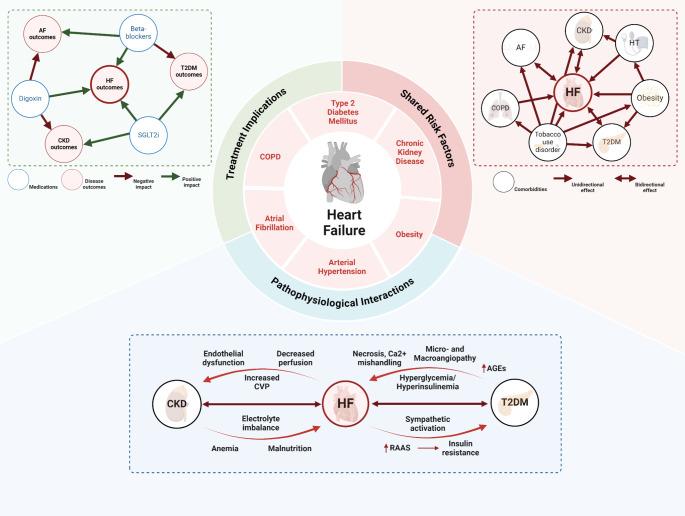
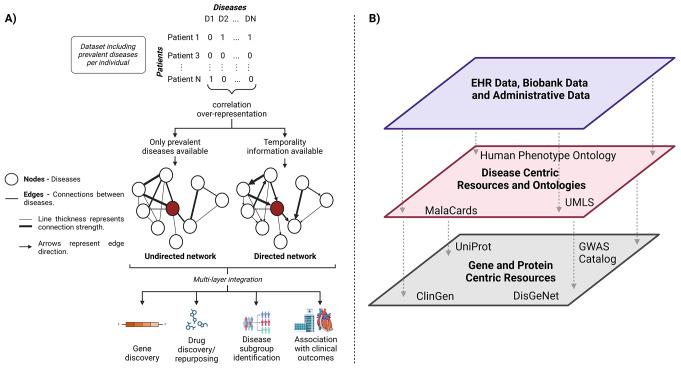
Heart failure (HF) is often accompanied by a constellation of comorbidities, leading to diverse patient presentations and clinical trajectories. While traditional methods have provided valuable insights into our understanding of HF, network medicine approaches seek to leverage these complex relationships by analyzing disease at a systems level. This review introduces the concepts of network medicine and explores the use of comorbidity networks to study HF and heart disease.
RECENT FINDINGS
Comorbidity networks are used to understand disease trajectories, predict outcomes, and uncover potential molecular mechanisms through identification of genes and pathways relevant to comorbidity. These networks have shown the importance of non-cardiovascular comorbidities to the clinical journey of patients with HF. However, the community should be aware of important limitations in developing and implementing these methods. Network approaches hold promise for unraveling the impact of comorbidities in the complex presentation and genetics of HF. Methods that consider comorbidity presence and timing have the potential to help optimize management strategies and identify pathophysiological mechanisms.
综述目的
心力衰竭(HF)常伴有一系列合并症,导致患者表现多样且临床病程各异。虽然传统方法为我们理解HF提供了有价值的见解,但网络医学方法试图通过在系统层面分析疾病来利用这些复杂关系。本综述介绍网络医学的概念,并探讨使用合并症网络来研究HF和心脏病。
最新发现
合并症网络用于通过识别与合并症相关的基因和通路来理解疾病轨迹、预测结局并揭示潜在分子机制。这些网络已显示非心血管合并症对HF患者临床病程的重要性。然而,学界应意识到在开发和实施这些方法时存在的重要局限性。网络方法有望阐明合并症在HF复杂表现和遗传学中的影响。考虑合并症存在情况和发生时间的方法有可能帮助优化管理策略并识别病理生理机制。

 Zotero 插件