
基于气体生成反应的免疫分析概述。
Overview of Gas-Generating-Reaction-Based Immunoassays.
作者信息
Yu Zhao-Jiang, Deng De-Hua, Liang Si-Rui, Huang Ya-Liang, Yi Xin-Yao
机构信息
College of Chemistry and Chemical Engineering, Anyang Normal University, Anyang 455000, China.
School of Pharmacy, Hunan University of Chinese Medicine, Changsha 410208, China.
出版信息
Biosensors (Basel). 2024 Nov 28;14(12):580. doi: 10.3390/bios14120580.
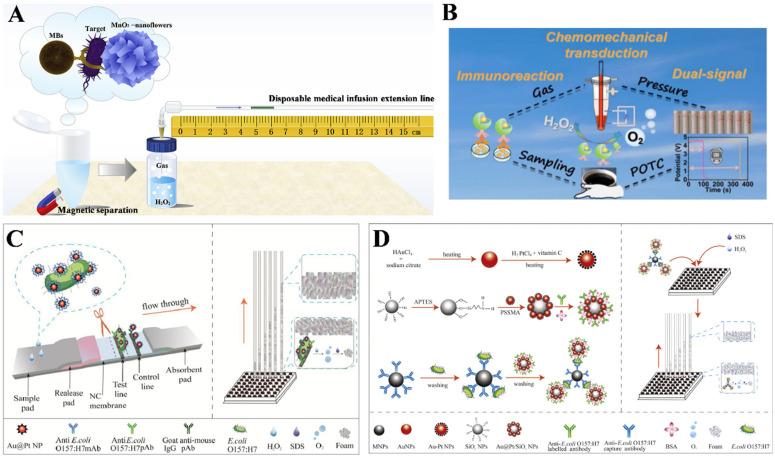
Point-of-care (POC) immunoassays have become convincing alternatives to traditional immunosensing methods for the sensitive and real-time detection of targets. Immunoassays based on gas-generating reactions were recently developed and have been used in various fields due to their advantages, such as rapid measurement, direct reading, simple operation, and low cost. Enzymes or nanoparticles modified with antibodies can effectively catalyze gas-generating reactions and convert immunorecognition events into gas pressure signals, which can be easily recorded by multifunctional portable devices. This article summarizes the advances in gas-generating-reaction-based immunoassays, according to different types of signal output systems, including distance-based readout, pressure differential, visualized detection, and thermal measurement. The review mainly focuses on the role of photothermal materials and the working principle of immunoassays. In addition, the challenges and prospects for the future development of gas-generating-reaction-based immunoassays are briefly discussed.
即时检测(POC)免疫测定法已成为传统免疫传感方法的有力替代方案,用于目标物的灵敏和实时检测。基于气体生成反应的免疫测定法最近得到了发展,由于其具有测量快速、直接读数、操作简单和成本低等优点,已在各个领域得到应用。用抗体修饰的酶或纳米颗粒可以有效地催化气体生成反应,并将免疫识别事件转化为气压信号,这些信号可以很容易地被多功能便携式设备记录下来。本文根据不同类型的信号输出系统,包括基于距离的读数、压差、可视化检测和热测量,总结了基于气体生成反应的免疫测定法的进展。该综述主要关注光热材料的作用和免疫测定法的工作原理。此外,还简要讨论了基于气体生成反应的免疫测定法未来发展面临的挑战和前景。


 Zotero 插件