
腹主动脉瘤治疗中个性化医疗的新趋势:综述
New Trends of Personalized Medicine in the Management of Abdominal Aortic Aneurysm: A Review.
作者信息
Alsabbagh Yaman, Erben Young, Vandenberg Jonathan, Farres Houssam
机构信息
Division of Vascular and Endovascular Surgery, Mayo Clinic, Jacksonville, FL 32224, USA.
出版信息
J Pers Med. 2024 Dec 10;14(12):1148. doi: 10.3390/jpm14121148.
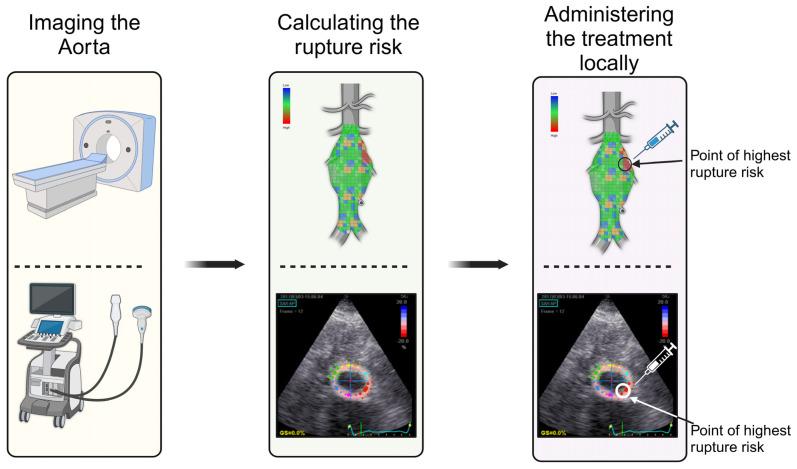
Abdominal aortic aneurysm (AAA) is a significant vascular condition characterized by the dilation of the abdominal aorta, presenting a substantial risk of rupture and associated high mortality rates. Current management strategies primarily rely on aneurysm diameter and growth rates to predict rupture risk and determine the timing of surgical intervention. However, this approach has limitations, as ruptures can occur in smaller AAAs below surgical thresholds, and many large AAAs remain stable without intervention. This review highlights the need for more precise and individualized assessment tools that integrate biomechanical parameters such as wall stress, wall strength, and hemodynamic factors. Advancements in imaging modalities like ultrasound elastography, computed tomography (CT) angiography, and magnetic resonance imaging (MRI), combined with artificial intelligence, offer enhanced capabilities to assess biomechanical indices and predict rupture risk more accurately. Incorporating these technologies can lead to personalized medicine approaches, improving decision-making regarding the timing of interventions. Additionally, emerging treatments focusing on targeted delivery of therapeutics to weakened areas of the aortic wall, such as nanoparticle-based drug delivery, stem cell therapy, and gene editing techniques like CRISPR-Cas9, show promise in strengthening the aortic wall and halting aneurysm progression. By validating advanced screening modalities and developing targeted treatments, the future management of AAA aims to reduce unnecessary surgeries, prevent ruptures, and significantly improve patient outcomes.
腹主动脉瘤(AAA)是一种严重的血管疾病,其特征为腹主动脉扩张,具有很高的破裂风险和相关的高死亡率。目前的管理策略主要依靠动脉瘤直径和生长速度来预测破裂风险并确定手术干预时机。然而,这种方法存在局限性,因为低于手术阈值的较小腹主动脉瘤也可能破裂,而且许多大的腹主动脉瘤未经干预仍保持稳定。本综述强调需要更精确和个性化的评估工具,这些工具应整合诸如壁应力、壁强度和血流动力学因素等生物力学参数。超声弹性成像、计算机断层扫描(CT)血管造影和磁共振成像(MRI)等成像模态的进展,结合人工智能,提供了更强的能力来评估生物力学指标并更准确地预测破裂风险。纳入这些技术可导致个性化医疗方法,改善关于干预时机的决策。此外,专注于将治疗剂靶向递送至主动脉壁薄弱区域的新兴治疗方法,如基于纳米颗粒的药物递送、干细胞疗法以及CRISPR-Cas9等基因编辑技术,在强化主动脉壁和阻止动脉瘤进展方面显示出前景。通过验证先进的筛查模态并开发靶向治疗方法,腹主动脉瘤的未来管理旨在减少不必要的手术、预防破裂并显著改善患者预后。

 Zotero 插件