
基于网络的被动监测:孟加拉国索纳利鸡疾病及抗菌药物处方模式的多因素评估
Web-Based Passive Surveillance: Multifactorial Assessment of Sonali Chicken Diseases and Antimicrobial Prescription Pattern in Bangladesh.
作者信息
Khalil Ibrahim, Sayeed Md Abu, Sarkar Mitun, Islam Md Nurul, Osmani Mozaffar G, Islam Meherjan, Chowdhury Sharmin, Mohsin Md Abu Shoieb, Hoque Md Ahasanul
机构信息
Department of Livestock Services, Ministry of Fisheries and Livestock, Dhaka 1215, Bangladesh.
National Centre for Epidemiology and Population Health (NCEPH), College of Health and Medicine, The Australian National University, Canberra, ACT 2601, Australia.
出版信息
Vet Sci. 2024 Dec 17;11(12):662. doi: 10.3390/vetsci11120662.
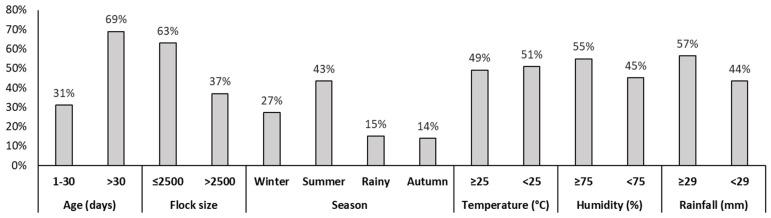
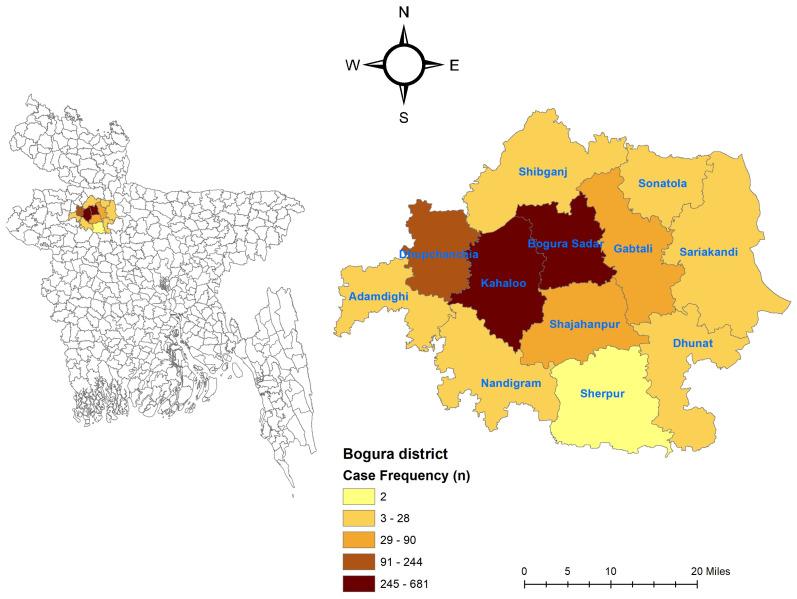
Despite the significant growth in Sonali chicken production across Bangladesh, inadequate disease surveillance and control measures along with indiscriminate antimicrobial use remain major challenges to the sector. In this study, we evaluated the disease burden and antimicrobial prescription patterns of Sonali chickens in Bangladesh using a web-based data recording system from 2020 to 2021 and analyzed 1690 cases. The diagnoses recorded in the system were presumptive, as they were based on clinico-epidemiological history, clinical signs, and gross necropsy findings noted by registered veterinarians. We conducted this study in Bogura, a district renowned for its high concentration of Sonali chicken farms. We estimated a higher prevalence of infection among grower chickens (69.0%) compared to starter chickens (31.0%). Small- to medium-sized flocks (63%) were more frequently infected than larger flocks (37.0%). Most disease cases occurred during the summer season (43.0%), followed by winter (27%), the rainy season (15%), and autumn (14%). Overall, climatic factors contributed to 51% of disease occurrence at temperatures below 25°C, 55% at high humidity (≥75%), and 57% during heavy rainfall (≥29 mm). The most prevalent disease was Newcastle disease (ND) (19.5%), followed by Marek's disease (9.8%), coccidiosis (7.4%), necrotic enteritis (4.7%), infectious bursal disease (3.2%), and infectious laryngotracheitis (3.2%). The odds of ND were 1.4 (grower chickens vs. starter chickens), 11.4 (summer vs. winter), 4.1 (autumn vs. winter), 3.9 (rainy vs. winter), 3.5 (≥25 °C vs. <25 °C), and 2.6 (≥75% vs. <75%). Tylvalosin (38.0%) was the most frequently prescribed antibiotic, followed by fluoroquinolones (9.0%), aminoglycosides (8.0%), and colistin sulphate (4.0%). These findings suggest that a web-based disease record could be an important tool for a centralized poultry disease surveillance system in low- and middle-income countries like Bangladesh.
尽管孟加拉国索纳利鸡的产量显著增长,但疾病监测和控制措施不足以及抗菌药物的滥用仍然是该行业面临的主要挑战。在本研究中,我们使用基于网络的数据记录系统,对2020年至2021年孟加拉国索纳利鸡的疾病负担和抗菌药物处方模式进行了评估,并分析了1690个病例。系统中记录的诊断是推测性的,因为它们基于临床流行病学病史、临床症状以及注册兽医记录的大体剖检结果。我们在博古拉进行了这项研究,该地区以索纳利鸡养殖场高度集中而闻名。我们估计,与雏鸡(31.0%)相比,育成鸡的感染率更高(69.0%)。中小型鸡群(63%)比大型鸡群(37.0%)更容易感染。大多数疾病病例发生在夏季(43.0%),其次是冬季(27%)、雨季(15%)和秋季(14%)。总体而言,气候因素导致在温度低于25°C时疾病发生率为51%,在高湿度(≥75%)时为55%,在强降雨(≥29毫米)时为57%。最常见的疾病是新城疫(ND)(19.5%),其次是马立克氏病(9.8%)、球虫病(7.4%)、坏死性肠炎(4.7%)、传染性法氏囊病(3.2%)和传染性喉气管炎(3.2%)。患新城疫的几率为1.4(育成鸡与雏鸡相比)、11.4(夏季与冬季相比)、4.1(秋季与冬季相比)、3.9(雨季与冬季相比)、3.5(≥25°C与<25°C相比)和2.6(≥75%与<75%相比)。泰万菌素(38.0%)是最常使用的抗生素,其次是氟喹诺酮类(9.0%)、氨基糖苷类(8.0%)和硫酸黏菌素(4.0%)。这些发现表明,基于网络的疾病记录可能是孟加拉国等低收入和中等收入国家集中式家禽疾病监测系统的重要工具。
 Zotero 插件