
脂尾等位基因特异性表达基因可能影响绵羊尾部脂肪沉积。
Fat-tail allele-specific expression genes may affect fat deposition in tail of sheep.
作者信息
Mansourizadeh Hossein, Bakhtiarizadeh Mohammad Reza, de Almeida Regitano Luciana Correia, Bruscadin Jennifer Jessica
机构信息
Department of Animal and Poultry Science, College of Aburaihan, University of Tehran, Tehran, Iran.
Embrapa Southeast Livestock, São Carlos, Brazil.
出版信息
PLoS One. 2024 Dec 27;19(12):e0316046. doi: 10.1371/journal.pone.0316046. eCollection 2024.
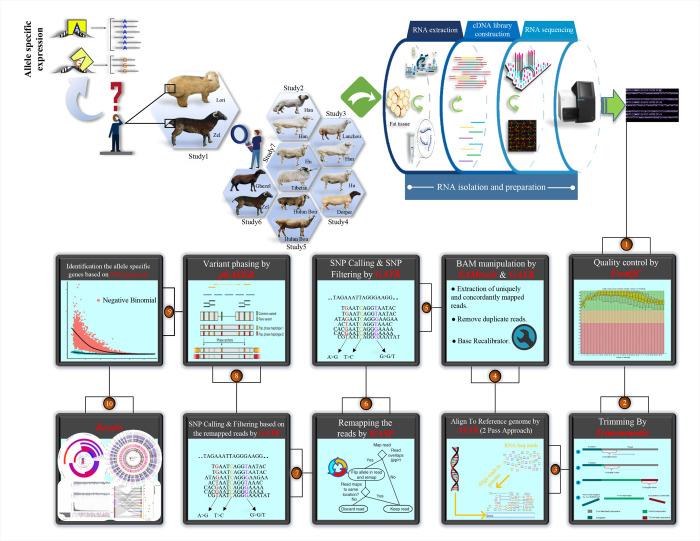
Different sheep breeds show distinct phenotypic plasticity in fat deposition in the tails. The genetic background underlying fat deposition in the tail of sheep is complex, multifactorial, and may involve allele-specific expression (ASE) mechanism to modulate allelic expression. ASE is a common phenomenon in mammals and refers to allelic imbalanced expression modified by cis-regulatory genetic variants that can be observed at heterozygous loci. Therefore, regulatory processes behind the fat-tail formation in sheep may be to some extent explained by cis- regulatory variants, through ASE mechanism, which was investigated in the present study. An RNA-Seq-based variant calling was applied to perform genome-wide survey of ASE genes using 45 samples from seven independent studies comparing the transcriptome of fat-tail tissue between fat- and thin-tailed sheep breeds. Using a rigorous computational pipeline, 115 differential ASE genes were identified, which were narrowed down to four genes (LPL, SOD3, TCP1 and LRPAP1) for being detected in at least two studies. Functional analysis revealed that the ASE genes were mainly involved in fat metabolism. Of these, LPL was of greater importance, as 1) observed in five studies, 2) reported as ASE gene in the previous studies and 3) with a known role in fat deposition. Our findings implied that complex physiological traits, like fat-tail formation, can be better explained by considering various genetic mechanisms, which can be more finely mapped through ASE analyses. The insights gained in this study indicate that biallelic expression may not be a common mechanism in sheep fat-tail development. Hence, allelic imbalance of the fat deposition-related genes can be considered a novel layer of information for future research on genetic improvement and increased efficiency in sheep breeding programs.
不同绵羊品种在尾部脂肪沉积方面表现出明显的表型可塑性。绵羊尾部脂肪沉积的遗传背景复杂、多因素,可能涉及等位基因特异性表达(ASE)机制来调节等位基因表达。ASE是哺乳动物中的常见现象,指由顺式调控遗传变异修饰的等位基因表达失衡,可在杂合位点观察到。因此,本研究通过ASE机制,对绵羊肥尾形成背后的调控过程在一定程度上可由顺式调控变异来解释进行了研究。应用基于RNA测序的变异检测方法,对来自7项独立研究的45个样本进行ASE基因的全基因组调查,这些研究比较了肥尾和瘦尾绵羊品种的肥尾组织转录组。通过严格的计算流程,鉴定出115个差异ASE基因,经筛选后确定了4个基因(LPL、SOD3、TCP1和LRPAP1)在至少两项研究中被检测到。功能分析表明,这些ASE基因主要参与脂肪代谢。其中,LPL更为重要,原因如下:1)在5项研究中被观察到;2)在先前研究中被报道为ASE基因;3)在脂肪沉积中具有已知作用。我们的研究结果表明,像肥尾形成这样复杂的生理性状,通过考虑各种遗传机制可以得到更好的解释,而通过ASE分析可以更精细地定位这些机制。本研究获得的见解表明,双等位基因表达可能不是绵羊肥尾发育的常见机制。因此,与脂肪沉积相关基因的等位基因失衡可被视为绵羊育种计划中未来遗传改良和提高效率研究的新信息层面。



 Zotero 插件