
血管重塑中血管平滑肌和内皮细胞的钙信号传导:综述
Ca signaling in vascular smooth muscle and endothelial cells in blood vessel remodeling: a review.
作者信息
Suzuki Yoshiaki, Giles Wayne R, Zamponi Gerald W, Kondo Rubii, Imaizumi Yuji, Yamamura Hisao
机构信息
Department of Molecular and Cellular Pharmacology, Graduate School of Pharmaceutical Sciences, Nagoya City University, Nagoya, 467-8603, Japan.
Department of Physiology & Pharmacology, Cumming School of Medicine, University of Calgary, Calgary, AB, T2N 4N1, Canada.
出版信息
Inflamm Regen. 2024 Dec 27;44(1):50. doi: 10.1186/s41232-024-00363-0.
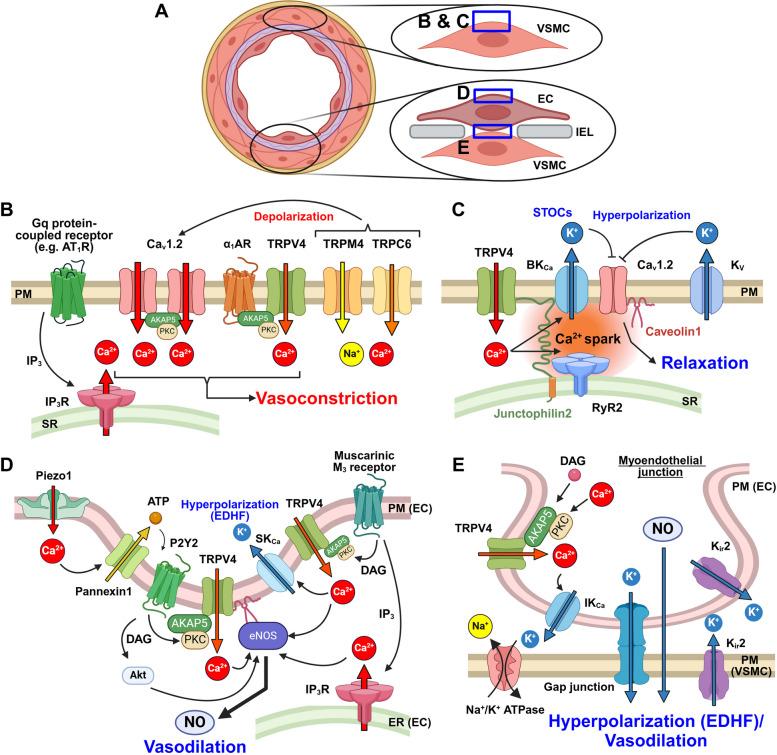
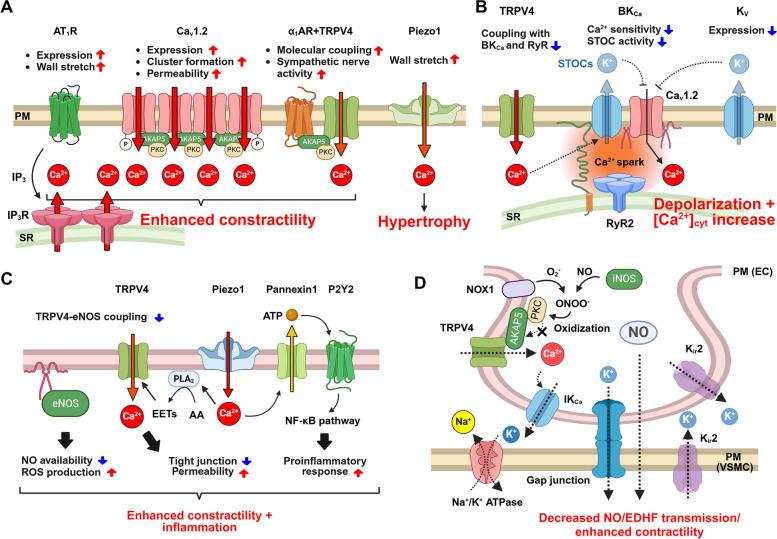
Vascular smooth muscle cells (VSMCs) and endothelial cells (ECs) act together to regulate blood pressure and systemic blood flow by appropriately adjusting blood vessel diameter in response to biochemical or biomechanical stimuli. Ion channels that are expressed in these cells regulate membrane potential and cytosolic Ca concentration ([Ca]) in response to such stimuli. The subsets of these ion channels involved in Ca signaling often form molecular complexes with intracellular molecules via scaffolding proteins. This allows Ca signaling to be tightly controlled in localized areas within the cell, resulting in a balanced vascular tone. When hypertensive stimuli are applied to blood vessels for extended periods, gene expression in these vascular cells can change dramatically. For example, alteration in ion channel expression often induces electrical remodeling that produces a depolarization of the membrane potential and elevated [Ca]. Coupled with endothelial dysfunction blood vessels undergo functional remodeling characterized by enhanced vasoconstriction. In addition, pathological challenges to vascular cells can induce inflammatory gene products that may promote leukocyte infiltration, in part through Ca-dependent pathways. Macrophages accumulating in the vascular adventitia promote fibrosis through extracellular matrix turnover, and cause structural remodeling of blood vessels. This functional and structural remodeling often leads to chronic hypertension affecting not only blood vessels, but also multiple organs including the brain, kidneys, and heart, thus increasing the risk of severe cardiovascular events. In this review, we outline recent advances in multidisciplinary research concerning Ca signaling in VSMCs and ECs, with an emphasis on the mechanisms underlying functional and structural vascular remodeling.
血管平滑肌细胞(VSMCs)和内皮细胞(ECs)共同作用,通过响应生化或生物力学刺激适当地调节血管直径来调控血压和全身血流。这些细胞中表达的离子通道响应此类刺激调节膜电位和胞质钙浓度([Ca])。参与钙信号传导的这些离子通道亚群通常通过支架蛋白与细胞内分子形成分子复合物。这使得钙信号在细胞内的局部区域受到严格控制,从而产生平衡的血管张力。当高血压刺激长时间作用于血管时,这些血管细胞中的基因表达会发生显著变化。例如,离子通道表达的改变常常诱导电重构,导致膜电位去极化和[Ca]升高。再加上内皮功能障碍,血管会经历以血管收缩增强为特征的功能重构。此外,对血管细胞的病理刺激可诱导炎症基因产物,部分通过钙依赖途径促进白细胞浸润。积聚在血管外膜的巨噬细胞通过细胞外基质周转促进纤维化,并导致血管结构重构。这种功能和结构重构常常导致慢性高血压,不仅影响血管,还影响包括脑、肾和心脏在内的多个器官,从而增加严重心血管事件的风险。在本综述中,我们概述了关于VSMCs和ECs中钙信号传导的多学科研究的最新进展,重点是血管功能和结构重构的潜在机制。


 Zotero 插件