
抗精神病药物停药后精神分裂症患者功能缓解的预测(FURSAD):一项真实世界病例对照研究的方案
Prediction of functional remission in patients with schizophrenia after antipsychotic discontinuation (FURSAD): protocol for a real-world case-control study.
作者信息
Lu Chang, Dong Yuke, Zhai Zhaolin, Gao Tianhao, Luo Mengyi, Feng Tienan, Ma Xiangyi, Chang Di, Chen Jing, Xue Jingxin, Zhao Yuqing, Li Xuan, Shao Chunhong, Liu Dengtang
机构信息
Huashan Hospital Fudan University, Shanghai, China.
Shanghai Mental Health Center, Shanghai, China.
出版信息
BMJ Open. 2024 Dec 27;14(12):e087645. doi: 10.1136/bmjopen-2024-087645.
INTRODUCTION
Although maintenance treatment is recommended for the prevention of relapse, in real-world settings, a subset of patients discontinue antipsychotics while having a good prognosis. The prediction of functional remission in patients with schizophrenia after antipsychotic discontinuation (FURSAD) study aims to obtain real-world knowledge regarding the characteristics of schizophrenia (SCZ) patients who achieve functional remission after antipsychotic discontinuation for 1 year or more. This study also aims to establish a prediction model to identify patients likely to benefit from antipsychotic discontinuation.
METHODS AND ANALYSIS
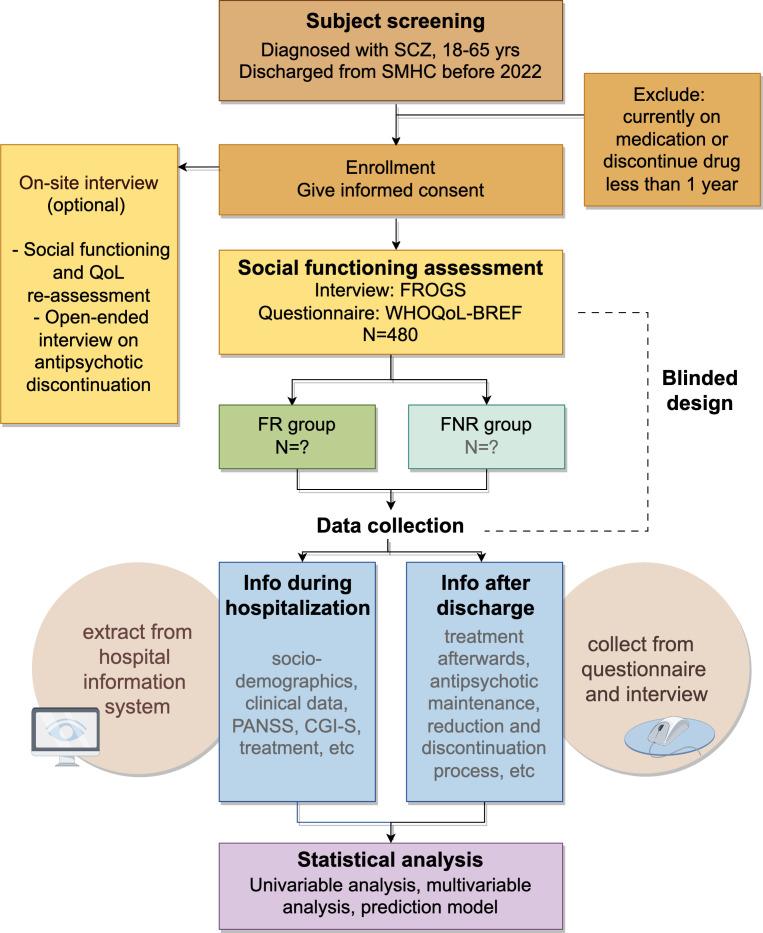
The FURSAD study employs a real-world case-control design. Researchers will first screen patients with a diagnosis of SCZ (ICD-10) from the Shanghai Mental Health Center discharged patient pool to identify 480 participants who have been off-antipsychotic for at least 1 year. They will be assigned to the functional remission group or the functional non-remission group according to their social functioning assessment scores, including the self-assessment questionnaire WHO Quality of Life abbreviated version (WHOQoL-BREF) and the peer-assessment scale Functional Remission of General Schizophrenia (FROGS) Scale. Sociodemographic, symptom and treatment information of participants during their hospitalisation and after discharge will be extracted from the Hospital Information System and collected via interviews, respectively, to find independent variables for good prognosis after antipsychotic discontinuation. A nomogram will visualise the prediction model results to help psychiatrists make decisions.
ETHICS AND DISSEMINATION
Full ethical approval for the study (study design, data acquisition license and informed consent) was granted by the ethics committee at Shanghai Mental Health Center, Shanghai, China (approval letter number: 2022-59). The findings of the FURSAD study will be published in peer-reviewed journals or disseminated in conference presentations.
TRIAL REGISTRATION NUMBER
NCT05667961.
引言
尽管推荐进行维持治疗以预防复发,但在现实环境中,一部分患者在预后良好的情况下停用了抗精神病药物。抗精神病药物停用后精神分裂症患者功能缓解预测(FURSAD)研究旨在获取关于在停用抗精神病药物1年或更长时间后实现功能缓解的精神分裂症(SCZ)患者特征的真实世界知识。本研究还旨在建立一个预测模型,以识别可能从停用抗精神病药物中获益的患者。
方法与分析
FURSAD研究采用现实世界病例对照设计。研究人员将首先从上海市精神卫生中心出院患者库中筛选出诊断为SCZ(ICD - 10)的患者,以确定480名停用抗精神病药物至少1年的参与者。根据他们的社会功能评估得分,包括自我评估问卷世界卫生组织生活质量简表(WHOQoL - BREF)和同伴评估量表精神分裂症总体功能缓解(FROGS)量表,将他们分配到功能缓解组或功能未缓解组。参与者住院期间和出院后的社会人口统计学、症状和治疗信息将分别从医院信息系统中提取并通过访谈收集,以找出停用抗精神病药物后预后良好的独立变量。列线图将直观显示预测模型结果,以帮助精神科医生做出决策。
伦理与传播
本研究(研究设计、数据采集许可和知情同意)已获得中国上海上海市精神卫生中心伦理委员会的全面伦理批准(批准文号:2022 - 59)。FURSAD研究的结果将发表在同行评审期刊上或在会议报告中传播。
试验注册号
NCT05667961。
 Zotero 插件