
印度人群遗传性乳腺癌和卵巢癌BRCA1/2基因的突变谱分析
Mutation Spectrum Analysis of BRCA1/2 Genes for Hereditary Breast and Ovarian Cancer in the Indian Population.
作者信息
Lila Kunjal, Bhanushali Harshita, Chanekar MIlind, Jatale Raj, Banerjee Monisha, Dixit Rakhi Bajpai, Rajadhyaksha Aparna, Chadha Kirti
机构信息
Department of Surgical Pathology and Molecular Biology, Global Reference Laboratory, Metropolis Healthcare Limited, Vidyavihar, Mumbai, Maharashtra, India.
出版信息
Asian Pac J Cancer Prev. 2024 Dec 1;25(12):4145-4151. doi: 10.31557/APJCP.2024.25.12.4145.
OBJECTIVE
The objective of this study was to determine the prevalence and spectrum of genetic mutations linked to inherited breast and ovary cancer (HBOC) in the Indian population, and to evaluate the correlation of BRCA mutation types, frequency, and incidence with age, gender, and personal and family history.
METHODS
A retrospective cohort of 500 Indian HBOC patients, meeting NCCN criteria who underwent BRCA1/2 testing from 2017 to 2023 were shortlisted for this study. The anonymized data was retrieved from medical records. Genetic analysis was conducted using Next Generation Sequencing (NGS) on the Thermo Ion GeneStudio™ S5 System, with positive mutations confirmed via Sanger sequencing. Peripheral blood samples were processed for DNA extraction, library preparation, and variant classification following ACMG guidelines.
RESULTS
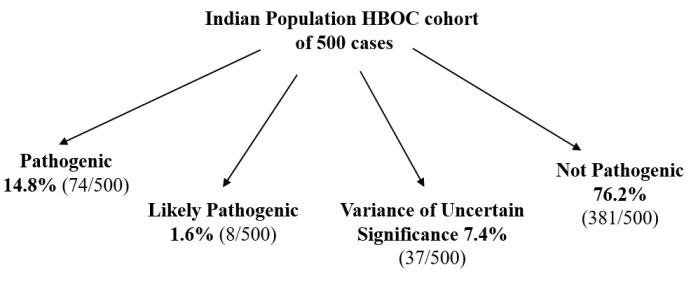
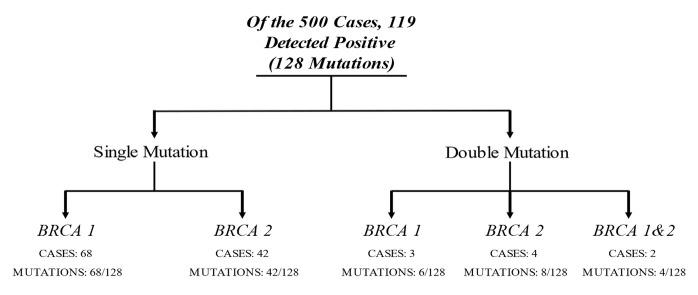
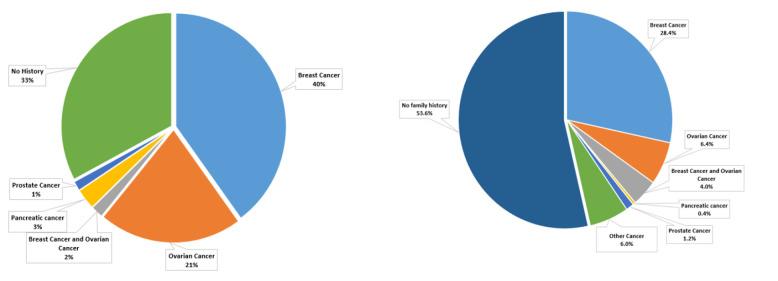
Out of the 500 patients, 119 (23.8%) were positive for BRCA mutations, and 381 (76.2%) were negative. The prevalence of BRCA pathogenesis, likely pathogenicity, and variants of uncertain significance (VUSs) were 14.8%, 1.6%, and 7.4%, respectively. A total of 128 mutations were detected in the positive BRCA1/2 patients. A statistically significant correlation was found between BRCA mutations with the patient and family history. A total of 38.8% of the patients with mutations had a family history of BC, OC or BC/OC, while 7.6% had other cancers. BRCA mutations were predominant (26.2%) in the age group of 46-65 Y. Among the 128 mutations, 59.3% (76/128) and 40.6% (52/12) of the patients had mutations in BRCA1 and BRCA2, respectively. Missense mutations were the most common in both the BRCA1 (30.26%) and BRCA2 (55.77%) genes, followed by frameshift (22.3%) and nonsense (17.3%) mutations in BRCA1 and BRCA2, respectively.
CONCLUSION
BRCA positivity was detected in 23.8% of the patients. A statistically significant association was shown between BRCA mutations and patient and family history.
目的
本研究的目的是确定印度人群中与遗传性乳腺癌和卵巢癌(HBOC)相关的基因突变的患病率和谱系,并评估BRCA突变类型、频率以及发病率与年龄、性别、个人及家族病史之间的相关性。
方法
本研究从2017年至2023年接受BRCA1/2检测且符合美国国立综合癌症网络(NCCN)标准的500例印度HBOC患者的回顾性队列中进行筛选。从病历中检索匿名数据。使用赛默飞世尔科技Ion GeneStudio™ S5系统通过下一代测序(NGS)进行基因分析,并通过桑格测序确认阳性突变。按照美国医学遗传学与基因组学学会(ACMG)指南对周边血样进行DNA提取、文库制备和变异分类处理。
结果
在500例患者中,119例(23.8%)BRCA突变呈阳性,381例(76.2%)呈阴性。BRCA致病、可能致病及意义未明变异(VUS)的患病率分别为14.8%、1.6%和7.4%。在BRCA1/2阳性患者中共检测到128个突变。BRCA突变与患者及家族病史之间存在统计学显著相关性。共有38.8%的突变患者有乳腺癌、卵巢癌或乳腺癌/卵巢癌家族史,而7.6%有其他癌症家族史。BRCA突变在46 - 65岁年龄组中占主导(26.2%)。在这128个突变中,分别有59.3%(76/128)和40.6%(52/128)的患者BRCA1和BRCA2发生突变。错义突变在BRCA1(30.26%)和BRCA2(55.77%)基因中最为常见,其次是BRCA1中的移码突变(22.3%)和无义突变(17.3%)以及BRCA2中的移码突变(22.3%)和无义突变(17.3%)。
结论
23.8%的患者检测到BRCA阳性。BRCA突变与患者及家族病史之间存在统计学显著关联。

 Zotero 插件