
基于人乳头瘤病毒整合状态的宫颈癌初筛风险评估与分诊策略:一项前瞻性队列研究的5年随访
Risk assessment and triage strategy of cervical cancer primary screening on HPV integration status: 5-year follow-up of a prospective cohort study.
作者信息
Tian Xun, Weng Danhui, Chen Ye, Wang Yi, Li Xiao, Wang Xin, Cao Chen, Gong Danni, Zeng Zhen, Wu Qiongyan, Wang Xueqian, Wu Peng, Fan Lu, Zhang Qinghua, Wang Hui, Hu Zheng, Cheng Xiaodong, Ma Ding
机构信息
Department of Gynecological Oncology, Tongji Hospital, Tongji Medical College, Huazhong University of Science and Technology, Wuhan, China.
National Clinical Research Center for Obstetrics and Gynecology, Cancer Biology Research Center (Key Laboratory of the Ministry of Education), Tongji Hospital, Tongji Medical College, Huazhong University of Science and Technology, Wuhan, China.
出版信息
J Natl Cancer Cent. 2024 Oct 16;4(4):311-317. doi: 10.1016/j.jncc.2024.08.001. eCollection 2024 Dec.
OBJECTIVE
We investigated the relation between man papillomavirus (HPV) integration status and the immediate risk of cervical intraepithelial neoplasia (CIN), as well as the triage strategy based on HPV integration test.
METHODS
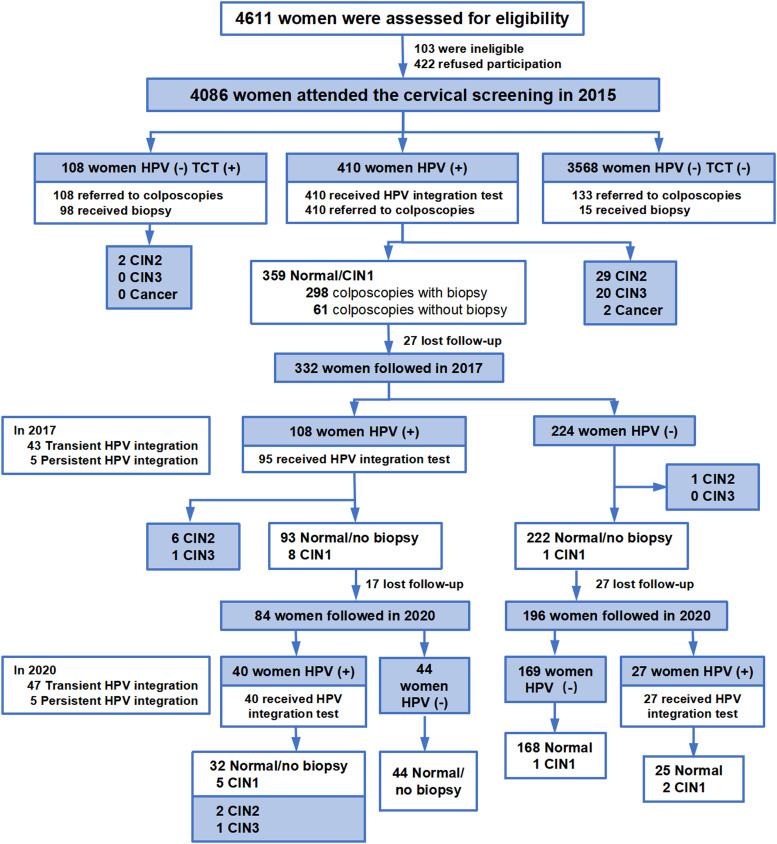
4086 women aged 20 to 65 years in China were enrolled in 2015 for a prospective, population-based, clinical observational study to evaluate the triage performance of HPV integration. Cervical exfoliated cells were collected for HPV testing and cytologic test. If high-risk HPV was positive, HPV integration test was performed at baseline, 2-year and 5-year follow-up.
RESULTS
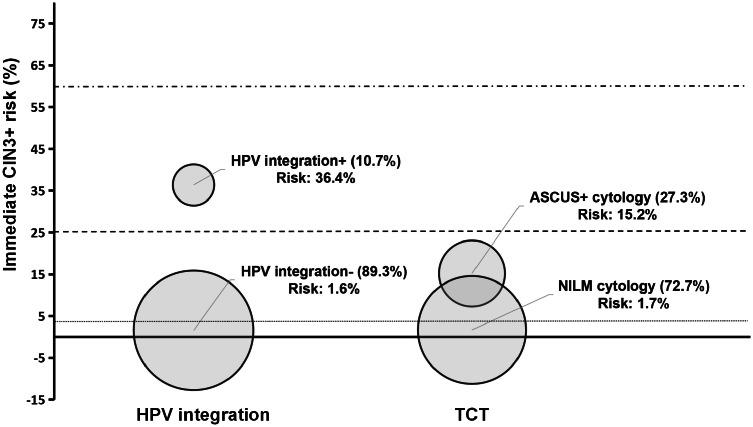
At baseline, HPV integration was positively correlated with the severity of cervical pathology, ranging from 5.0% (15/301) in normal diagnosis, 6.9% (4/58) in CIN1, 31.0% (9/29) in CIN2, 70% (14/20) in CIN3, and 100% (2/2) in cervical cancer ( < 0.001). Compared with cytology, HPV integration exhibits comparable sensitivity and negative predictive value for the diagnosis of CIN3+, higher specificity (92.8% [90.2%-95.4%] vs. 75.5% [71.2%-79.8%], < 0.001) and higher positive predictive value (36.4% [22.1%-50.6%] vs. 15.2% [8.5%-21.8%], < 0.001). HPV integration testing strategy yielded a significantly lower colposcopy referral rate than cytology strategy (10.7% [44/410] vs. 27.3% [112/410], < 0.001). The HPV integration-negative group exhibited the lowest immediate risk for CIN3+ (1.6%) and accounted for the largest proportion of the total population (89.3%), when compared with the normal cytology group (risk, 1.7%; proportion, 72.7%).
CONCLUSION
As a key molecular basis for the development of cervical cancer, HPV integration might be a promising triage strategy for HPV-positive patients.
目的
我们研究了人乳头瘤病毒(HPV)整合状态与宫颈上皮内瘤变(CIN)即刻风险之间的关系,以及基于HPV整合检测的分流策略。
方法
2015年,中国4086名年龄在20至65岁之间的女性被纳入一项前瞻性、基于人群的临床观察性研究,以评估HPV整合的分流性能。收集宫颈脱落细胞进行HPV检测和细胞学检查。如果高危HPV呈阳性,则在基线、2年和5年随访时进行HPV整合检测。
结果
在基线时,HPV整合与宫颈病变的严重程度呈正相关,正常诊断中为5.0%(15/301),CIN1中为6.9%(4/58),CIN2中为31.0%(9/29),CIN3中为70%(14/20),宫颈癌中为100%(2/2)(P<0.001)。与细胞学检查相比,HPV整合对CIN3+诊断的敏感性和阴性预测值相当,特异性更高(92.8%[90.2%-95.4%]对75.5%[71.2%-79.8%],P<0.001),阳性预测值更高(36.4%[22.1%-50.6%]对15.2%[8.5%-21.8%],P<0.001)。HPV整合检测策略导致的阴道镜转诊率显著低于细胞学检查策略(10.7%[44/410]对27.3%[112/410],P<0.001)。与正常细胞学检查组(风险为1.7%;比例为72.7%)相比,HPV整合阴性组CIN3+的即刻风险最低(1.6%),在总人口中所占比例最大(89.3%)。
结论
作为宫颈癌发生的关键分子基础,HPV整合可能是HPV阳性患者一种有前景的分流策略。
 Zotero 插件