
埃塞俄比亚绵羊和山羊中囊型棘球蚴病的患病率:一项系统评价和荟萃分析
Prevalence of Cystic Echinococcosis in Sheep and Goats of Ethiopia: A Systematic Review and Meta-Analysis.
作者信息
Fayisa Wakgari Oljira, Sarba Edilu Jorga, Borena Bizunesh Mideksa, Gebremedhin Endrias Zewdu, Tola Getachew Kebebew
机构信息
Agriculture Office of Jimma Rare District, Horo Guduru Wollega Zone, Oromia, Ethiopia.
Department of Veterinary Science, School of Veterinary Medicine, Ambo University, Ambo, Ethiopia.
出版信息
Vet Med Sci. 2025 Jan;11(1):e70189. doi: 10.1002/vms3.70189.
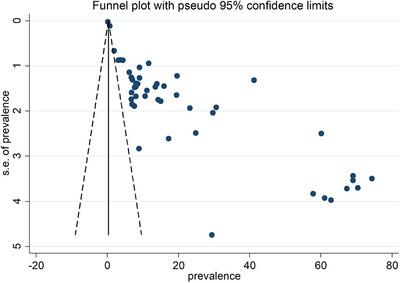
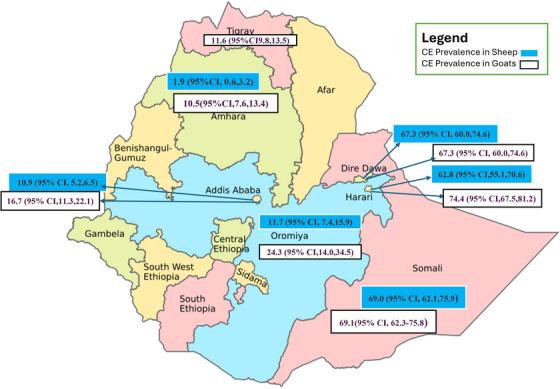
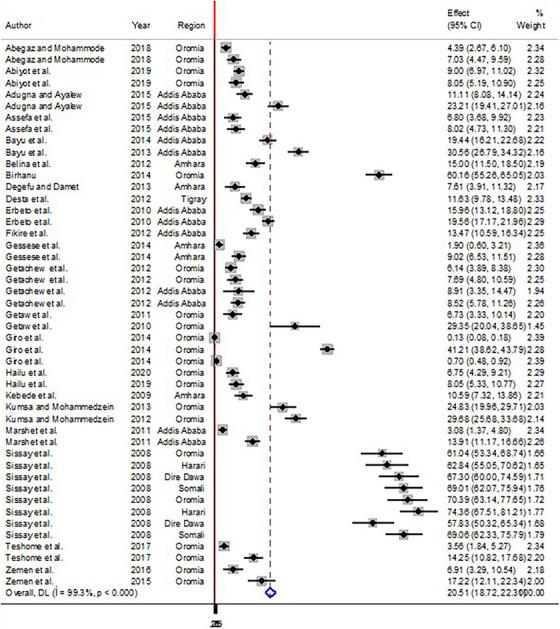
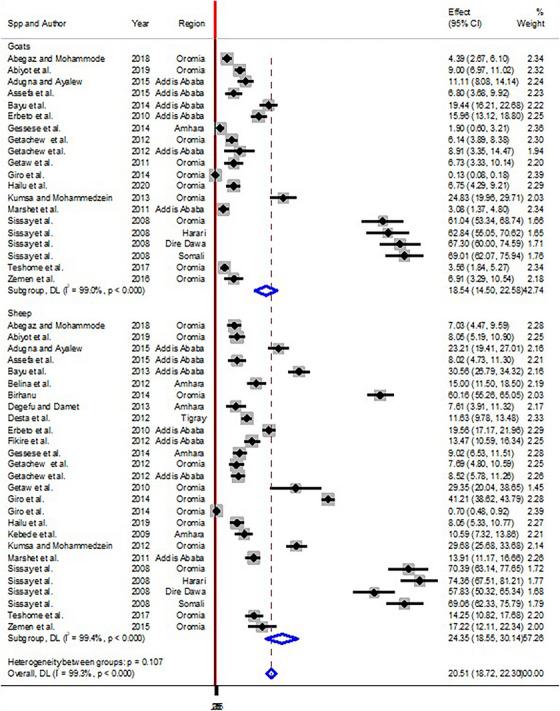
Cystic echinococcosis (CE) is a cestode infection of significant public health and economic importance. A systematic review and meta-analysis was performed to estimate the pooled prevalence of small ruminant CE and associated risk factors in Ethiopia. The published literature written in English from 01 January 2000 to 30 December 2019 was searched from electronic databases and eligible reports that fulfilled inclusion and exclusion criteria. A total of 1140 records were identified, of which 23 reports met the eligibility criteria. A random-effects meta-analysis model was used to pool the prevalence estimations, and a subgroup meta-analysis was utilized to compare the pooled prevalence of CE among the species, age group and sex of the studied animals. The pooled estimated small ruminant CE prevalence was 20.5% (95% confidence interval [CI]: 18.7, 22.3) in Ethiopia, and there was significant heterogeneity among the studies (p < 0.05). The pooled prevalence was higher for sheep, 24.3% (18.5, 30.1), compared to goats, 18.5% (14.5, 22.6), and in adults than young animals. The results of the present analysis suggested a high prevalence of CE at the national level. CE has a significant economic impact due to organ condemnation and production losses and poses a serious public health risk. Effective control requires public awareness, improved slaughterhouse practices, stray dog population management and integrated surveillance and control programmes involving veterinary, public health and environmental sectors. Such synthesis reports are believed to be useful in influencing policymakers towards designing effective prevention and control policies and strategies.
囊型包虫病(CE)是一种具有重大公共卫生和经济意义的绦虫感染。进行了一项系统评价和荟萃分析,以估计埃塞俄比亚小型反刍动物CE的合并患病率及相关危险因素。从电子数据库中检索了2000年1月1日至2019年12月31日以英文撰写的已发表文献以及符合纳入和排除标准的合格报告。共识别出1140条记录,其中23份报告符合合格标准。采用随机效应荟萃分析模型汇总患病率估计值,并利用亚组荟萃分析比较所研究动物的物种、年龄组和性别中CE的合并患病率。埃塞俄比亚小型反刍动物CE的合并估计患病率为20.5%(95%置信区间[CI]:18.7,22.3),各研究之间存在显著异质性(p<0.05)。绵羊的合并患病率较高,为24.3%(18.5,30.1),而山羊为18.5%(14.5,22.6),且成年动物高于幼年动物。本分析结果表明,该国CE患病率较高。由于器官废弃和生产损失,CE具有重大经济影响,并构成严重的公共卫生风险。有效的控制需要提高公众意识、改善屠宰场操作、管理流浪狗数量以及开展涉及兽医、公共卫生和环境部门的综合监测与控制计划。这类综合报告被认为有助于影响政策制定者制定有效的预防和控制政策及策略。

 Zotero 插件