
新鲜睾丸精子抽吸术与使用解冻的冷冻前精子或卵母细胞冷冻的比较:对射精功能障碍夫妇累积活产率的影响。
Comparison of fresh testicular sperm aspiration and use of either thawed pre-frozen sperm or oocyte freezing: impact on cumulative live birth rates for couples experiencing ejaculation failure.
作者信息
Zhan Shaoquan, An Geng, Gan Jiayu, Du Hongzi, Fu Xin, Wang Chunyan, Mao Yuling, Kang Xiangjin, Liu Jianqiao, Liu Hanyan
机构信息
Department of Obstetrics and Gynecology, Center for Reproductive Medicine, Guangdong Provincial Key Laboratory of Major Obstetric Diseases, Guangdong Provincial Clinical Research Center for Obstetrics and Gynecology, Guangdong-Hong Kong-Macao Greater Bay Area Higher Education Joint Laboratory of Maternal-Fetal Medicine, The Third Affiliated Hospital of Guangzhou Medical University, Guangzhou, China.
Key Laboratory for Reproductive Medicine of Guangdong Province, The Third Affiliated Hospital of Guangzhou Medical University, Guangzhou, China.
出版信息
Hum Reprod. 2025 Feb 1;40(2):199-209. doi: 10.1093/humrep/deae290.
STUDY QUESTION
Is there a difference in the cumulative live birth rate (CLBR) after fresh testicular sperm aspiration (TESA) compared with the use of either pre-frozen sperm or oocyte freezing for couples experiencing ejaculation failure on the day of oocyte retrieval?
SUMMARY ANSWER
After adjusting for confounding factors, the use of pre-frozen sperm or the freezing and thawing of oocytes appeared to be as effective as TESA in achieving CLBRs for couples experiencing temporary ejaculation failure.
WHAT IS KNOWN ALREADY
Male patients may be concerned about experiencing temporary ejaculation failure on the day of their partner's oocyte retrieval, in which case they may choose surgical sperm retrieval, oocyte freezing on the day, or have their sperm frozen in advance. However, the clinical efficacy of these three options has not yet been evaluated.
STUDY DESIGN, SIZE, DURATION: A retrospective data analysis was conducted on 65 178 oocyte retrieval cycles at a university-affiliated IVF center from January 2012 to May 2021.
PARTICIPANTS/MATERIALS, SETTING, METHODS: The overall characteristics, completed cycle characteristics, and clinical outcomes were analyzed among couples with ejaculation failure who underwent three distinct clinical interventions, with those receiving TESA serving as the control group. The primary outcome measure was the CLBR, and the secondary outcome measures were the clinical pregnancy rate (CPR) and live birth rate (LBR) per embryo transfer. A robust (modified) Poisson regression model was used to evaluate the association between the three clinical options for ejaculation failure and CLBRs.
MAIN RESULTS AND ROLE OF CHANCE
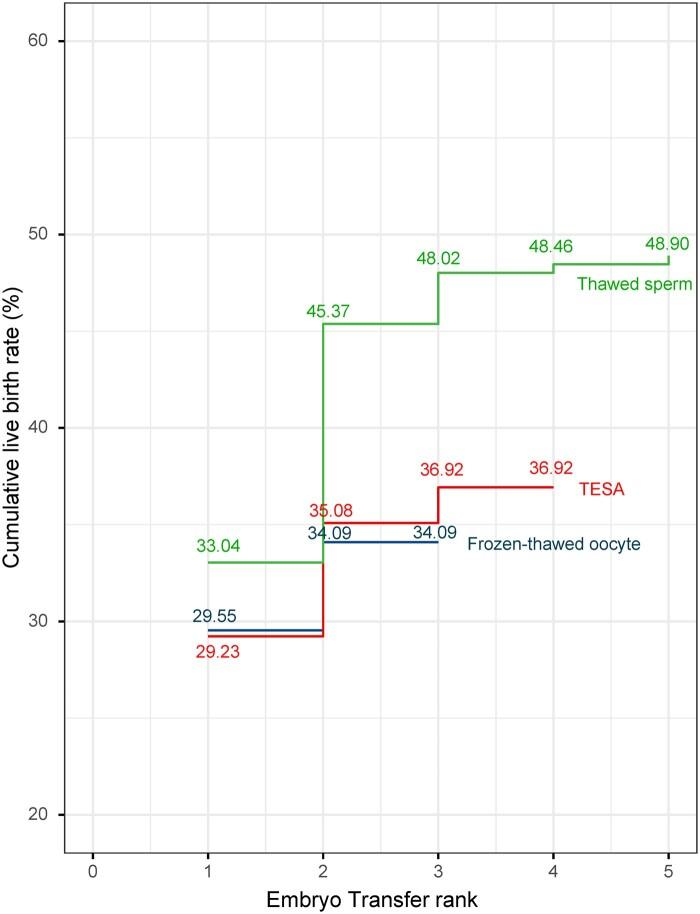
Of the eligible oocyte retrieval cycles, 756 cycles (1.2%) experienced ejaculation failure, with 640 cycles completing treatment. These treatments included 325 cycles using TESA, 227 cycles utilizing pre-frozen sperm, and 88 cycles involving frozen-thawed oocytes. The CLBRs for the TESA, thawed-sperm and thawed-oocyte groups were 36.9%, 48.9%, and 34.1%, respectively, showing a statistically significant difference (P = 0.007). Specifically, the thawed-sperm group demonstrated a significantly higher CLBR compared to the TESA group, while no significant difference was observed between the TESA and thawed-oocyte groups. Similarly, the CPRs and LBRs per embryo transfer for the three groups were 37.4%, 50.0%, and 41.8%, respectively (P = 0.005), and 29.9%, 39.6%, and 33.0%, respectively (P = 0.030). Again, the thawed-sperm group showed a significantly higher CPR and a significantly higher LBR, but no significant differences for the thawed-oocyte group, compared to the TESA group. Notably, the significant differences in both CLBR and LBR emerged after the second embryo transfer. However, after adjusting for multiple factors, including female age at oocyte retrieval, type and duration of infertility, female body mass index, number of previous IVF cycles, ovarian stimulation protocol, endometrial thickness on the last ultrasound, insemination method, number of oocytes retrieved, number of fertilized oocytes, and number of usable embryos on Day 3, the analysis revealed no significant association between CLBR and the use of pre-frozen sperm (risk ratio (RR) 1.08, 95% confidence interval (CI) 0.81-1.44) or thawed oocytes (RR 1.01, 95% CI 0.76-1.33), compared with TESA.
LIMITATIONS, REASONS FOR CAUTION: Given that the study is retrospective and the sample size is too small, particularly concerning the use of thawed oocytes, we acknowledge that the data present here is only suggestive and refers to an association that warrants cautious interpretation. Therefore, further research in the form of prospective studies as well as randomized controlled trials is needed to provide a definitive answer to the research question.
WIDER IMPLICATIONS OF THE FINDINGS
Our findings suggest that using pre-frozen sperm or frozen-thawed oocytes can offer comparable CLBRs to TESA for cases of temporary ejaculation failure, providing clinical alternatives that may reduce the logistical challenges in ART cycles.
STUDY FUNDING/COMPETING INTEREST(S): This study was supported by the National Nature Science Foundation of China (grant nos. 82101672, 82171589), the National Key Research and Development Program of China (grant nos. 2022YFC2702504, 2019YFE0109500), the Basic and Applied Basic Research Foundation of Guangdong Province (grant no. 2021A1515010774), and the Guangzhou Municipal Science and Technology Project (grant nos. 202102010075, 2023A4J0578). The authors declare that they have no conflict of interest in relation to the data in this paper.
TRIAL REGISTRATION NUMBER
N/A.
研究问题
对于在取卵日出现射精失败的夫妇,与使用预先冷冻的精子或冷冻卵子相比,新鲜睾丸精子抽吸术(TESA)后的累积活产率(CLBR)是否存在差异?
简要回答
在对混杂因素进行调整后,对于经历暂时射精失败的夫妇,使用预先冷冻的精子或卵子冷冻和解冻在实现CLBR方面似乎与TESA一样有效。
已知信息
男性患者可能担心在其伴侣取卵日出现暂时射精失败,在这种情况下,他们可能会选择手术取精、当日卵子冷冻,或提前冷冻精子。然而,这三种选择的临床疗效尚未得到评估。
研究设计、规模、持续时间:对2012年1月至2021年5月在一所大学附属体外受精中心进行的65178个取卵周期进行回顾性数据分析。
参与者/材料、设置、方法:对接受三种不同临床干预的射精失败夫妇的总体特征、完整周期特征和临床结局进行分析,以接受TESA的夫妇作为对照组。主要结局指标是CLBR,次要结局指标是每次胚胎移植的临床妊娠率(CPR)和活产率(LBR)。使用稳健(修正)泊松回归模型评估射精失败的三种临床选择与CLBR之间的关联。
主要结果及机遇的作用
在符合条件的取卵周期中,756个周期(1.2%)出现射精失败,其中640个周期完成治疗。这些治疗包括325个使用TESA的周期、227个使用预先冷冻精子的周期和88个涉及冷冻解冻卵子的周期。TESA组、解冻精子组和解冻卵子组的CLBR分别为36.9%、48.9%和34.1%,差异有统计学意义(P = 0.007)。具体而言,解冻精子组的CLBR显著高于TESA组,而TESA组和解冻卵子组之间未观察到显著差异。同样,三组每次胚胎移植的CPR和LBR分别为37.4%、50.0%和41.8%(P = 0.005),以及29.9%、39.6%和33.0%(P = 0.030)。再次,解冻精子组的CPR和LBR显著更高,但解冻卵子组与TESA组相比无显著差异。值得注意的是,CLBR和LBR的显著差异在第二次胚胎移植后出现。然而,在对包括取卵时女性年龄、不孕类型和持续时间、女性体重指数、既往体外受精周期数、卵巢刺激方案、末次超声检查时的子宫内膜厚度、授精方法、取卵数、受精卵子数和第3天可用胚胎数等多个因素进行调整后,分析显示与TESA相比,CLBR与使用预先冷冻的精子(风险比(RR)1.08,95%置信区间(CI)0.81 - 1.44)或解冻卵子(RR 1.01,95% CI 0.76 - 1.33)之间无显著关联。
局限性、谨慎理由:鉴于该研究是回顾性的且样本量过小,特别是关于解冻卵子的使用,我们承认此处呈现的数据仅具有提示性,且所指关联值得谨慎解读。因此,需要以前瞻性研究以及随机对照试验的形式进行进一步研究,以对该研究问题提供明确答案。
研究结果的更广泛影响
我们的研究结果表明,对于暂时射精失败的情况,使用预先冷冻的精子或冷冻解冻的卵子可提供与TESA相当的CLBR,提供了可能减少辅助生殖技术周期中后勤挑战的临床选择。
研究资金/利益冲突:本研究得到中国国家自然科学基金(项目编号82101672、82171589)、中国国家重点研发计划(项目编号2022YFC2702504、2019YFE0109500)、广东省基础与应用基础研究基金(项目编号2021A1515010774)以及广州市科技项目(项目编号202102010075、2023A4J0578)的支持。作者声明他们与本文数据不存在利益冲突。
试验注册号
无。


 Zotero 插件