
微调系统性红斑狼疮治疗:选择性酪氨酸激酶2抑制的潜力
Fine-tuning SLE treatment: the potential of selective TYK2 inhibition.
作者信息
Satoh-Kanda Yurie, Nakayamada Shingo, Tanaka Yoshiya
机构信息
The First Department of Internal Medicine, University of Occupational and Environmental Health, Japan, Kitakyushu, Fukuoka, Japan.
The First Department of Internal Medicine, University of Occupational and Environmental Health, Japan, Kitakyushu, Fukuoka, Japan
出版信息
RMD Open. 2024 Dec 31;10(4):e005072. doi: 10.1136/rmdopen-2024-005072.
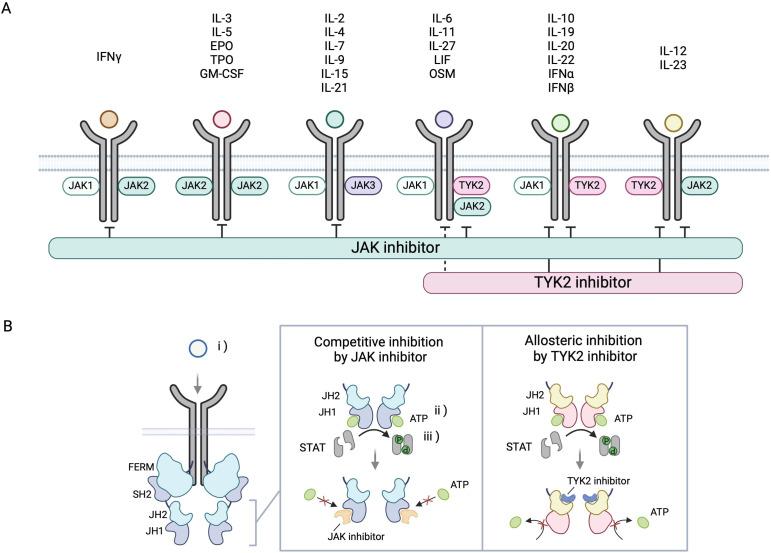
In systemic lupus erythematosus (SLE), adaptive immunity is activated by the stimulation of innate immunity, leading to the development of autoreactive T cells and activation and differentiation of B cells. Cytokine signalling plays an essential role in the pathogenesis and progression of this disease. In particular, the differentiation and function of CD4+ T cell subsets, which play a central role in SLE pathology, are significantly altered by cytokine stimulation. Many cytokines transmit signals via the Janus-activated kinase (JAK)-STAT pathway, but there is no one-to-one correspondence between cytokine receptors and JAK/TYK2. Multiple cytokines activate JAK/TYK2, and multiple JAK/TYK2 molecules are simultaneously activated by a single cytokine. Therefore, the modulation of the JAK-STAT pathway has the potential to control immune responses in SLE. Although several JAK/TYK2 inhibitors are currently undergoing clinical trials, more selective drugs that can target cytokine signals according to the specific pathology of the disease are required. TYK2 inhibitors, which are involved in the signal transduction of type I interferon and interleukin-12/23 pathways and are linked to disease susceptibility genes in SLE, may have the potential to fine-tune the differentiation and function of immune cells, particularly CD4+ T cells.
在系统性红斑狼疮(SLE)中,适应性免疫通过固有免疫的刺激而被激活,导致自身反应性T细胞的产生以及B细胞的激活和分化。细胞因子信号传导在该疾病的发病机制和进展中起着至关重要的作用。特别是,在SLE病理过程中起核心作用的CD4+ T细胞亚群的分化和功能会因细胞因子刺激而发生显著改变。许多细胞因子通过Janus激活激酶(JAK)-信号转导子和转录激活子(STAT)途径传递信号,但细胞因子受体与JAK/TYK2之间不存在一一对应关系。多种细胞因子激活JAK/TYK2,并且单个细胞因子可同时激活多个JAK/TYK2分子。因此,调节JAK-STAT途径有可能控制SLE中的免疫反应。尽管目前有几种JAK/TYK2抑制剂正在进行临床试验,但仍需要能够根据疾病的特定病理靶向细胞因子信号的更具选择性的药物。TYK2抑制剂参与I型干扰素和白细胞介素-12/23途径的信号转导,并且与SLE中的疾病易感基因相关,可能具有微调免疫细胞,特别是CD4+ T细胞的分化和功能的潜力。
 Zotero 插件