
短信与邮政提醒对提高结直肠癌筛查项目参与率的效果比较:随机对照试验
Text Messaging Versus Postal Reminders to Improve Participation in a Colorectal Cancer Screening Program: Randomized Controlled Trial.
作者信息
Vives Nuria, Binefa Gemma, Travier Noemie, Farre Albert, Panera Jon Aritz, Casas Berta, Vidal Carmen, Ibáñez-Sanz Gemma, Garcia Montse
机构信息
Catalan Institut of Oncology, Hospitalet del Llobregat, Spain.
Early Detection of Cancer Research Group, Epidemiology, Public Health, Cancer Prevention and Palliative Cures Program, Bellvitge Biomedical Research Institute, Hospitalet del Llobregat, Spain.
出版信息
JMIR Mhealth Uhealth. 2025 Jan 1;13:e64243. doi: 10.2196/64243.
BACKGROUND
Mobile phone SMS text message reminders have shown moderate effects in improving participation rates in ongoing colorectal cancer screening programs.
OBJECTIVE
This study aimed to assess the effectiveness of SMS text messages as a replacement for routine postal reminders in a fecal immunochemical test-based colorectal cancer screening program in Catalonia, Spain.
METHODS
We conducted a randomized controlled trial among individuals aged 50 to 69 years who were invited to screening but had not completed their fecal immunochemical test within 6 weeks. The intervention group (n=12,167) received an SMS text message reminder, while the control group (n=12,221) followed the standard procedure of receiving a reminder letter. The primary outcome was participation within 18 weeks of the invitation. The trial was stopped early, and a recovery strategy was implemented for nonparticipants in the intervention group. We performed a final analysis to evaluate the impact of the recovery strategy on the main outcome of the trial. Participation was assessed using a logistic regression model adjusting for potential confounders (sex, age, and deprivation score index) globally and by screening behavior.
RESULTS
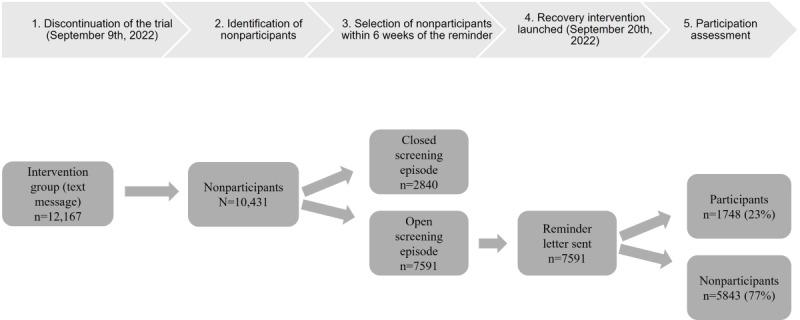
The trial was discontinued early in September 2022 due to the results of the interim analysis. The interim analysis included 5570 individuals who had completed 18 weeks of follow-up (intention-to-treat). The SMS text message group had a participation rate of 17.2% (477/2781), whereas the control group had a participation rate of 21.9% (610/2789; odds ratio 0.71, 95% CI 0.62-0.82; P<.001). As a recovery strategy, 7591 (72.7%) out of 10,442 nonparticipants in the SMS text message group had an open screening episode and received a second reminder by letter, reaching a participation rate of 23% (1748/7591). The final analysis (N=24,388) showed a participation rate of 29.3% (3561/12,167) in the intervention group, which received 2 reminders, while the participation rate was 26.5% (3235/12,221) in the control group (odds ratio 1.16, 95% CI 1.09-1.23; P<.001).
CONCLUSIONS
Replacing SMS text messages with reminder letters did not increase the participation rate but also led to a decline in participation among nonparticipants 6 weeks after the invitation. However, sending a second reminder by letter significantly increased participation rates among nonparticipants within 6 weeks in the SMS text message group compared with those who received 1 postal reminder (control group). Additional research is essential to determine the best timing and frequency of reminders to boost participation without being intrusive in their choice of participation.
TRIAL REGISTRATION
ClinicalTrials.gov NCT04343950; https://www.clinicaltrials.gov/study/NCT04343950.
背景
手机短信提醒在提高正在进行的结直肠癌筛查项目的参与率方面已显示出一定效果。
目的
本研究旨在评估在西班牙加泰罗尼亚基于粪便免疫化学检测的结直肠癌筛查项目中,短信作为常规邮寄提醒的替代方式的有效性。
方法
我们对年龄在50至69岁之间、被邀请参加筛查但在6周内未完成粪便免疫化学检测的个体进行了一项随机对照试验。干预组(n = 12167)接收短信提醒,而对照组(n = 12221)遵循接收提醒信的标准程序。主要结局是在邀请后的18周内参与筛查。试验提前终止,并对干预组的未参与者实施了恢复策略。我们进行了最终分析,以评估恢复策略对试验主要结局的影响。使用逻辑回归模型评估参与情况,该模型对潜在混杂因素(性别、年龄和贫困得分指数)进行了整体调整,并按筛查行为进行了调整。
结果
由于中期分析结果,试验于2022年9月提前终止。中期分析纳入了5570名完成18周随访(意向性分析)的个体。短信组的参与率为17.2%(477/2781),而对照组的参与率为21.9%(610/2789;优势比0.71,95%置信区间0.62 - 0.82;P <.001)。作为恢复策略,短信组10442名未参与者中的7591名(72.7%)有一次开放的筛查记录,并收到了第二封信件提醒,参与率达到23%(1748/7591)。最终分析(N = 24388)显示,接受两次提醒的干预组参与率为29.3%(3561/12167),而对照组的参与率为26.5%(3235/12221)(优势比1.16,95%置信区间1.09 - 1.23;P <.001)。
结论
用提醒信取代短信并未提高参与率,反而导致邀请6周后未参与者的参与率下降。然而,与仅收到一封邮寄提醒(对照组)的人相比,向短信组的未参与者发送第二封信件提醒显著提高了6周内的参与率。开展更多研究对于确定提醒的最佳时机和频率至关重要,以便在不干扰其参与选择的情况下提高参与率。
试验注册
ClinicalTrials.gov NCT04343950;https://www.clinicaltrials.gov/study/NCT04343950


 Zotero 插件