
对单体和二聚体阿片肽受体调控的结构见解。
Structural insights into the regulation of monomeric and dimeric apelin receptor.
作者信息
Yue Yang, Liu Lier, Wu Lijie, Xu Chanjuan, Na Man, Liu Shenhui, Liu Yuxuan, Li Fei, Liu Junlin, Shi Songting, Lei Hui, Zhao Minxuan, Yang Tianjie, Ji Wei, Wang Arthur, Hanson Michael A, Stevens Raymond C, Liu Jianfeng, Xu Fei
机构信息
iHuman Institute, ShanghaiTech University, Shanghai, China.
School of Life Science and Technology, ShanghaiTech University, Shanghai, China.
出版信息
Nat Commun. 2025 Jan 2;16(1):310. doi: 10.1038/s41467-024-55555-6.
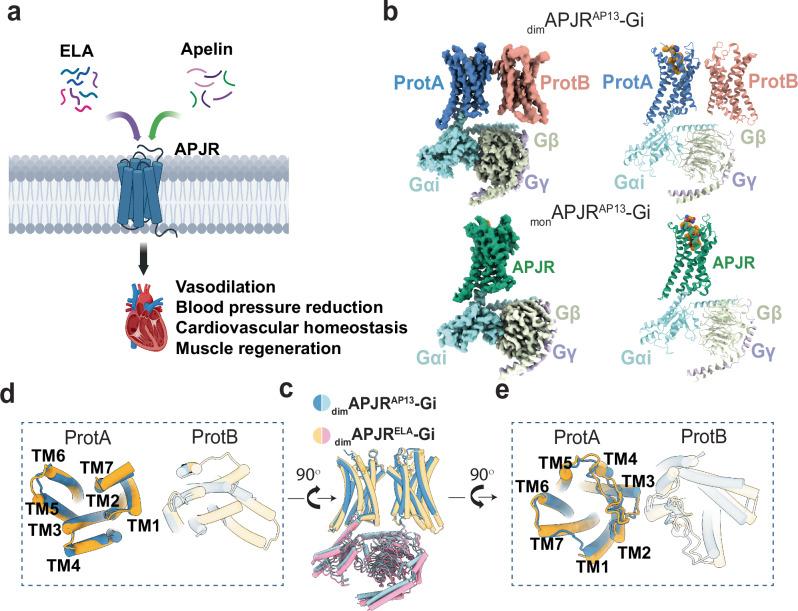
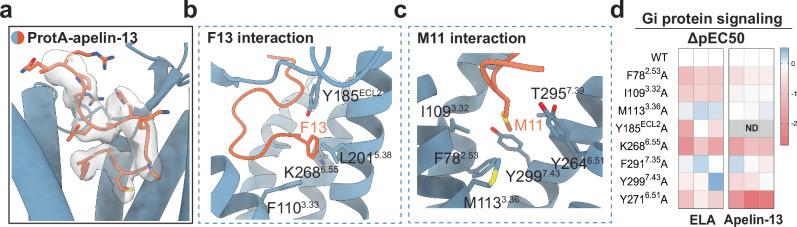
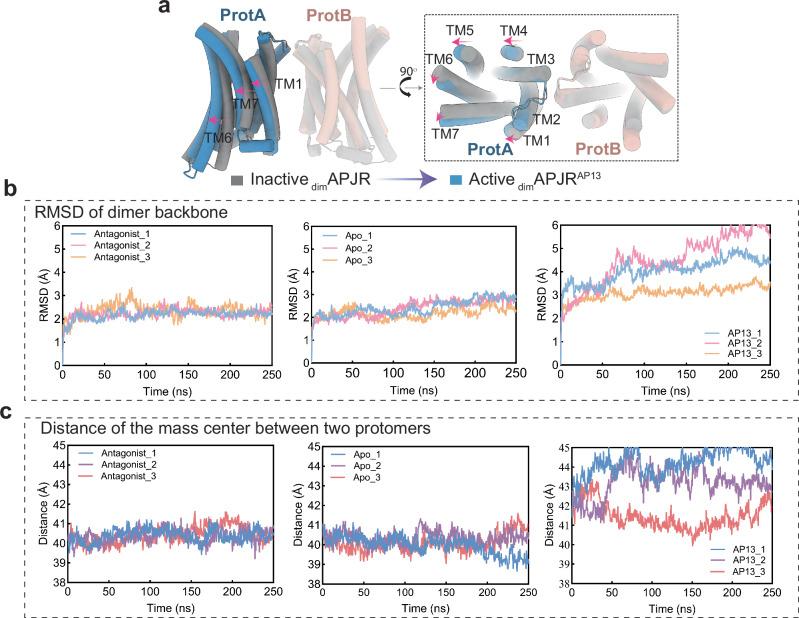
The apelin receptor (APJR) emerges as a promising drug target for cardiovascular health and muscle regeneration. While prior research unveiled the structural versatility of APJR in coupling to Gi proteins as a monomer or dimer, the dynamic regulation within the APJR dimer during activation remains poorly understood. In this study, we present the structures of the APJR dimer and monomer complexed with its endogenous ligand apelin-13. In the dimeric structure, apelin-13 binds exclusively to one protomer that is coupled with Gi proteins, revealing a distinct ligand-binding behavior within APJR homodimers. Furthermore, binding of an antagonistic antibody induces a more compact dimerization by engaging both protomers. Notably, structural analyses of the APJR dimer complexed with an agonistic antibody, with or without Gi proteins, suggest that G protein coupling may promote the dissociation of the APJR dimer during activation. These findings underscore the intricate interplay between ligands, dimerization, and G protein coupling in regulating APJR signaling pathways.
阿片肽受体(APJR)已成为心血管健康和肌肉再生领域一个很有前景的药物靶点。虽然先前的研究揭示了APJR作为单体或二聚体与Gi蛋白偶联时的结构多样性,但激活过程中APJR二聚体内的动态调节仍知之甚少。在本研究中,我们展示了与内源性配体阿片肽-13复合的APJR二聚体和单体的结构。在二聚体结构中,阿片肽-13仅与一个与Gi蛋白偶联的原体结合,揭示了APJR同型二聚体内独特的配体结合行为。此外,拮抗抗体的结合通过与两个原体结合诱导形成更紧密的二聚化。值得注意的是,对与激动抗体复合的APJR二聚体(有无Gi蛋白)的结构分析表明,G蛋白偶联可能在激活过程中促进APJR二聚体的解离。这些发现强调了配体、二聚化和G蛋白偶联在调节APJR信号通路中的复杂相互作用。


 Zotero 插件