
谷子(Setaria italica L.)中衔接蛋白复合体的全基因组鉴定及其表达模式分析。
Genome-wide identification of the adaptor protein complexes and its expression patterns analysis in foxtail millet (Setaria italica L.).
作者信息
Wang Dan, Su Min, Hao Jian-Hong, Li Zi-Dong, Dong Shuqi, Yuan Xiangyang, Li Xiaorui, Gao Lulu, Chu Xiaoqian, Yang Guanghui, Wang Jia-Gang, Du Huiling
机构信息
College of Agriculture, Shanxi Agricultural University, Taigu, 030801, China.
State Key Laboratory of Sustainable Dryland Agriculture (in Preparation), Shanxi Agricultural University, Taigu, 030801, China.
出版信息
BMC Plant Biol. 2025 Jan 2;25(1):7. doi: 10.1186/s12870-024-05959-9.
BACKGROUNDS
Adapter proteins (APs) complex is a class of heterotetrameric complexes comprising of 4-subunits with important regulatory functions in eukaryotic cell membrane vesicle trafficking. Foxtail millet (Setaria italica L.) is a significant C model plant for monocotyledon studies, and vesicle trafficking may plays a crucial role in various life activities related to growth and development. Despite this importance, studies on AP complexes in foxtail millet have been lacking.
RESULTS
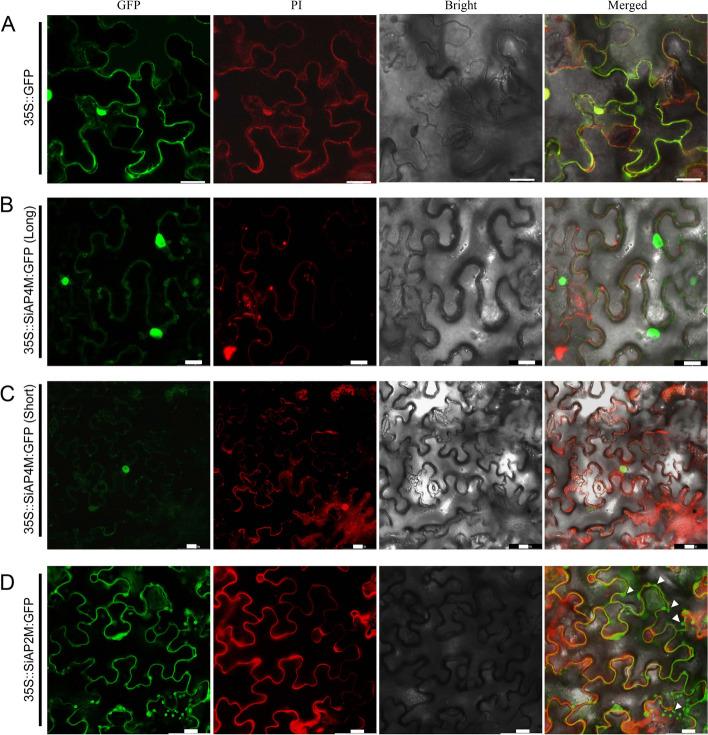
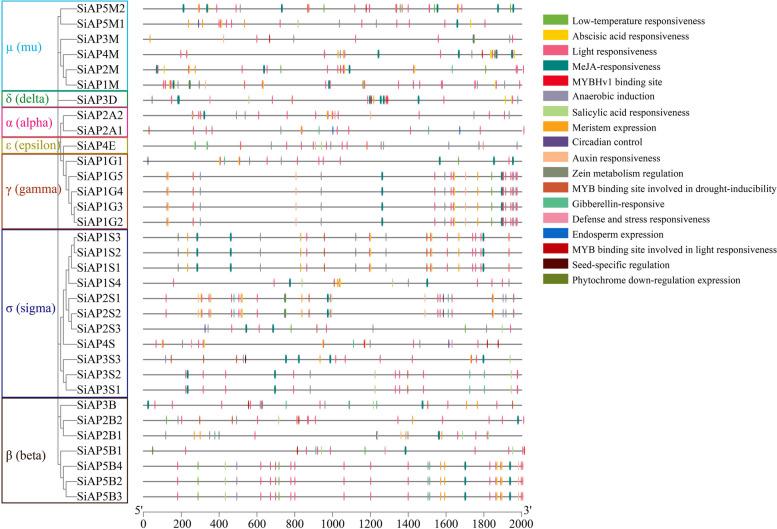
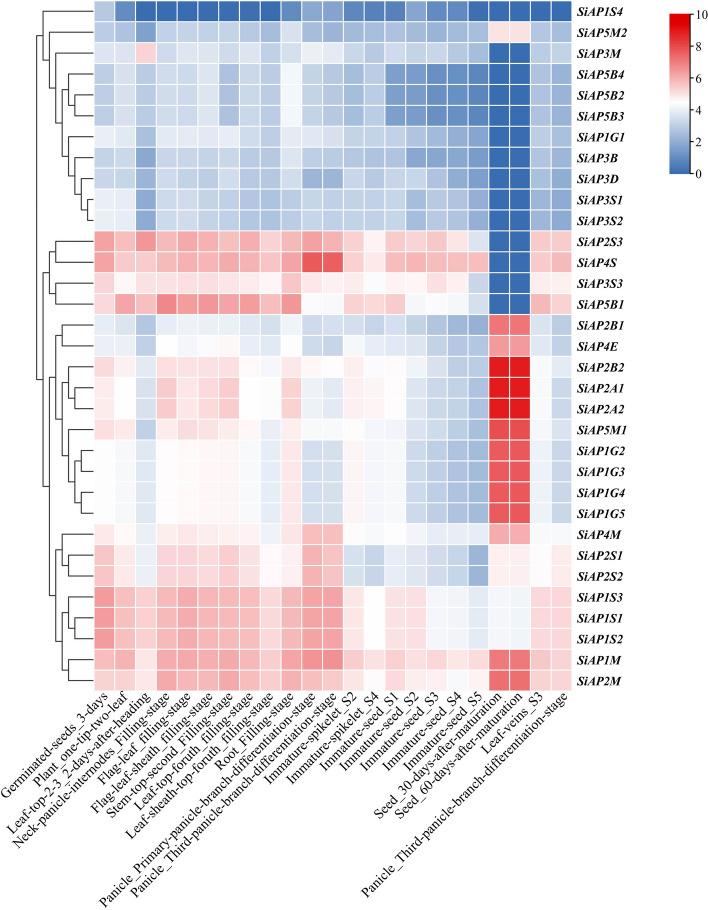
This research conducted genome-wide identification and systematical analysis of AP complexes in foxtail millet. 33 SiAP complex genes were identified and classified into 7 groups, distributed unevenly across 9 chromosomes in foxtail millet. Among these genes, 11 segmental duplication pairs were found. Out of the 33 SiAP complex genes, 24 exhibited collinear relationships with Setaria viridis, while only one showed relationship with Arabidopsis thaliana. Gene structure and motif composition were investigated to understand the function and evolution of these SiAP complex genes. Furthermore, these promoter region of the SiAP complex genes contains 49 cis-elements that are associated with responses to light, hormones, abiotic stress, growth and development. The interaction network between the SiAP complexes was analyzed, and there were strong interactions among the SiAP complex proteins. Expression patterns of SiAP complex genes in different organs and developmental stages of foxtail millet were investigated. The majority of the SiAP complex genes exhibited expressed in multiple tissues, with some genes being predominantly expressed in specific tissues. Subsequently, we selected SiAP4M and SiAP2M for validation of subcellular localization. The signal of 35 S:: SiAP4M: GFP (Long) and 35 S:: SiAP4M: GFP (Short) fused proteins were primarily observed in the nucleus, while the signal of 35 S:: SiAP2M: GFP fused proteins was widely distributed on the cell membrane and vesicles.
CONCLUSIONS
Overall, this study presents a comprehensive map of the SiAP complexes in foxtail millet. These findings not only administer to understanding the biological functions of AP complexes in foxtail millet growth and development but also offer insights for enhancing genetic breeding in this crop.
背景
衔接蛋白(AP)复合物是一类由4个亚基组成的异源四聚体复合物,在真核细胞膜泡运输中具有重要的调节功能。谷子(Setaria italica L.)是单子叶植物研究的重要C4模式植物,膜泡运输可能在与生长发育相关的各种生命活动中起关键作用。尽管其重要性,但谷子中关于AP复合物的研究却很缺乏。
结果
本研究对谷子中的AP复合物进行了全基因组鉴定和系统分析。共鉴定出33个SiAP复合物基因,并分为7组,在谷子的9条染色体上分布不均。在这些基因中,发现了11对片段重复。在33个SiAP复合物基因中,24个与绿色狗尾草(Setaria viridis)表现出共线性关系,而只有1个与拟南芥(Arabidopsis thaliana)有关系。研究了基因结构和基序组成,以了解这些SiAP复合物基因的功能和进化。此外,SiAP复合物基因的启动子区域包含49个与光、激素、非生物胁迫、生长和发育响应相关的顺式元件。分析了SiAP复合物之间的相互作用网络,SiAP复合物蛋白之间存在强烈的相互作用。研究了SiAP复合物基因在谷子不同器官和发育阶段的表达模式。大多数SiAP复合物基因在多个组织中表达,一些基因主要在特定组织中表达。随后,我们选择SiAP4M和SiAP2M进行亚细胞定位验证。35S::SiAP4M:GFP(长)和35S::SiAP4M:GFP(短)融合蛋白的信号主要在细胞核中观察到,而35S::SiAP2M:GFP融合蛋白的信号广泛分布在细胞膜和膜泡上。
结论
总体而言,本研究展示了谷子中SiAP复合物的全面图谱。这些发现不仅有助于理解AP复合物在谷子生长发育中的生物学功能,也为该作物的遗传育种提供了见解。



 Zotero 插件