
万古霉素诱导的血小板减少症的发病率及危险因素:一项为期六年的真实世界研究。
Incidence and risk factors of Vancomycin-induced thrombocytopenia: a six-year real-world study.
作者信息
Zhu Yuanchao, Huang Lishuang, Zhang Jingjing, Liang Liang, Jin Pengfei
机构信息
Department of Pharmacy, Beijing Hospital, National Center of Gerontology; Institute of Geriatric Medicine, Chinese Academy of Medical Sciences, Beijing Key Laboratory of Assessment of Clinical Drugs Risk and Individual Application Beijing Hospital, Beijing, 100730, P.R. China.
Tangshan Gongren Hospital, Tangshan, 063000, P.R. China.
出版信息
BMC Infect Dis. 2025 Jan 2;25(1):7. doi: 10.1186/s12879-024-10393-1.
OBJECTIVES
Drug-induced thrombocytopenia has been reported for numerous drugs. Vancomycin-induced thrombocytopenia (VIT) is infrequently and often under-recognized. VIT can lead to the serious consequences of some life-threatening bleeding, especially in high-risk population. However, few studies have focused on VIT. This study aimed to describe the occurrence and manifestation of VIT and evaluate its risk factors in real-world settings.
METHODS
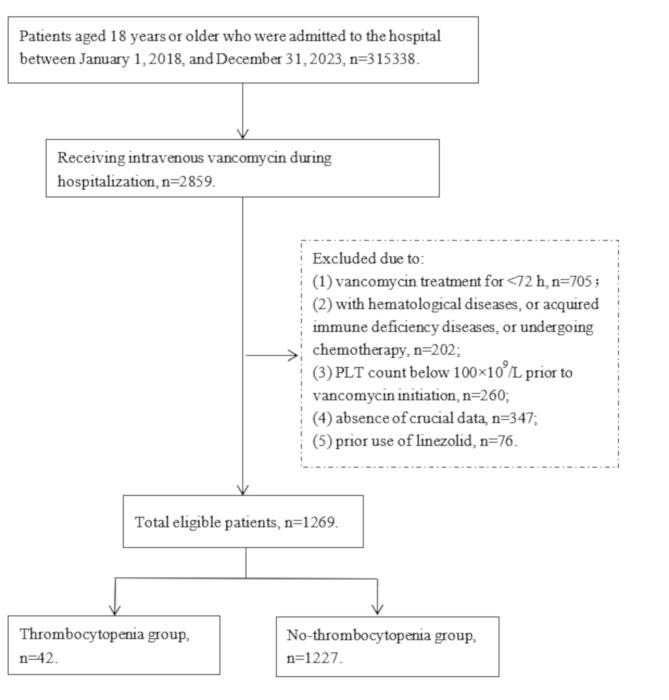
A retrospective case-control study of patients treated with intravenous vancomycin was conducted between January 2018 and December 2023.
RESULTS
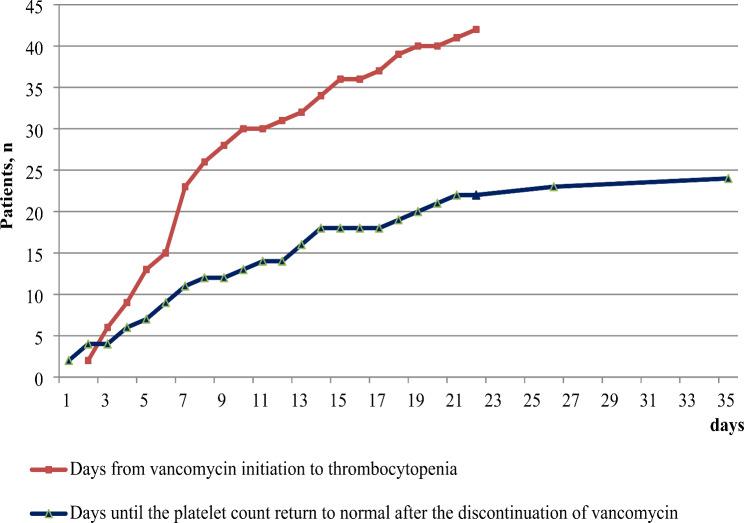
Among the 1269 identified patients, the incidence of thrombocytopenia was 3.3% (42/1269) after a medium of 9 days (range, 2 to 22) of the initiation of vancomycin therapy. Twenty-four patients experienced platelet recovery, and all recovered after discontinuing vancomycin, with a mean duration of 9 days (range, 1 to 35) after vancomycin cessation. The severity of thrombocytopenia varied among these patients, with 45.2% (19/42) experiencing Grade 3 to Grade 4 thrombocytopenia. Multivariate analysis indicated that risk factors for VIT were qSOFA score ≥ 2, underlying renal diseases, duration of vancomycin therapy ≥ 8 days, PLT ≤ 150 × 10/L, and BUN ≥ 12 mmol/L. In the retrospective cohort, among patients with 0-5 risk factors, the incidence rates of VIT were 0.2% (1/556), 1.6% (7/439), 5.8% (10/173), 14.9% (11/74), 42.1% (8/19), and 62.5% (5/8) respectively.
CONCLUSION
It is crucial for medical staff to remain vigilant and carefully observe any signs of potential bleeding throughout vancomycin therapy, especially in those with more than 3 combined risk factors.
目的
已有多种药物导致血小板减少的报道。万古霉素诱导的血小板减少症(VIT)并不常见,且常未被充分认识。VIT可导致一些危及生命的出血等严重后果,尤其是在高危人群中。然而,很少有研究关注VIT。本研究旨在描述VIT的发生情况和表现,并评估其在实际临床环境中的危险因素。
方法
对2018年1月至2023年12月期间接受静脉注射万古霉素治疗的患者进行一项回顾性病例对照研究。
结果
在1269例确诊患者中,万古霉素治疗开始平均9天(范围2至22天)后血小板减少症的发生率为3.3%(42/1269)。24例患者血小板恢复,停用万古霉素后均恢复,停用万古霉素后平均持续时间为9天(范围1至35天)。这些患者中血小板减少症的严重程度各不相同,45.2%(19/42)的患者出现3至4级血小板减少。多因素分析表明,VIT的危险因素为qSOFA评分≥2、存在基础肾脏疾病、万古霉素治疗持续时间≥8天、血小板计数(PLT)≤150×10⁹/L以及血尿素氮(BUN)≥12 mmol/L。在回顾性队列中,0至5个危险因素的患者中,VIT的发生率分别为0.2%(1/556)、1.6%(7/439)、5.8%(10/173)、14.9%(11/74)、42.1%(8/19)和62.5%(5/8)。
结论
医护人员在整个万古霉素治疗过程中保持警惕并仔细观察潜在出血的任何迹象至关重要,尤其是在那些合并危险因素超过3个的患者中。
 Zotero 插件