
HGF/c-MET通路在晚期非小细胞肺癌对免疫检查点抑制剂耐药中的作用
Role of the HGF/c-MET pathway in resistance to immune checkpoint inhibitors in advanced non-small cell lung cancer.
作者信息
Akli Assya, Takam Kamga Paul, Julie Catherine, Capron Claude, Costantini Adrien, Dumenil Coraline, Dumoulin Jennifer, Giraud Violaine, Parent Florence, Seferian Andrei, Guettier Catherine, Glorion Mathieu, Longchampt Elisabeth, Emile Jean-François, Giroux-Leprieur Étienne
机构信息
Université Paris-Saclay, UVSQ, EA 4340 BECCOH, Boulogne-Billancourt, France.
Department of Pathology, APHP-Ambroise Paré Hospital, Boulogne-Billancourt, France.
出版信息
Cancer Immunol Immunother. 2025 Jan 3;74(2):58. doi: 10.1007/s00262-024-03882-4.
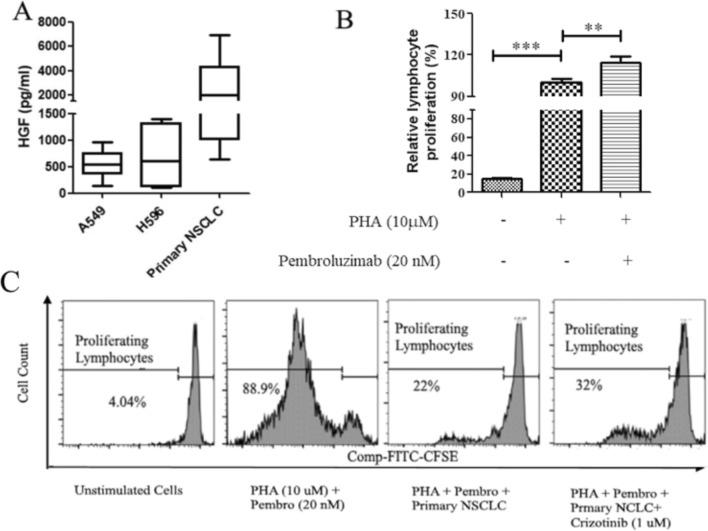
Most of advanced non-small cell lung cancer (NSCLC) patients will experience tumor progression with immunotherapy (IO). Preliminary data suggested an association between high plasma HGF levels and poor response to IO in advanced NSCLC. Our study aimed to evaluate further the role of the HGF/MET pathway in resistance to IO in advanced NSCLC. We included retrospectively 82 consecutive NSCLC patients from two academic hospitals. Among them, 49 patients received ICIs alone or in combination with chemotherapy (CT), while 33 patients received chemotherapy alone as the control group. We analyzed plasma HGF levels by ELISA and expression of PD-L1, MET/phospho-MET, and CD8+ T-Cell infiltration on lung tumor tissue by immunohistochemistry. We investigated the contribution of HGF/MET to IO response by culturing peripheral blood mononuclear cells (PBMC) with or without pembrolizumab, with recombinant HGF, or cocultured with NSCLC patients-derived explants. Additionally, c-MET inhibitors were used to evaluate the contribution of MET activation in NSCLC-mediated immunosuppression. High HGF levels were associated with high progression rate with IO (p = 0.0092), but not with CT. ELISA analysis of supernatants collected from cultured NSCLC cells showed that HGF was produced by tumor cells. Furthermore, when activated PBMCs were cultured in the presence of recombinant HGF or on NSCLC monolayer, the proliferation of CD3+CD8+ lymphocytes was inhibited, even in the presence of pembrolizumab. The addition of HGF/MET inhibitors restored lymphocyte activation and induced IFNγ production. In conclusion, inhibiting the HGF/MET signaling pathway could be a promising approach to enhance the efficacy of immunotherapy.
大多数晚期非小细胞肺癌(NSCLC)患者在接受免疫治疗(IO)时会出现肿瘤进展。初步数据表明,晚期NSCLC患者血浆中高HGF水平与对IO的不良反应之间存在关联。我们的研究旨在进一步评估HGF/MET通路在晚期NSCLC对IO耐药中的作用。我们回顾性纳入了来自两家学术医院的82例连续的NSCLC患者。其中,49例患者单独接受免疫检查点抑制剂(ICIs)或与化疗(CT)联合使用,而33例患者单独接受化疗作为对照组。我们通过酶联免疫吸附测定(ELISA)分析血浆HGF水平,并通过免疫组织化学分析肺肿瘤组织中PD-L1、MET/磷酸化MET和CD8+T细胞浸润的表达。我们通过用或不用派姆单抗、重组HGF培养外周血单个核细胞(PBMC),或与NSCLC患者来源的外植体共培养,研究了HGF/MET对IO反应的作用。此外,使用c-MET抑制剂评估MET激活在NSCLC介导的免疫抑制中的作用。高HGF水平与IO的高进展率相关(p = 0.0092),但与CT无关。对培养的NSCLC细胞收集的上清液进行ELISA分析表明,HGF由肿瘤细胞产生。此外,当在重组HGF存在下或在NSCLC单层上培养活化的PBMC时,即使在存在派姆单抗的情况下,CD3+CD8+淋巴细胞的增殖也受到抑制。添加HGF/MET抑制剂可恢复淋巴细胞激活并诱导γ干扰素(IFNγ)产生。总之,抑制HGF/MET信号通路可能是提高免疫治疗疗效的一种有前景的方法。


 Zotero 插件