
使用小型化蓝牙低功耗近程记录仪研究农业环境中小型啮齿动物之间的接触情况。
The use of miniaturised Bluetooth Low Energy proximity loggers to study contacts among small rodents in agricultural settings.
作者信息
Huels Florian, Vanden Broecke Bram, Sluydts Vincent, Kirkpatrick Lucinda, Herrera Olivares Ivan, Ennen Hendrik, Vermeiren Dries, Leirs Herwig, Jacob Jens
机构信息
Julius Kühn-Institut (JKI), Federal Research Centre for Cultivated Plants, Institute for Epidemiology and Pathogen Diagnostics, Rodent Research, Muenster, Germany.
Evolutionary Ecology Group (EVECO), University of Antwerp, Wilrijk, Belgium.
出版信息
PLoS One. 2025 Jan 3;20(1):e0312553. doi: 10.1371/journal.pone.0312553. eCollection 2025.
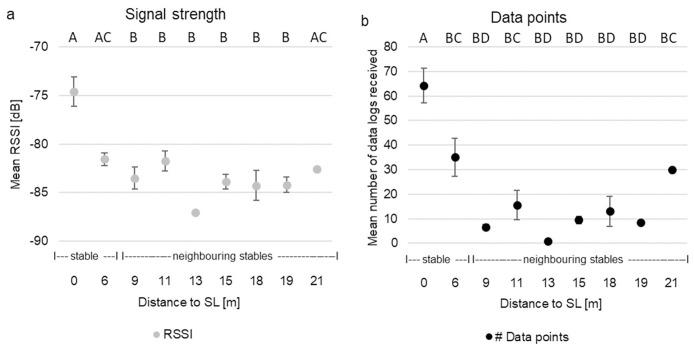
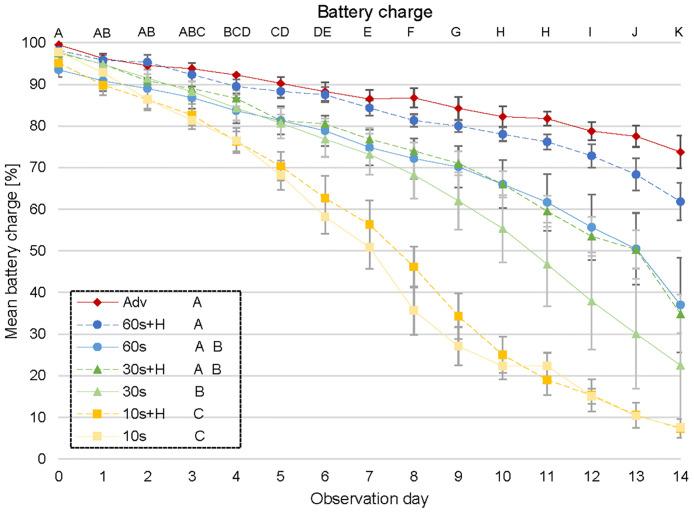
Small rodents can cause problems on farms such as infrastructure damage, crop losses or pathogen transfer. The latter threatens humans and livestock alike. Frequent contacts between wild rodents and livestock favour pathogen transfer and it is therefore important to understand the movement patterns of small mammals in order to develop strategies to prevent damage and health issues. Miniaturised proximity loggers are a newly developed tool for monitoring spatial behaviour of small mammals. The strength of the Bluetooth Low Energy (BLE) signal can be used as an indicator of close contacts between wild rodents and livestock feeding sites, which is relevant for identifying possible transmission routes. This method study focussed on the use of the technology in an agricultural setting as well as dry runs for testing and calibrating this technology in farming environments used for animal husbandry. Results show that the battery life of the loggers was mainly influenced by the pre-set scan interval. Short scan intervals resulted in reduced battery lifespan and should be maximised according to the activity patterns of the target species. Habitat affects BLE signal strength resulting in higher signal strength indoors than outdoors. The height of the location of the loggers positively affected signal strength in livestock stables. Signal reception generally decreased with increasing distance and differed among loggers making calibration necessary. Within habitat specific distances, BLE proximity logging systems can identify contacts among small mammals and between animals and particular structures of interest. These results support the use of BLE based systems in animal husbandry environments and contribute to a body of evidence of validated techniques. In addition, such approaches can provide valuable insights into possible pathogen transmission routes.
小型啮齿动物会在农场引发诸多问题,比如基础设施损坏、作物损失或病原体传播。后者对人类和牲畜都构成威胁。野生啮齿动物与牲畜之间的频繁接触有利于病原体传播,因此了解小型哺乳动物的活动模式对于制定预防损害和健康问题的策略至关重要。小型化近距离记录器是一种新开发的用于监测小型哺乳动物空间行为的工具。蓝牙低功耗(BLE)信号的强度可作为野生啮齿动物与牲畜觅食地点之间密切接触的指标,这对于识别可能的传播途径具有重要意义。本方法研究聚焦于该技术在农业环境中的应用,以及在用于畜牧业的养殖环境中对该技术进行测试和校准的预演。结果表明,记录器的电池寿命主要受预设扫描间隔的影响。短扫描间隔会导致电池寿命缩短,应根据目标物种的活动模式将其最大化。栖息地会影响BLE信号强度,导致室内信号强度高于室外。记录器放置位置的高度对牲畜厩舍中的信号强度有积极影响。信号接收通常会随着距离增加而减弱,且不同记录器之间存在差异,因此需要进行校准。在特定栖息地距离内,BLE近距离记录系统可以识别小型哺乳动物之间以及动物与特定感兴趣结构之间的接触。这些结果支持在畜牧环境中使用基于BLE的系统,并为一系列经过验证的技术提供了证据。此外,此类方法可以为可能的病原体传播途径提供有价值的见解。

 Zotero 插件