
拔管后膈肌活动度预测重症外科患者恢复通气支持需求的能力。
The ability of diaphragmatic excursion after extubation to predict the need for resumption of ventilatory support in critically ill surgical patients.
作者信息
Hasanin Ahmed, Helmy Mina A, Aziz Ayman, Mostafa Maha, Alrahmany Mostafa, Elshal Mamdouh M, Hamimy Walid, Lotfy Ahmed
机构信息
Department of Anesthesia and Critical Care Medicine, Cairo University, Cairo, Egypt.
Department of Anesthesia and Critical Care Medicine, National Cancer Institute, Cairo University, Cairo, Egypt.
出版信息
J Anesth. 2025 Apr;39(2):189-197. doi: 10.1007/s00540-024-03442-1. Epub 2025 Jan 5.
BACKGROUND
This study evaluated the ability of diaphragmatic excursion (DE), measured 2 h after extubation, to predict the need for resumption of ventilatory support within 48 h in surgical critically ill patients.
METHODS
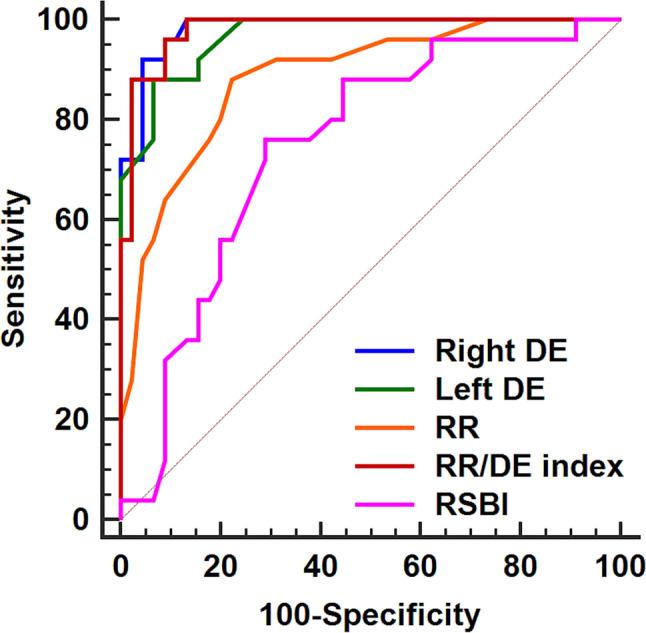
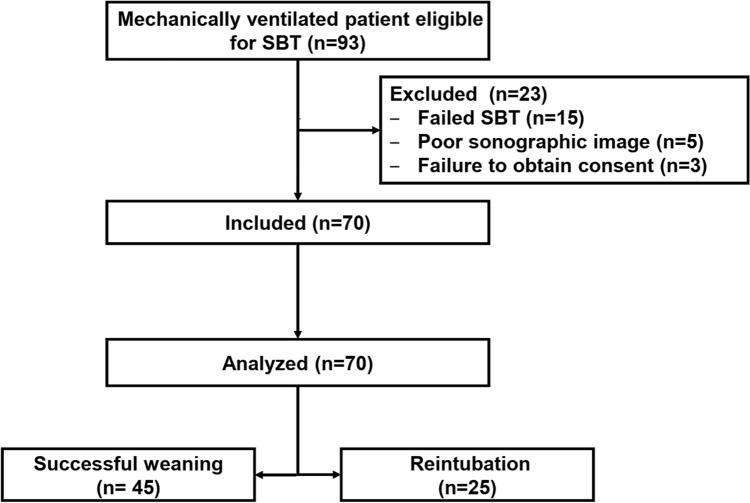
This prospective observational study included adult surgical critically ill patients intubated for > 24 h and extubated after a successful spontaneous breathing trial. Sonographic measurement of the DE was performed 2 h after extubation. Patients were followed up for 48 h after extubation and were divided into reintubation group and successful weaning group. The primary outcome was DE's ability to predict the need for resumption of ventilatory support using the area under receiver characteristic curve (AUC) analysis.
RESULTS
Data from 70 patients were analyzed and 25/70 (36%) patients needed reintubation. DE was lower in the reintubation group than the successful weaning group. The AUC (95% confidence interval) for the ability of DE to predict the need for resumption of ventilatory support was 0.98(0.92-1.00) and 0.97(0.89-1.00) for the right and left side, respectively. At cutoff values of 20.8 and 19.8 mm, the right and left DE had positive predictive values of 92% and 88% and negative predictive values of 96% and 93%, respectively.
CONCLUSION
Among surgical critically ill patients undergoing weaning from invasive mechanical ventilation, DE obtained 2h after extubation is an accurate predictor for the need for resumption of ventilatory support. Diaphragmatic excursion < 20-21 mm could predict the need for resumption of ventilatory support with a positive predictive value of 88-92% and negative predictive value of 93-96%.
背景
本研究评估了拔管后2小时测量的膈肌移动度(DE)预测外科重症患者48小时内恢复通气支持需求的能力。
方法
这项前瞻性观察性研究纳入了插管超过24小时且在成功进行自主呼吸试验后拔管的成年外科重症患者。拔管后2小时进行DE的超声测量。患者在拔管后随访48小时,并分为再插管组和成功脱机组。主要结局是使用受试者特征曲线下面积(AUC)分析DE预测恢复通气支持需求的能力。
结果
分析了70例患者的数据,25/70(36%)例患者需要再次插管。再插管组的DE低于成功脱机组。DE预测恢复通气支持需求能力的AUC(95%置信区间),右侧为0.98(0.92 - 1.00),左侧为0.97(0.89 - 1.00)。在截断值为20.8和19.8毫米时,右侧和左侧DE的阳性预测值分别为92%和88%,阴性预测值分别为96%和93%。
结论
在接受有创机械通气撤机的外科重症患者中,拔管后2小时测得的DE是恢复通气支持需求的准确预测指标。膈肌移动度<20 - 21毫米可预测恢复通气支持的需求,阳性预测值为88% - 92%,阴性预测值为93% - 96%。
 Zotero 插件