
追踪前列腺癌——PET-CT应用的发展历程
Tracing prostate cancer - the evolution of PET-CT applications.
作者信息
Cholewiński Witold, Camoni Luca, Mocydlarz-Adamcewicz Mirosława, Pietrzak Agata
机构信息
Nuclear Medicine Department, Greater Poland Cancer Centre, Poznan, Poland.
Electroradiology Department, Poznan University of Medical Sciences, Poznan, Poland.
出版信息
Rep Pract Oncol Radiother. 2024 Dec 4;29(5):627-637. doi: 10.5603/rpor.102615. eCollection 2024.
BACKGROUND
The study aimed to overview radiopharmaceuticals used for the nuclear medicine (NM) imaging of prostate cancer (Pca) since the first mentions in the literature up to recent reports, with the special focus on positron emission tomography-computed tomography (PET-CT) radiotracers.
MATERIALS AND METHODS
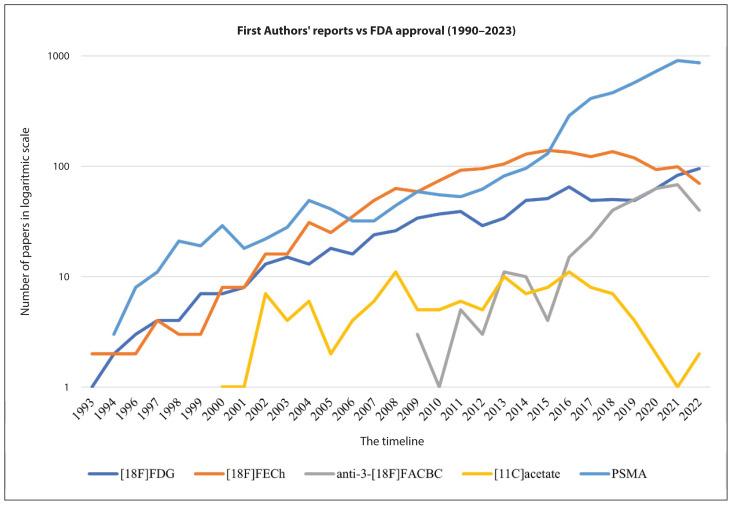
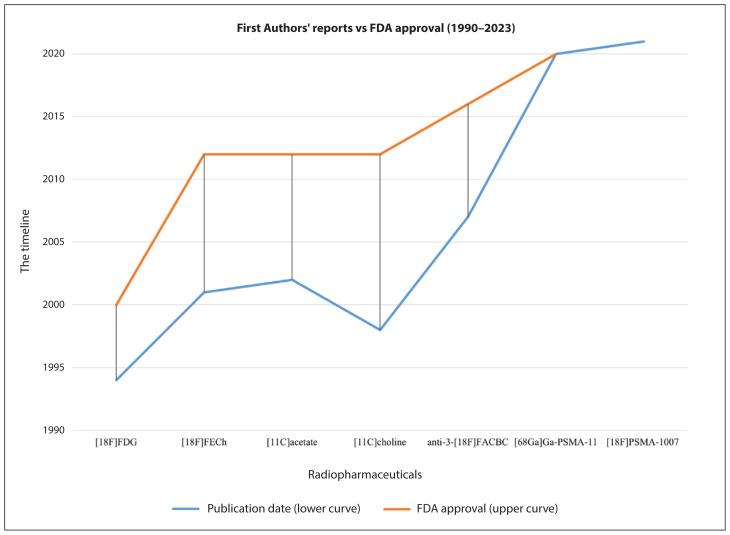
We found over 3500 articles discussing the role of PET-CT in Pca patients' management published within 1990-2023. We summarized the past and present interests of the Authors when the Pca diagnostic imaging and the use of radiotracers in Pca diagnosis are considered. Eventually, we have compared the radiotracers' introduction in the literature with the United States (U.S.) Food and Drug Administration (FDA) approval timeline.
RESULTS
The most mentions by the Authors were made of the following PET-CT study compounds: 2-[F]fluoroethyl-choline ([F]FECh), gallium--labelled prostate-specific membrane antigen using peptide-11, ([Ga]Ga-PSMA-11), carbon--labelled acetic acid ([C]acetate), and the anti-1-amino-3-[F]-fluorocyclobutane-1-carboxylic acid (-3-[F]FACBC, Axumin®), as well as the non-tumour-specific 2-deoxy-2-[F]fluoro-D-glucose ([F]FDG). The most recent studies analysis showed an increasing interest of the Authors not only in a relatively new Pca-specific [Ga]Ga-PSMA-11, but also in a widely used non-specific [F]FDG.
CONCLUSIONS
The literature analysis results lead to the conclusion that Pca remains a constant focus of the NM drug development with particularly high interest in PET-CT-dedicated radiotracers.
背景
本研究旨在综述自文献首次提及以来直至近期报道中用于前列腺癌(Pca)核医学(NM)成像的放射性药物,特别关注正电子发射断层扫描-计算机断层扫描(PET-CT)放射性示踪剂。
材料与方法
我们检索了1990年至2023年间发表的3500多篇讨论PET-CT在Pca患者管理中作用的文章。当考虑Pca诊断成像及放射性示踪剂在Pca诊断中的应用时,我们总结了作者过去和现在的关注点。最终,我们将文献中放射性示踪剂的引入情况与美国食品药品监督管理局(FDA)的批准时间表进行了比较。
结果
作者提及最多的PET-CT研究化合物如下:2-[F]氟乙基胆碱([F]FECh)、使用肽-11标记的镓-前列腺特异性膜抗原([Ga]Ga-PSMA-11)、碳-标记的乙酸([C]乙酸盐)、抗1-氨基-3-[F]-氟环丁烷-1-羧酸(-3-[F]FACBC,Axumin®),以及非肿瘤特异性的2-脱氧-2-[F]氟-D-葡萄糖([F]FDG)。最新的研究分析表明,作者不仅对相对较新的Pca特异性[Ga]Ga-PSMA-11越来越感兴趣,而且对广泛使用的非特异性[F]FDG也越来越感兴趣。
结论
文献分析结果得出结论,Pca仍然是核医学药物研发的持续重点,对PET-CT专用放射性示踪剂尤其感兴趣。

 Zotero 插件