
高血压父母的高血压前期子代在运动前饮用鸡精会引发运动后低血压:一项交叉随机对照试验
Preworkout Consumption of Chicken Essence Elicits Post-Exercise Hypotension in Prehypertensive Offspring of Hypertensive Parents: A Crossover Randomized Controlled Trial.
作者信息
Nakthong Sasitorn, Wutthikrairat Sauwanit, Tumnark Piyaporn, Phoemsapthawee Jatuporn
机构信息
Department of Food Safety Innovation, Faculty of Agriculture at Kamphaeng Saen, Kasetsart University, Kamphaeng Saen Campus, Nakhon Pathom 73140, Thailand.
Research and Development Program, Faculty of Agriculture at Kamphaeng Saen, Kasetsart University, Kamphaeng Saen Campus, Nakhon Pathom 73140, Thailand.
出版信息
Prev Nutr Food Sci. 2024 Dec 31;29(4):394-404. doi: 10.3746/pnf.2024.29.4.394.
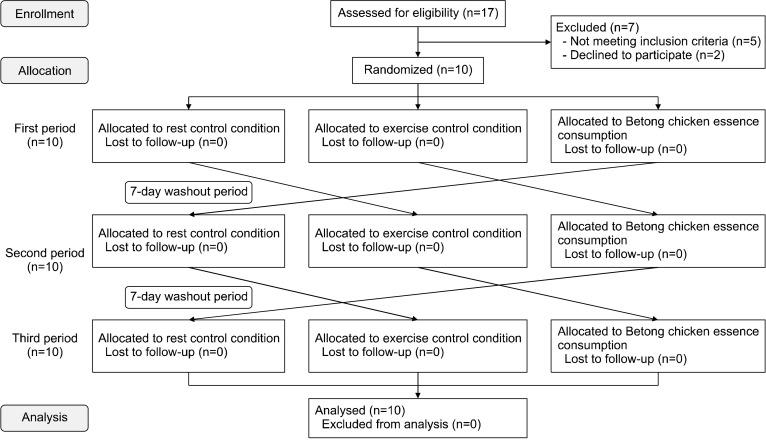
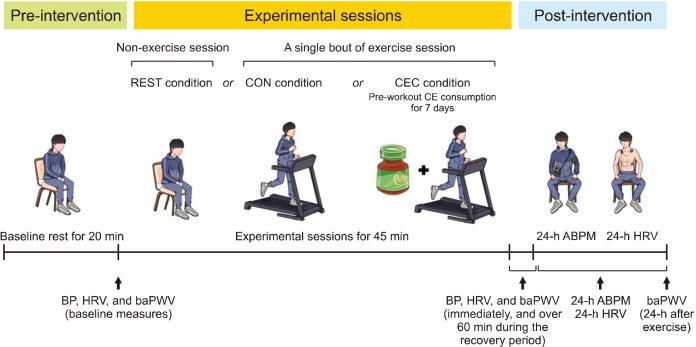
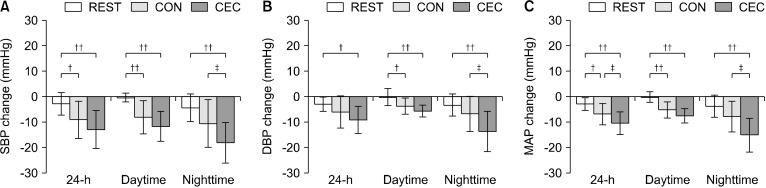
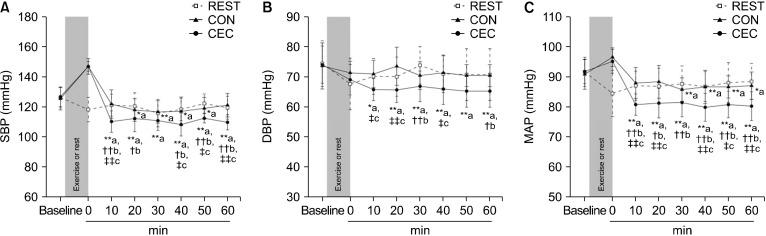
Chicken essence (CE) is known for its antihypertensive properties. However, few studies have investigated the effects of CE in prehypertensive individuals. Here, we conducted a randomized crossover clinical trial on prehypertensive offspring of hypertensive parents to evaluate the effects of preworkout CE consumption (CEC) on post-exercise hypotension (PEH) and cardiac autonomic and vascular responses. Ten prehypertensive males participated in three randomly ordered sessions: a resting control (REST) condition and two exercise conditions involving CEC and an exercise control (CON). The participants in the CEC condition consumed CE daily for seven days prior to the experimental sessions. Measurements were taken before and after each intervention. The results showed that the CEC condition resulted in significantly lower systolic blood pressure (SBP), diastolic blood pressure (DBP), and mean arterial pressure (MAP) at night compared with the CON and REST conditions (<0.05 and <0.01, respectively). This reduction in SBP and MAP in the CEC condition was observed as early as 10 min and persisted for up to 12 h after a single exercise session. Only the CEC condition showed significantly higher root mean square of successive differences at night (<0.05) and across a 24-h period (<0.05). Moreover, we observed a significantly lower brachial-ankle pulse wave velocity 30 min post-exercise (<0.05). These findings support the efficacy of CE in promoting PEH, particularly with greater reductions in SBP, DBP, and MAP at night, while also enhancing post-exercise vagal activity and reducing vascular stiffness. Thus, CEC may be an effective strategy for preventing hypertension.
鸡精(CE)以其降压特性而闻名。然而,很少有研究调查鸡精对高血压前期个体的影响。在此,我们对高血压患者的高血压前期后代进行了一项随机交叉临床试验,以评估运动前食用鸡精(CEC)对运动后低血压(PEH)以及心脏自主神经和血管反应的影响。十名高血压前期男性参与了三个随机排序的阶段:静息对照(REST)阶段以及两个运动阶段,分别涉及CEC和运动对照(CON)。CEC组的参与者在实验阶段前连续七天每天食用鸡精。在每次干预前后进行测量。结果显示,与CON组和REST组相比,CEC组夜间的收缩压(SBP)、舒张压(DBP)和平均动脉压(MAP)显著降低(分别<0.05和<0.01)。在单次运动后,CEC组的SBP和MAP降低最早在10分钟时出现,并持续长达12小时。只有CEC组在夜间(<0.05)和24小时期间(<0.05)的连续差值均方根显著更高。此外,我们观察到运动后30分钟时臂踝脉搏波速度显著降低(<0.05)。这些发现支持了鸡精在促进运动后低血压方面的功效,特别是在夜间SBP、DBP和MAP有更大程度的降低,同时还增强了运动后的迷走神经活动并降低了血管僵硬度。因此,CEC可能是预防高血压的一种有效策略。

 Zotero 插件