
早期感染负担与儿童期感染风险及全身性抗生素使用情况
Burden of Infections in Early Life and Risk of Infections and Systemic Antibiotics Use in Childhood.
作者信息
Brustad Nicklas, Buchvald Frederik, Jensen Signe Kjeldgaard, Kyvsgaard Julie Nyholm, Vahman Nilo, Thorsen Jonathan, Schoos Ann-Marie Malby, Nygaard Ulrikka, Vissing Nadja, Stokholm Jakob, Bønnelykke Klaus, Chawes Bo
机构信息
Copenhagen Prospective Studies on Asthma in Childhood, Herlev and Gentofte Hospital, University of Copenhagen, Copenhagen, Denmark.
Department of Pediatrics, Rigshospitalet, Copenhagen, Denmark.
出版信息
JAMA Netw Open. 2025 Jan 2;8(1):e2453284. doi: 10.1001/jamanetworkopen.2024.53284.
IMPORTANCE
A high infection burden in early childhood is common and a risk factor for later disease development. However, longitudinal birth cohort studies investigating early-life infection burden and later risk of infection and antibiotic episodes are lacking.
OBJECTIVE
To investigate whether early-life infection burden is associated with a later risk of infection and systemic antibiotic treatment episodes in childhood.
DESIGN, SETTING, AND PARTICIPANTS: This longitudinal cohort study of children from birth to age 10 or 13 years included data from the Danish population-based Copenhagen Prospective Studies on Asthma in Childhood (COPSAC) birth cohort between November 2008 to November 2010. Children were monitored for infection diagnoses and systemic antibiotic prescriptions from national databases until February 1, 2024, by which time they had completed the age 10- or 13-year visit. Children with immune deficiencies or congenital diseases were excluded.
EXPOSURES
Daily diary-registered common infection episodes of cold, acute otitis media, tonsillitis, pneumonia, gastroenteritis, and fever episodes from birth to 3 years.
MAIN OUTCOME AND MEASURES
After age 3 years, the incidence of moderate to severe infection diagnoses and systemic antibiotic prescriptions were estimated using adjusted incidence rate ratios (AIRRs) calculated from quasi-Poisson regression models. All analyses were adjusted for social and environmental confounders.
RESULTS
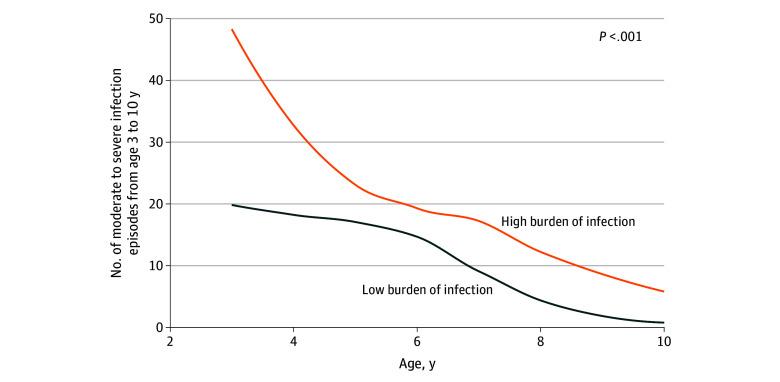
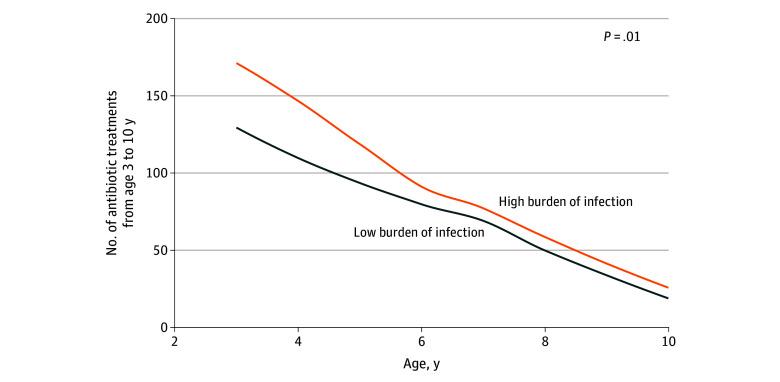
A total of 614 children (317 male [51.6%]) with diary data from birth to 3 years had completed follow-up until age 10 or 13 years. No differences in baseline characteristics between the children having vs not having available diary data were noted. Children with a high vs low burden of diary-registered infections between birth and 3 years (ie, equal to and above vs below the median of 16) had an increased risk of later moderate to severe infections (181 vs 87 episodes; AIRR, 2.39; 95% CI, 1.52-3.89) and systemic antibiotic treatments (799 vs 623 episodes; AIRR, 1.34; 95% CI, 1.07-1.68) until age 10 or 13 years. Each diary infection episode also increased the later risk of moderate to severe infections (AIRR, 1.05; 95% CI, 1.02-1.08) and systemic antibiotic treatments (AIRR, 1.02; 95% CI, 1.01-1.04). Subtype analyses showed significant associations between each cold, acute otitis media, pneumonia, gastroenteritis, and fever episode between birth and 3 years and risk of later moderate to severe infections or systemic antibiotic treatments.
CONCLUSIONS AND RELEVANCE
This longitudinal cohort study suggests that early-life infection burden may continue throughout childhood and is associated with later antibiotic treatments independent of social and environmental risk factors. These findings are important for prognosis and follow-up of children experiencing a high burden of common infections in early life.
重要性
幼儿期感染负担高很常见,且是后期疾病发展的危险因素。然而,缺乏调查生命早期感染负担以及后期感染风险和抗生素使用情况的纵向出生队列研究。
目的
探讨生命早期感染负担是否与儿童期后期感染风险和全身性抗生素治疗情况相关。
设计、地点和参与者:这项对从出生到10或13岁儿童的纵向队列研究纳入了2008年11月至2010年11月丹麦基于人群的儿童哮喘哥本哈根前瞻性研究(COPSAC)出生队列的数据。通过国家数据库对儿童的感染诊断和全身性抗生素处方进行监测,直至2024年2月1日,此时他们已完成10岁或13岁的访视。排除有免疫缺陷或先天性疾病的儿童。
暴露因素
从出生到3岁,通过每日日记记录的感冒、急性中耳炎、扁桃体炎、肺炎、肠胃炎等常见感染发作以及发热发作情况。
主要结局和测量指标
3岁以后,使用从准泊松回归模型计算的调整发病率比(AIRR)来估计中度至重度感染诊断和全身性抗生素处方的发生率。所有分析均对社会和环境混杂因素进行了调整。
结果
共有614名儿童(317名男性[51.6%])从出生到3岁有日记数据,并完成了至10岁或13岁的随访。有和没有可用日记数据的儿童在基线特征上没有差异。出生至3岁期间日记记录感染负担高(即等于及高于中位数16次)与低的儿童,在10岁或13岁之前发生后期中度至重度感染(分别为181次和87次发作;AIRR,2.39;95%CI,1.52 - 3.89)和全身性抗生素治疗(分别为799次和623次发作;AIRR,1.34;95%CI,1.07 - 1.68)的风险增加。每次日记记录的感染发作也增加了后期中度至重度感染(AIRR,1.05;95%CI,1.02 - 1.08)和全身性抗生素治疗(AIRR,1.02;95%CI,1.01 - 1.04)的风险。亚组分析显示,出生至3岁期间每次感冒、急性中耳炎、肺炎、肠胃炎和发热发作与后期中度至重度感染或全身性抗生素治疗风险之间存在显著关联。
结论及意义
这项纵向队列研究表明,生命早期感染负担可能持续整个儿童期,且与后期抗生素治疗相关,独立于社会和环境风险因素。这些发现对于生命早期经历高负担常见感染儿童的预后和随访具有重要意义。

 Zotero 插件