
德克萨斯州20年间与交通相关的空气污染暴露变化及其与不良出生结局的关联。
Changes in traffic-related air pollution exposures and associations with adverse birth outcomes over 20 years in Texas.
作者信息
Hystad Perry, Hill Elaine L, Larkin Andrew, Schrank David, Harleman Max, Volkin Evan, Campbell Erin J, Molitor John, Harris Lena, Ritz Beate R, Willis Mary D
机构信息
School of Nutrition and Public Health, College of Health, Oregon State University, Corvallis, OR, USA.
Department of Economics, School of Arts and Sciences, University of Rochester, Rochester, NY, USA.
出版信息
Int J Epidemiol. 2024 Dec 16;54(1). doi: 10.1093/ije/dyae178.
BACKGROUND
Billions of dollars have been spent implementing regulations to reduce traffic-related air pollution (TRAP) from exhaust pipe emissions. However, few health studies have evaluated the change in TRAP emissions and associations with infant health outcomes. We hypothesize that the magnitude of association between vehicle exposure measures and adverse birth outcomes has decreased over time, parallelling regulatory improvements in exhaust pipe emissions.
METHODS
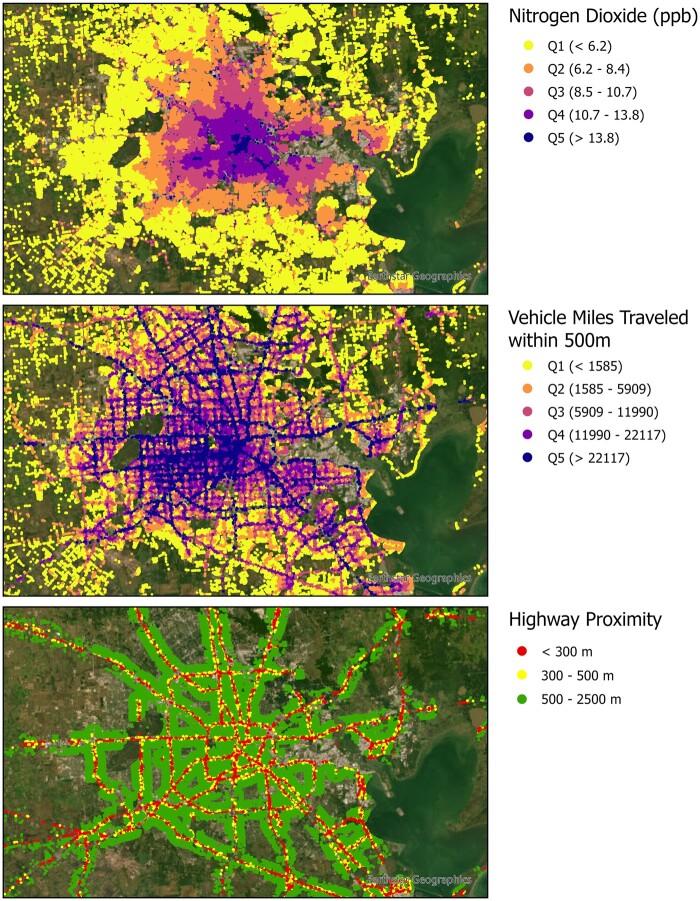
Using birth records in Texas from 1996 to 2016, we calculated residential exposure measures related to TRAP: nitrogen dioxide (NO2, a marker of the TRAP mixture), vehicle miles travelled within 500 m of homes (VMT500), a measure of traffic volume, and highway proximity. Using an accountability study framework, our analysis examined term birthweight, term low birthweight (TLBW) (<2500 g), preterm birth (PTB) (<37 weeks) and very preterm birth (VPTB) (<32 weeks). We implemented linear and logistic regression models to examine overall and time-stratified associations, including trends by race/ethnicity and socioeconomic groups.
RESULTS
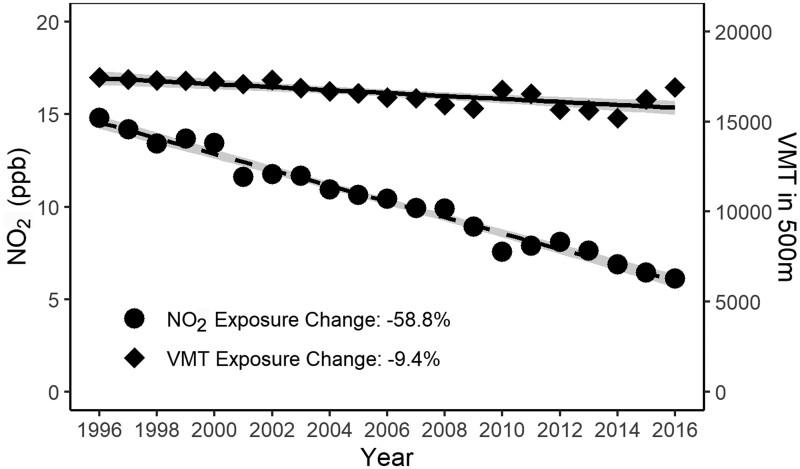
Among exposures for 6 158 518 births, NO2 exposures decreased 59% over time but VMT500 remained relatively stable. TRAP-related exposure measures were persistently associated with harmful birth outcomes [e.g. OR1996-2016 of 1.07 (95% CI: 1.04, 1.08) for TLBW comparing the highest vs lowest NO2 quintile]. The magnitude of associations decreased for total VMT500 and TLBW (-60%, OR1996: 1.08 to OR2016: 1.03 for the highest vs lowest quintile) and PTB (-65%) and VTPT (-61%), but not for term birthweight.
CONCLUSIONS
We observed evidence of small improvements in birth outcomes associated with reductions in exhaust pipe emissions over a 20-year period in Texas.
背景
数十亿美元已被用于实施相关法规,以减少排气管排放造成的与交通相关的空气污染(TRAP)。然而,很少有健康研究评估TRAP排放的变化以及与婴儿健康结果的关联。我们假设,随着时间的推移,车辆暴露指标与不良出生结局之间的关联程度有所下降,这与排气管排放法规的改善情况相平行。
方法
利用1996年至2016年得克萨斯州的出生记录,我们计算了与TRAP相关的居住暴露指标:二氧化氮(NO2,TRAP混合物的一个标志物)、住宅500米范围内的车辆行驶里程(VMT500,一种交通流量指标)以及与高速公路的距离。使用责任研究框架,我们的分析考察了足月出生体重、足月低出生体重(TLBW,<2500克)、早产(PTB,<37周)和极早产(VPTB,<32周)。我们实施了线性和逻辑回归模型,以检验总体和按时间分层的关联,包括按种族/族裔和社会经济群体划分的趋势。
结果
在6158518例出生的暴露情况中,NO2暴露随时间下降了59%,但VMT500保持相对稳定。与TRAP相关的暴露指标一直与有害出生结局相关[例如,比较最高与最低NO2五分位数时,1996 - 2016年TLBW的OR为1.07(95%CI:1.04,1.08)]。总VMT500与TLBW之间的关联程度下降(-60%,最高与最低五分位数相比,1996年的OR为1.08至2016年的OR为1.03),PTB(-65%)和VPTB(-61%)也是如此,但足月出生体重的关联程度未下降。
结论
我们观察到在得克萨斯州的20年期间,与排气管排放减少相关的出生结局有小幅改善的证据。

 Zotero 插件