
产后24个月时护士家访对亲密伴侣暴力以及产妇收入、心理健康和自我效能的影响:一项随机对照试验(不列颠哥伦比亚省健康连接项目)
Effects of nurse-home visiting on intimate partner violence and maternal income, mental health and self-efficacy by 24 months postpartum: a randomised controlled trial (British Columbia Healthy Connections Project).
作者信息
Catherine Nicole L A, MacMillan Harriet, Jack Susan, Zheng Yufei, Xie Hui, Boyle Michael, Sheehan Debbie, Gonzalez Andrea, Gafni Amiram, Tonmyr Lil, Barr Ronald, Marcellus Lenora, Varcoe Colleen, Waddell Charlotte
机构信息
Faculty of Health Sciences, Simon Fraser University, Vancouver, British Columbia, Canada
Psychiatry and Behavioural Neurosciences, Faculty of Health Sciences, McMaster University, Hamilton, Ontario, Canada.
出版信息
BMJ Open. 2025 Jan 6;15(1):e083147. doi: 10.1136/bmjopen-2023-083147.
OBJECTIVE
To evaluate the impact of Nurse-Family Partnership (NFP), a home-visiting programme, on exploratory maternal outcomes in British Columbia (BC), Canada.
DESIGN
Pragmatic, parallel arm, randomised controlled trial conducted October 2013-November 2019. Random allocation of participants (1:1) to comparison (existing services) or NFP (plus existing services). Researchers were naïve to allocation.
SETTING
26 local health areas across four of five BC regional health authorities.
PARTICIPANTS
739 young (<25 years), first-time mothers (enrolled <28 weeks gestation), experiencing socioeconomic disadvantage.
INTERVENTION
Public health nurses with NFP education offered home visits (up to 64) during pregnancy and until children's second birthday plus existing services on offer in BC.
OUTCOME MEASURES
Prespecified exploratory outcomes included exposure to intimate partner violence (IPV), income (annual from employment) and not in education, employment or training (NEET) by 24 months postpartum, and psychological distress and self-efficacy across five time points (34-36 weeks gestation, 2, 10, 18 and 24 months postpartum).
RESULTS
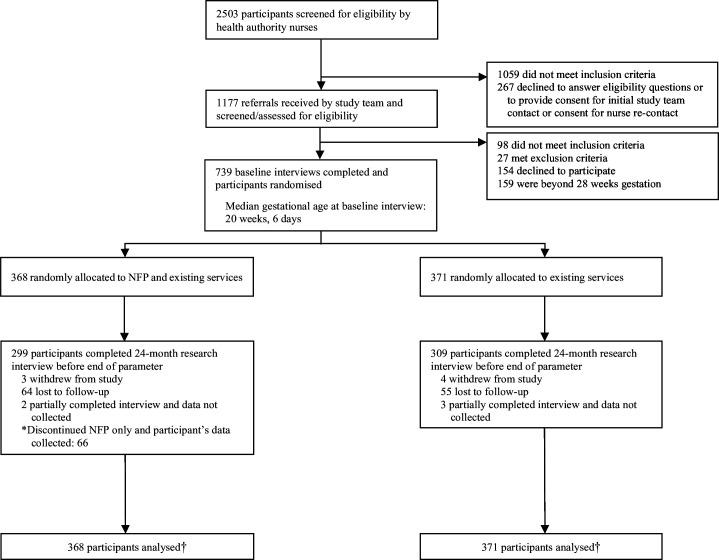
A total of 739 participants were randomised (368 NFP, 371 comparison) and analysed via an intention-to-treat analysis. At 24 months postpartum, for participants receiving NFP, a lower percentage reported IPV (group difference -7.14; 95% CI: -14.17, -0.10); incomes were larger ($1629.74, 95% CI: $5.20, $3254.28) after adjusting for baseline differences and no difference in percentage of NEET (-2.41, 95% CI: -10.11, 5.30). For participants receiving NFP, psychological distress was lower across time points (-1.59, 95% CI: -2.35 to -0.84); self-efficacy was greater at 34-36 weeks gestation (0.78, 95% CI: 0.34, 1.22), then decreasing and becoming insignificant by 24 months postpartum (0.29, 95% CI: -0.18, 0.75). No unanticipated serious adverse events were reported.
CONCLUSION
Relying on the maternal report, at 24 months postpartum, the NFP group had reduced IPV exposure and increased incomes. Benefits observed in late pregnancy were sustained to study end for psychological distress, but not self-efficacy. Longer-term follow-up is recommended.
TRIAL REGISTRATION
NCT01672060.
目的
评估家访项目“护士-家庭伙伴关系”(NFP)对加拿大不列颠哥伦比亚省(BC)产妇探索性结局的影响。
设计
2013年10月至2019年11月进行的实用、平行组、随机对照试验。将参与者按1:1随机分配至对照组(现有服务)或NFP组(现有服务加NFP)。研究人员对分配情况不知情。
地点
BC省五个区域卫生当局中四个的26个当地卫生区。
参与者
739名年轻(<25岁)初产妇(妊娠<28周登记入组),存在社会经济劣势。
干预措施
接受过NFP培训的公共卫生护士在孕期及儿童两岁生日前进行家访(最多64次),并提供BC省现有的服务。
结局指标
预先设定的探索性结局包括产后24个月时遭受亲密伴侣暴力(IPV)的情况、收入(就业年收入)以及未接受教育、未就业或未参加培训(NEET)的情况,以及五个时间点(妊娠34 - 36周、产后2、10、18和24个月)的心理困扰和自我效能感。
结果
共739名参与者被随机分组(368名NFP组,371名对照组),并通过意向性分析进行分析。产后24个月时,接受NFP的参与者报告遭受IPV的比例较低(组间差异 -7.14;95%CI:-14.17,-0.10);调整基线差异后,收入更高(1629.74美元,95%CI:5.20美元,3254.28美元),NEET比例无差异(-2.41,95%CI:-10.11,5.30)。接受NFP的参与者在各时间点的心理困扰较低(-1.59,95%CI:-2.35至-0.84);妊娠34 - 36周时自我效能感更高(0.78,95%CI:0.34,1.22),随后下降,到产后24个月时变得不显著(0.29,95%CI:-0.18,0.75)。未报告意外的严重不良事件。
结论
根据产妇报告,产后24个月时,NFP组遭受IPV的情况减少,收入增加。妊娠晚期观察到的益处持续到研究结束时心理困扰方面,但自我效能感方面未持续。建议进行长期随访。
试验注册
NCT01672060
 Zotero 插件