
慢性疼痛背景下心理灵活性的综合与高效评估
Comprehensive and Efficient Assessment of Psychological Flexibility in the Context of Chronic Pain.
作者信息
Lavefjord Amani, Sundström Felicia T A, Chia Dane, Tabrizi Fara, Buhrman Monica, McCracken Lance M
机构信息
Department of Psychology, Uppsala University, Uppsala, Sweden.
Department of Psychology, Mid Sweden University, Östersund, Sweden.
出版信息
Eur J Pain. 2025 Feb;29(2):e4781. doi: 10.1002/ejp.4781.
BACKGROUND
The Multidimensional Psychological Flexibility Inventory (MPFI) is a measure of all facets of psychological flexibility and inflexibility, potentially important processes of change in psychological treatment for chronic pain. In some contexts, it can be considered too long. The aim of this study was, therefore, to validate a short form MPFI (MPFI-24P) in a chronic pain sample.
METHODS
Adults with chronic pain were recruited online (N = 404) for a cross-sectional survey study. They first completed pain background questions and the MPFI. For examining convergent construct validity and explained variance in pain-related outcomes, participants also completed the Brief Pain Inventory (BPI) Pain Interference Scale, the Work and Social Adjustment Scale (WSAS) and the Patient Health Questionnaire (PHQ-9), a depression measure. Data were collected on two occasions, 2 weeks apart. Item response theory (IRT) and confirmatory factor analysis (CFA) were used for selecting the best-performing items.
RESULTS
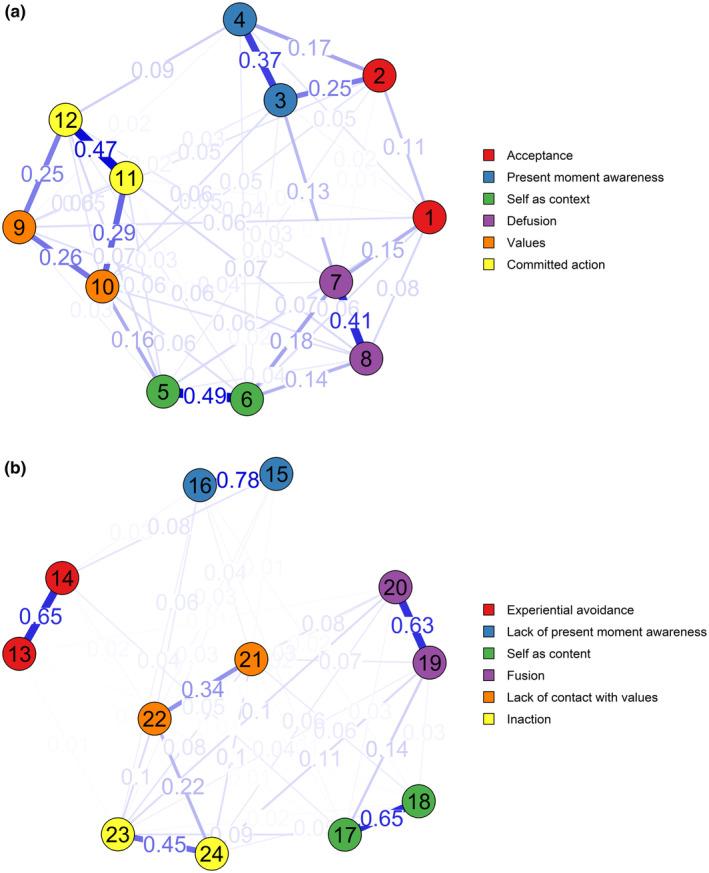
IRT parameters were overall adequate, and hierarchical CFA demonstrated a good model fit. Network analysis of the MPFI items indicated that, in general, items intended to measure the same facets were substantially interconnected, more so for the inflexibility items. Temporal stability was adequate, and internal consistency was good. The MPFI-24P correlated with pain interference, work and social adjustment and depression, with the inflexibility scale better predicting these outcomes. The MPFI-24P correlated strongly with the full-length MPFI.
CONCLUSIONS
The MPFI-24P for chronic pain is generally valid and reliable, especially the inflexibility scale. It performs similarly to the full-length MPFI.
SIGNIFICANCE
This paper contributes with a measure that is both feasible to use in clinical practice and research, while being able to measure all facets of psychological flexibility and inflexibility-psychological processes of change that are important to evaluate in psychological treatment of chronic pain in order to better individualize treatment.
背景
多维心理灵活性量表(MPFI)用于测量心理灵活性和僵化的各个方面,这可能是慢性疼痛心理治疗中重要的潜在变化过程。在某些情况下,它可能被认为过长。因此,本研究的目的是在慢性疼痛样本中验证MPFI的简版(MPFI - 24P)。
方法
通过在线招募患有慢性疼痛的成年人(N = 404)进行横断面调查研究。他们首先完成疼痛背景问题和MPFI。为了检验收敛效度和疼痛相关结果的解释方差,参与者还完成了简明疼痛量表(BPI)疼痛干扰量表、工作与社会适应量表(WSAS)以及患者健康问卷(PHQ - 9,一种抑郁测量工具)。在相隔2周的两个时间点收集数据。项目反应理论(IRT)和验证性因素分析(CFA)用于选择表现最佳的项目。
结果
IRT参数总体上是合适的,分层CFA显示模型拟合良好。MPFI项目的网络分析表明,一般来说,旨在测量相同方面的项目之间存在实质性的相互联系,对于僵化项目更是如此。时间稳定性足够,内部一致性良好。MPFI - 24P与疼痛干扰、工作和社会适应以及抑郁相关,僵化量表能更好地预测这些结果。MPFI - 24P与全长MPFI高度相关。
结论
用于慢性疼痛的MPFI - 24P总体上是有效且可靠的,尤其是僵化量表。它的表现与全长MPFI相似。
意义
本文提供了一种在临床实践和研究中都可行的测量工具,它能够测量心理灵活性和僵化的各个方面——这些心理变化过程对于评估慢性疼痛心理治疗以更好地实现个体化治疗非常重要。
 Zotero 插件